admin
admin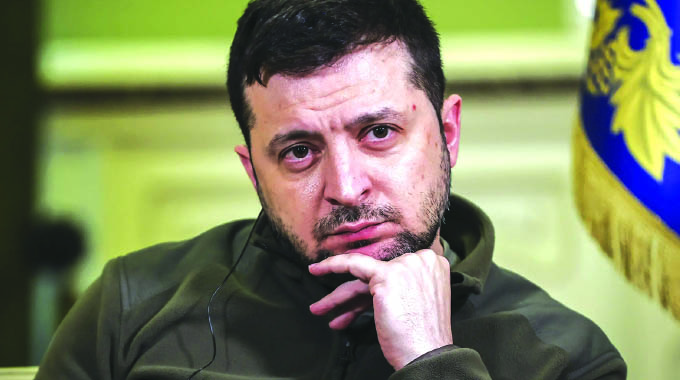
Naboth Ibrahim
After a meeting between Trump and Ukraine’s Vladimir Zelensky in the White House turned into a fiasco, US and Ukrainian delegations met in Riyadh on March 11.
Suffice it to say, at the White House meeting, Zelensky maintained his hardline posture on fighting the Russians, refusing any recourse to diplomacy to end the conflict, instead insisting on obtaining security guarantees from the US.
In Riyadh — after the US temporarily blocked arms supplies and intelligence sharing — Zelensky discarded his obstinate position and agreed to an immediate ceasefire for 30 days.
The course of peace in Ukraine is beset by many problems. The issue extends beyond Ukraine’s security — it is equally, if not more, about Russia’s security, which ultimately drove its decision to take military action.
But Zekenskyy is the big problem. He does not understand that he is not acting a film. This is real life issue.
The politics of bed-hoping between US and European Union countries makes him a very dangerous dimwit. Today he is with US, the next day he is with EU, the third day he is with both of them.
What makes him a real dimwit is that as he hops from one bed to another, Russia remains focused and pummelling Ukraine, the people there are suffering.
Unlike Putin who has depth of character, Zelensky has shown is a willing pawn, a not-so-much intelligent leader and a man with no ideological clarity.
Zelensky provoked Russia for this war and it was really unnecessary and uncalled for; a little intelligence, the kind of intelligence possessed by an average person, would have informed him that a NATO expansion into his country is simply slapping the lion into the face, with bare hands.
At the heart of this provocation has been NATO’s eastward expansion, the regime change in Ukraine provoked by the US, the capture of power in Ukraine by what Russia sees as forces wedded to a Nazi-like ideology and hostile to anything Russian, and the reneging on the Minsky Agreement.
The declared goals of Russia’s military operation are the denazification and demilitarisation of Ukraine.
Zelensky over the years has been made to believe by NATO members as an embodiment of Russian resistance and continues to be lionised there, at the expense of his own people.
When he was rebuffed by Trump and Vice President J.D. Vance, the European leaders collectively embraced and honoured him immediately after his US visit, with UK Prime Minister Keir Starmer arranging for him to be received by King Charles, which could be interpreted as a snub to Trump.
Trump has called Zelensky a dictator and advocated for elections in Ukraine, the Europeans do not question his democratic credentials and see him as fully legitimate because he is their pawn.
It is fact not fiction that peace in Europe, and durably in Ukraine, cannot be achieved if Europe is preparing for a long term confrontation with Russia.
In early March, the EU decided on a massive €800 billion re-armament programme, a five-part plan to bolster Europe’s defence industry and increase its military capability and help provide urgent military support for Ukraine
The member states would be given more fiscal space for defence investments, as well as €150 billion in loans for those investments.
On March 11, in a meeting in Paris of 34 countries, French President Emmanuel Macron called on European and NATO military chiefs to draw up a plan “to define credible security guarantees” for Ukraine in the event of a ceasefire and throw their full weight behind Ukraine. Macron has joined with Starmer to lead efforts to form a “coalition of the willing” to enforce an eventual ceasefire in Ukraine and give security guarantees to Ukraine that, according to the Elysée, should be “credible and long-term, and should be accompanied by unfailing support for the Ukrainian army.”
But if truth be told, the differences between the US and Europe on NATO actually means less pressure on Russia on the NATO front.
Whatever its defence plans, it will take many years for Europe to build its defence capabilities.
Europe does not have a standing European army with a single command structure and collectively defined war plans or strategy outside of NATO.
On the other hand, with the US unable to discipline Europe, the security headaches for Russia will take a new turn.
It is known clearly that the EU leadership is profoundly hostile to Russia, whether it is the president of the European Commission, Ursula von der Leyen, the high representative of the EU for foreign affairs and security policy, Kaja Kallas, the EU commissioner for defence and space, Andrius Kubilius, etc.
This will make peace understandings with Russia that much more difficult in the European framework.
Trump himself is a problem as he is wont to air his views publicly on sensitive matters rather than leaving his emissaries to conduct talks discreetly away from media glare, often contradicting himself, and being accommodating and threatening at intervals.
Trump is constantly doing this on the Ukraine issue. He is a player, commentator, and umpire at the same time.
Russia’s challenge is to keep him engaged, as he seems to genuinely want to end the conflict, and not alienate him, but at the same time protect Russia’s fundamental interests, even if means dissonance with Trump’s expansive positions.
President Putin has tailored his approach as well as possible by remaining open to a ceasefire while seeking clarifications and answers to obvious questions that arise, which he has spelled out to the press.
The uniform statement coming from the Western leaders is that the ball is in Putin’s court. Putin has to put the ball right back in the US and Ukraine’s court. Hostile forces in the West will promote a narrative against him, with Zelensky already claiming that Putin does not want peace.
Let’s see how this plays out. Bridging the differences in interests and perspectives between the various sides will not be easy.
Zelenskyy must change his attitude, stop bed-hoping and let his country remain neutral. Now he has accumulated a lot of debts over weaponry, and his country needs to pay. The more the more proceeds the more debts he accumulates. — Touching the Base


 Online Reporter