Chronicle Editor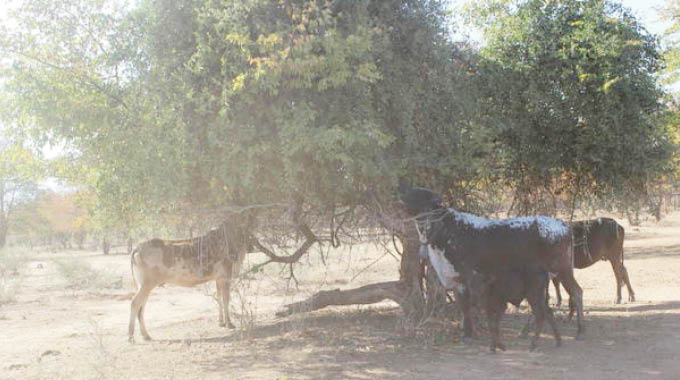
Vusumuzi Dube, Senior Reporter
THE past two years have been dreadful for livestock farmers in the Matabeleland region, especially for areas falling under natural farming region four, this being the region where nature dictates that cattle production sprouts with natural ease.
Changes in climate have however, seen a ravaging drought depleting pastures as water sources dried up thereby wiping out nearly 5 000 cattle in the Matabeleland South Province only. Statistics provided by the Department of Livestock and Veterinary Services in Matabeleland South showed that 4 539 cattle had died by October last year with the most affected district being Beitbridge where 1 057 cattle had succumbed to drought.
The second most affected was Insiza where 918 cattle had died while 600 had been lost in Gwanda. In Matobo, 524 had died and 498 succumbed in Mangwe while the least affected is Umzingwane where 330 cattle were lost.
With the cost of livestock feed ever cumulating, for most farmers it became largely a frantic task to feed their livestock with most giving up and relying on divine intervention, just for their livestock to survive.
However, for Mbizingwe villagers in Umzingwane district, the effects of climate change did not allow them to sit back and whimper in pain at the loss of their livestock, it challenged them to think outside the box. They did not just sit on their laurels and wait for their livestock to perish, instead they used available resources to mitigate the effects of a global catastrophe and ensure that their livestock survived.
With the support of the Zimbabwe Resilience Building Fund and a local facilitating partner — the Matabeleland Enhanced Livelihoods, Agriculture and Nutrition Adaptation (Melana), Mbizingwe villagers came up with one facility which when told by any individual would seem impossible but after one sees it, they then can believe that such is possible.
A group of villagers came together, formed a co-operative and introduced the Vusanani bush mill livestock feed. This is feed largely made up of what one can dismiss as thorns and twigs but when mixed in the right quantities can be served as livestock supplementary feeding.
The livestock feed’s ingredients include monkey bread (ihabahaba), acacia pod (igagu), acacia branches, chicken droppings, coarse salt and a bit of maize meal. Ground using a bush grinding mill, the various ingredients are then mixed together in specific quantities then packed in 50kg bags, like any other livestock one could get from shops. They then sell the feed at $100 for a 50kg bag to other villagers.
The venture initially started to service the nine members of the co-operative has since grown such that not only have they managed to service their entire village but they have grown to sell not only in their ward but in two other wards in the district. Vusanani group chairlady, Mrs Thembi Mlilo revealed that after attempts at a number of self-sustaining projects as a group they settled for the bush mill which they purchased with the aid of Melana where they started making stock feed.
“We started off as a money lending club, then we bought she goats with our profits. It is then that we hit a hurdle, the drought that was experienced in our region saw some of the goats being affected. However, through ZRBF-Melana we got the idea of the bush mill which we intended to use to grind stock feed initially meant to feed our goats. We were provided with an expert who taught us how to come up with this type of stock feed, then Melana provided us with 70 percent of the funds towards the purchase of the grinding mill. We only contributed the remaining 30 percent,” said Mrs Mlilo.
The chairlady said they were trained on how to harness their natural resources to make the stock feed as a means of finding local solutions to local problems. She said what was important was that as villagers they were not just spoon-fed but they were instead taught to be resilient and be able to sustain themselves outside donor funding.
The treasurer of the group, Mrs Sinqobizitha Ncube, revealed that when they acquired the grinding mill in October last year their target was to service 350 farmers in a year, with their stock feed but they had surpassed that target within four months.
“Within four months we had already serviced 351 farmers with about 13,5 tonnes of our stock feed, we also managed to service our community as the grinding mill can also grind maize into mealie-meal, to add to our coffers. We also bought a scotch-cart as a means of value locking.
“What showed us that this project had huge potential was that we just aimed to service our ward which is Ward 4 but within those four months we had also managed to increase our reach to Ward 3 and 5. As we go forward our aim is to eventually service the entire district during this year,” said the treasurer.
Melana project markets linkage advisor Mr Rodney Mushongachiware said Mbizingwe project was part of a number of initiatives they were spearheading in four districts in Matabeleland. The districts covered are Bubi, Umguza, Nkayi and Umzingwane — where they aimed to create resilience in the face of climate change induced problems. He said theirs was about villagers being able to continue operating their identified projects long after the donors have moved out of their areas.
“What we do is identify local solutions to solve local problems, we do not just identify projects but it is the communities that identify these projects. We then give the villagers adequate training in these various projects and try to create a sense of ownership from within the villagers which is the reason why we insist that the villagers must also contribute towards the purchase of the equipment. If you see our model, the thrust is to train villagers on the necessary business skills to run the projects, we do not envisage a situation that the minute our funding lapses the project then die a natural death,” he said.
On the stock feed, Mr Mushongachiware revealed that although no official study had been done pertaining to the exact nutritional contents of the feed, the various ingredients confirmed the presence of the essential nutrients required for livestock supplementary feeding.
“Yes, the stock feed has all the necessary nutrients like your calcium and various vitamins. This feed can also be used for pen fattening, which is what we have also trained some of our farmers to partake in so as to boost their livestock. There is also the controversy of deforestation, which some environmentalists claim occurs when the farmers harvest the ingredients but this is not the case as we encourage our farmers to be pruning the trees so as to encourage regrowth,” he said.
Umguza District Development Coordinator, Mr Peter Mahlathini paid tribute to ZRBF-Melana saying the establishment of such projects had gone a long way in ensuring self-sustainability within their communities.
“We are fortunate to have such organisations that come in to train our villagers not to just rely on donor funding but to be able to sustain themselves with or without the donor funds. I will tell you that such projects are going a long way in uplifting our districts both in terms of development and self-sustainability. It is not enough to just identify problems, what is needed are solutions to those projects,” Mr Mahlathini.



 Online Reporter