Gibson Mhaka, Zimpapers Politics Hub
UNITY Day, celebrated annually on December 22 since 1987, marks a significant convergence point in Zimbabwe’s political history.
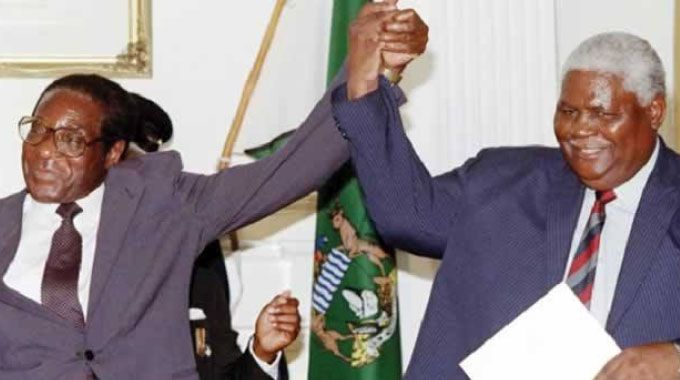
It commemorates the signing of the Unity Accord between the Zimbabwe African National union (Zanu) and the Zimbabwe African People’s union (Zapu), an act that unified the nation by ending the post-independence conflict known as Gukurahundi.
This historic day, led by the late former President Cde Robert Mugabe and the late Vice-President Dr Joshua Mqabuko Nkomo, remains an essential annual reminder that national stability is intrinsically linked to reconciliation and inclusion. Far from being a mere symbolic gesture, the Unity Accord laid the groundwork for a unified, forward-looking Zimbabwe.
That vision continues to resonate today through the Second Republic’s guiding philosophy of “leaving no one and no place behind.”
The period leading up to the signing of the Unity Accord was marked by political turbulence and divisions that posed a grave threat to Zimbabwe’s stability.
Recognising the critical need for reconciliation and harmony, visionary leaders, Cde Mugabe and Dr Nkomo, united their political parties — Zanu and Zapu into a single, cohesive force, Zanu-PF
Unity Day acquires profound importance as it coincides with the Second Republic’s intensified push for national healing and closure on historical injustices, particularly the Gukurahundi disturbances of the early 1980s.
The most significant contemporary aspect of Unity Day is that it falls within a period defined by the Government’s unprecedented Gukurahundi Community Engagement Outreach Programme.
This home-grown initiative, spearheaded by President Mnangagwa and led by traditional leaders, represents a critical step in acknowledging and addressing the dark chapter that the 1987 Unity Accord was initially designed to extinguish.
While the accord provided a necessary political solution by merging the liberation movements, the Gukurahundi Outreach Programme aims for a more comprehensive, grassroots resolution for the affected communities.
This strong commitment to healing is demonstrated by the impressive 22 486 testimonies and grievances recorded as of December 5, 2025, since its commencement in June.
This significant number, confirmed by the Command Centre, and the notable participation of women (60,62 percent), underscores the community’s trust in the process being led by traditional leaders.
Attorney-General Mrs Virginia Mabiza, who heads the secretariat of the Matabeleland Peacebuilding Outreach Programme, highlighted the importance of these numbers.
“These figures reflect strong community participation and sustained commitment by traditional leaders to the outreach and documentation process,” said Mrs Mabiza.
Acknowledging and healing these historical wounds is now recognised as a foundational step towards achieving the national goals of Vision 2030, as lasting peace and unity are seen not as symbolic ideals, but as essential components of sustainable development, stability, and attracting investment under the “Zimbabwe is Open for Business” policy.
The Government’s approach to national unity and development is firmly rooted in the philosophy, “Nyika inovakwa, igotongwa, igonamatigwa nevene vayo/Ilizwe lakhiwa, libuswe, futhi lithandazelwe ngabaninilo.” (A country is built, governed, and prayed for by its owners/people.)
This principle is crucial to the success of the current healing and unity initiatives.
By empowering traditional leaders to lead the Gukurahundi Outreach, the process is indigenised and owned by the communities themselves.
This aligns directly with the “vene vayo/ngabaninilo (the owners/people) principle, ensuring the solutions are home-grown and culturally resonant, rather than being dictated by external actors.
Furthermore, this philosophy directly underpins the Second Republic’s central mantra of “leaving no one and no place behind.”
This commitment extends beyond infrastructure to include social and historical healing.
True national unity requires that every citizen feels their history is acknowledged and their place in the nation is valued, which is the ultimate goal of both Unity Day and the current outreach, solidifying national unity and fostering inclusive development.
It is important to note that Unity Day is more than a commemoration of a past political agreement; it is a vital checkpoint in Zimbabwe’s ongoing journey towards holistic national reconciliation.
The original Unity Accord extinguished political conflict, laying a necessary foundation of peace.
Now, the Gukurahundi Community Engagement Outreach Programme is building upon that foundation by addressing the deep-seated grievances that the Accord could not resolve alone.
By coupling the historical significance of Unity Day with the active, community-led pursuit of healing, and anchoring both efforts in the national philosophy of, “Nyika inovakwa nevene vayo/Ilizwe lakhiwa ngabaninilo,” Zimbabwe is strategically reinforcing national cohesion as the most valuable asset for stability, economic development, and achieving the goals of Vision 2030.
The commitment displayed in the current political moment reinforces the profound meaning of the Unity Accord.
The initial peace agreement signed in 1987 established the political framework for stability, extinguishing a tragic conflict and redirecting national focus towards development.
Today, the Gukurahundi Community Engagement Outreach Programme acts as the necessary extension of that Accord, ensuring that reconciliation is not just a political event but a grassroots process of healing.
This strategic focus, which prioritises community ownership and addresses historical grievances, solidly embodies the philosophy that “Nyika inovakwa, igotongwa, igonamatigwa nevene vayo/Ilizwe lakhiwa, libuswe, futhi lithandazelwe ngabaninilo,” guaranteeing that the benefits of peace and development — the very essence of the “leaving no one behind” mantra — are shared equitably across the entire nation.
Finally, Unity Day 2025 serves as a powerful reminder of Zimbabwe’s capacity for self-determination and restorative justice.
By leveraging the foundation of peace established decades ago and applying the principle of inclusive ownership, the Second Republic is strategically positioning unity as the country’s most valuable economic and social asset.
This enduring peace allows the Government to focus on long-term goals like industrialisation and economic diversification, making Zimbabwe a stable partner for investment and ensuring that the nation’s journey towards Vision 2030 is built on a resilient, cohesive, and fully reconciled society.