Moffat Mungazi
Lloyd Makonya
Correspondent
AS Zimbabwe prepares to mark its 46th Independence Anniversary this April, the nation does so under the theme: “Unity and Development Towards Vision 2030.”
This year’s commemorations will be held in Maphisa, in Matabeleland South Province, a deliberate and symbolic choice that underscores the importance of inclusivity, decentralisation and balanced national development.
More than a ceremonial gathering, the commemorations provide a moment to reflect on the country’s liberation heritage, while reaffirming a collective commitment to a shared developmental future.
The story of Zimbabwe’s independence is rooted in a protracted and bitter struggle against colonial rule.
It was a struggle that demanded sacrifice, courage and unity of purpose from ordinary citizens and freedom fighters alike.
From the rural communities that provided shelter and sustenance to liberation forces, to the young men and women who took up arms, the journey to independence was defined by a collective resolve to reclaim land, identity and sovereignty.
The attainment of independence in 1980 was therefore, not merely a political transition, but a profound assertion of self-determination.
The theme for this year’s commemorations speaks directly to both the past and the future.
“Unity and Development Towards Vision 2030” encapsulates the enduring values of the liberation struggle, while aligning them with Zimbabwe’s contemporary developmental aspirations.
For the people of Zimbabwe, unity is not an abstract ideal, it is a lived experience forged in the crucible of struggle. It is the recognition that national progress depends on cohesion across regions, cultures and sectors.
Hosting the commemorations in Maphisa carries deep national significance.
It reflects Government’s commitment to ensure that national events rotate across provinces, bringing infrastructure development, economic activity and national attention to different parts of the country.
Such an approach promotes a sense of ownership and inclusion among citizens, reinforcing the idea that independence belongs to every Zimbabwean, regardless of geographical location.
Beyond symbolism, the theme emphasises the centrality of development in the post-independence era. Vision 2030, Zimbabwe’s blueprint for attaining upper middle-income status, is anchored on economic growth, industrialisation and improved standards of living. The linkage between unity and development is critical, for without unity, development efforts can become fragmented and uneven; with unity, the nation can mobilise its full potential toward shared goals.
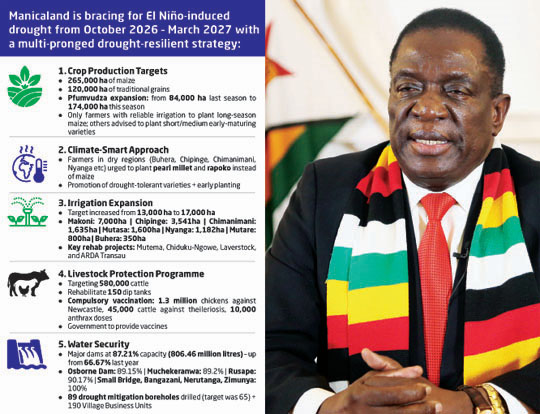
Manicaland Province offers a compelling example of how the ideals captured in this year’s theme can be translated into tangible outcomes.
Endowed with fertile soils, abundant rainfall and rich biodiversity, Manicaland plays a pivotal role in Zimbabwe’s agricultural economy.
The production of tea, coffee, macadamia nuts and horticultural products positions the province as a key contributor to both food security and export earnings.
Tourism further amplifies Manicaland’s importance within the national development matrix.
The Eastern Highlands, with their breathtaking landscapes and cultural heritage, present significant opportunities for both domestic and international tourism. As Zimbabwe intensifies efforts to grow the tourism sector, provinces like Manicaland are central to diversifying the country’s tourism offering beyond traditional destinations.
Infrastructure development is also gaining traction, with ongoing improvements in road networks, urban expansion and service delivery. These developments are not occurring in isolation; they are part of a broader national strategy to modernise the economy and enhance competitiveness.
Crucially, the success of these initiatives depends on collaboration among government, the private sector and local communities an embodiment of the unity espoused in this year’s theme.
For ordinary Zimbabweans, the theme: “Unity and Development Towards Vision 2030” carries practical implications. It speaks to the need for active participation in national development, whether through productive economic activity, community engagement, or the preservation of peace and social harmony. It is a call to move beyond the memory of independence as a historical milestone and to embrace it as an ongoing responsibility.
The commemorations also serve as a platform to honour the heroes and heroines of the liberation struggle, whose sacrifices laid the foundation for today’s opportunities. Their legacy is a reminder that progress is achieved through collective effort and shared vision. As Zimbabwe navigates the complexities of the modern global economy, this legacy remains a source of inspiration and guidance.
In essence, the 46th Independence Anniversary is both a celebration and a recommitment. It is a celebration of how far Zimbabwe has come from the hardships of colonial rule to the sovereignty of an independent nation. At the same time, it is a recommitment to the ideals of unity, resilience and development that defined the liberation struggle.
As the nation gathers in Maphisa, the message is clear: the future of Zimbabwe lies in its ability to harness the spirit of unity that secured independence and channel it toward sustainable development. For Manicaland and the rest of the country, Vision 2030 is not just a policy framework—it is a national aspiration that requires the participation, dedication, and unity of all Zimbabweans.



 Online Reporter