Online Reporter
Sifelani Tsiko
Fact Check Editor
THE death of 94 people who perished on August 11, 2026 when a Rural Infrastructure Development Agency ferry capsized on Lake Kariba – the world’s largest man-made reservoir by volume, spanning 223km long and up to 40km wide triggered Zimbabwe to declare it a State of disaster.
The lake straddles the border between Zimbabwe and Zambia on the Zambezi River and offers a vital means of transport to villages along the river.
In this report, we unpack what prompts Zimbabwe to declare a State of Disaster, the laws, the powers and the actions and coercive powers that provide symbolic recognition of the gravity of a particular crisis or tragedy.
What is a State of Disaster?
There are various explanations for this. Disaster risk experts generally define a State of Disaster as a formal government declaration that activates emergency response and recovery plans when a natural or human-made crisis overwhelms normal laws or daily operations.
They say this allows authorities to unlock emergency funds, speed up supply purchases and coordinate rapid help across different public groups.
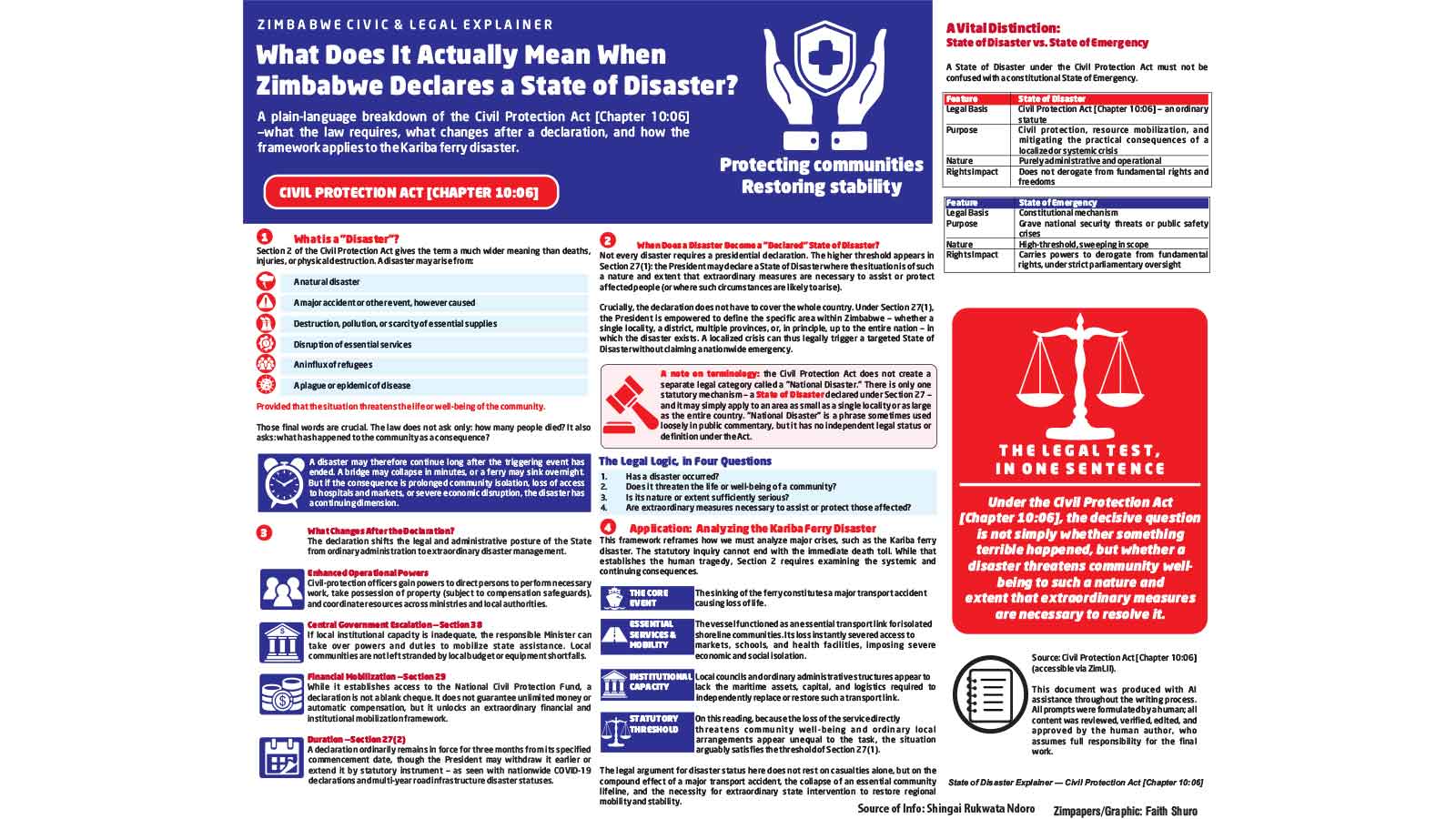
What is the main disaster law in Zimbabwe?
The main disaster law in Zimbabwe is the Civil Protection Act (Chapter 10:06) which is divided into 13 key topics relating to disaster risk management.
This legal framework establishes the country’s civil protection system and provides mechanisms through which the State can intervene when a crisis has moved beyond what ordinary administrative arrangements can manage.
Broadly, the Act also confers a broad power to give any other direction that is reasonably necessary to protect the public.
In addition, disaster risk experts say the Act acknowledges the gravity of a situation, sharpens the focus of emergency services, puts political leaders firmly in charge of the emergency and reassures the public and ensures high-level government attention.
What triggers Zimbabwe to declare a State of Disaster?
Broadly, natural events, human-made crises and major disease outbreaks or epidemics. Natural events may include floods, droughts, severe storms, large fires, earthquakes, tropical cyclones, hailstorms and others. Human-made crises could cover major infrastructure failures or utility collapses, accidents, environmental hazards and others.
Public health threats include dangerous disease outbreaks or epidemics. Under Section 2 of the Civil Protection Act, disaster risk analysts say a disaster is not confined to an incident involving deaths, injuries or widespread physical destruction.
“The definition is broad enough to encompass a natural disaster; a major accident or other event, however caused; destruction, pollution or scarcity of essential supplies; disruption of essential services; an influx of refugees; and a plague or epidemic of disease.
But there is an important qualification: the situation must threaten the life or well-being of the community,” according to the Civil Protection Act review report.
Here are the critical elements that a State of Disaster declaration may include:
- Nature of disaster
- Disaster prevention and mitigation
- Early warning
- Disaster preparedness
- Disaster response
- Disaster recovery
- Government institutional arrangements
- Civil society participation
- Financing of disaster risk management
- Principles, rights and protection
- Women and gender
- Facilitation for domestic response
- Facilitation for international response
What are the key powers that a State of Disaster can provide?
The declaration of a State of Disaster gives the Government agencies the responsibility for directing and co-ordinating the activities of all Government agencies. It may also allocate government resources as necessary to respond to the disaster.
The Government can direct agencies to act or refrain from acting in particular ways to deal with the disaster.
And this may prevail over anything to the contrary in any state law.
Here are some of the key powers that can be granted:
- Fast-tracked buying: Bypasses slow standard rules to get critical goods quickly.
- Resource sharing: Releases special Government funds and emergency vehicles.
- Better coordination: Connects local, regional, and national groups to work together.
- Targeted rules: Allows specific restrictions or exemptions to protect vital services.
How long does a declaration last?
According to a report titled: “What Does It Mean When Zimbabwe Declares a State of Disaster?” – a State of Disaster ordinarily remains in force for three months from its specified commencement date.
It further says that the President can withdraw the declaration earlier or extend it through a statutory instrument.
“This means the legal status can remain in place for as long as circumstances justify extraordinary intervention, subject to the mechanisms provided by the Act,” it notes.
The difference between a State of Disaster and a State of Emergency
A State of Disaster is intended to deal with emergencies that cover civil protection, resource mobilisation and managing the impact of a localised or systemic crisis.
Experts say it is fundamentally administrative and operational and does not derogate from fundamental rights and freedoms.
On the contrary, experts suggest that a State of Emergency is a constitutional mechanism intended for grave national-security threats or serious public-safety crises.
Some key examples of tragedies that were declared a state of disaster
- RIDA Mbuya Nehanda ferry disaster – August 11, 2026 – death toll 94.“The immediate loss of life is obviously central to understanding the human tragedy. But under the Civil Protection Act, the analysis cannot necessarily stop with the death toll. The sinking constitutes a major transport accident. The ferry also functioned as an essential transport connection for isolated shoreline communities.”
- Zimbabwe has in the past declared droughts caused by El Nino as national disasters – periods e.g. 2015 – 2016, 2024
- In May 2026, President Mnangagwa declared a State of Disaster for at least 17 rivers following years of degradation linked to mining activities
- Several devastating road accidents have in the past been declared a State of Disaster, both on Zimbabwean roads and others outside, mainly in South Africa carrying locals. These constitute a majority
- Tropical cyclone Idai which killed more than 344 people and left hundreds missing was declared a state of disaster on 15 March 2019. Other cyclones include cyclone Eline (2000), Japhet (2003), Dineo (2017), Chalane (2020), Cyclone Eloise (2021) among others.
- In May 2020, Zimbabwe joined many other countries around the world in declaring coronavirus, also known as COVID-19, a national disaster. This sought to help the government to mobilise resources to respond to the pandemic.
At the peak of the pandemic, Zimbabwe recorded a total of 5 740 cumulative official COVID-19 deaths out of 266 436 confirmed cases since the pandemic began in 2019.
HIV/Aids at its peak was also declared a national disaster.