Online Reporter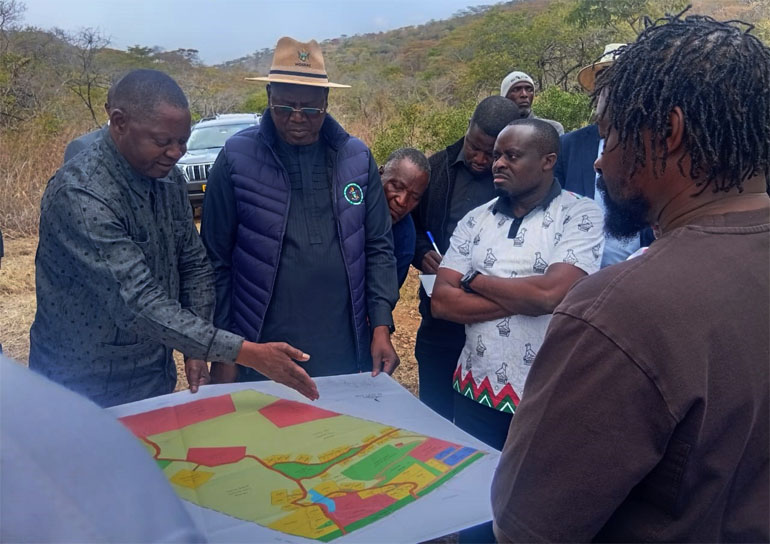
Ray Bande
Senior Reporter
A VISIONARY US$100 million to US$150 million creative and business village anchored by a National Gallery of Zimbabwe branch is set to transform Mutare into one of the country’s premier cultural, tourism and investment destinations.
The ambitious project is being developed on the 200-hectare Mount Worsley Estate, owned by the Masamvu and Rodgers families, less than 20 kilometres from Mutare’s Central Business District.
Designed as a multifunctional arts, tourism and lifestyle destination, the development will feature a national art gallery, museum, wellness centre, school of arts, open-air theatre, libraries, restaurants, sporting facilities, retail outlets, a clinic, fuel service station, production workshops and limited residential accommodation.
Preparatory work is already underway, with topographical surveys, layout plans, water and geological assessments completed. Applications for subdivision permits have also been submitted to the Ministry of Local Government and Public Works.
Upon approval of the permits, expected by October 22, the project will proceed to title surveys and the issuance of title deeds.
The development’s centrepiece will be a National Gallery of Zimbabwe facility to be established on 10 hectares donated to Government by the Masamvu and Rodgers families.
The land was officially handed over during a ceremony held on Monday.
Stakeholders consulted on the project include the Ministry of Mines and Mining Development, Department of Spatial Planning, Zimbabwe National Water Authority (ZINWA), Mutasa Rural District Council and the Ministry of Transport and Infrastructural Development because of the planned Christmas Pass Bypass Road.
Speaking during the handover ceremony, Sports, Recreation, Arts and Culture Minister, Lieutenant General (Retired) Ambassador Anselem Nhamo Sanyatwe, hailed the donation as a landmark investment in Zimbabwe’s cultural heritage.
“We are gathered here because two families, the Masamvus and the Rodgers, looked at a portion of land they held dear and chose to give part of it not to a single institution, but to a nation’s memory,” he said.
Minister Sanyatwe said the new gallery will help correct the historical imbalance that has seen major cultural institutions concentrated in Harare and Bulawayo, while artists from the Eastern Highlands had limited access to formal exhibition spaces.
“For too long, the national conversation about art and heritage has orbited around Harare and Bulawayo, leaving the Eastern Highlands with all their colour, traditions, painters, sculptors and storytellers without a major gallery space of their own. That changes today,” he said.
The development comes after the closure of the Mutare Art Gallery on December 31, 2024, following operational challenges, a move that left artists and cultural stakeholders concerned about the absence of a dedicated visual arts platform in the province.
Co-director of Mount Worsley Estate, Mr Misheck Masamvu, said the broader vision extends far beyond the construction of a gallery.
He revealed that the village will include an artists-in-residence facility, museum, wellness centre, school of arts, agricultural allotments, interdenominational church, memorial park, open-air theatre, libraries, restaurants, gymnasium, workshops, clinic, shops, dams and sporting facilities.
“We only have 63 residential stands allocated. We could have up to 1 000 stands, but because we do not have enough water we will have to limit numbers,” he said.
Mr Masamvu said the school of arts will nurture creativity from an early age, providing opportunities for children and adults alike to develop artistic talent.
“This is where we want to make sure that anything creative a child is doing gets attention. If we can reduce screen time and time spent on phones and computers, this centre can become a place where creativity flourishes,” he said.
He added that residents and visitors will also have access to agricultural allotments supported by professional agronomists, allowing the integration of arts, agriculture and community development.
Mr Masamvu described the planned national gallery as a cultural sanctuary capable of inspiring future generations of artists.
“The most important thing about a national gallery is that it gives creative work a home. Every child who draws, paints or creates something can believe that what they do matters and belongs somewhere. It creates hope and possibility,” he said.
He projected that the development could generate between US$100 million and US$150 million in value over the next decade if fully implemented.
Mr Masamvu said the estimate is driven, not only by infrastructure development, but also by the potential of art production, tourism and international creative exchanges.
“We are not only talking about artists from Zimbabwe. We are talking about artists from around the world who can come here, create work and contribute to the value of the entire ecosystem,” he said.
He said the project also aims to embrace niche tourism markets, including motorsport and other creative attractions, to ensure the village becomes a year-round destination.
Ends