Online Reporter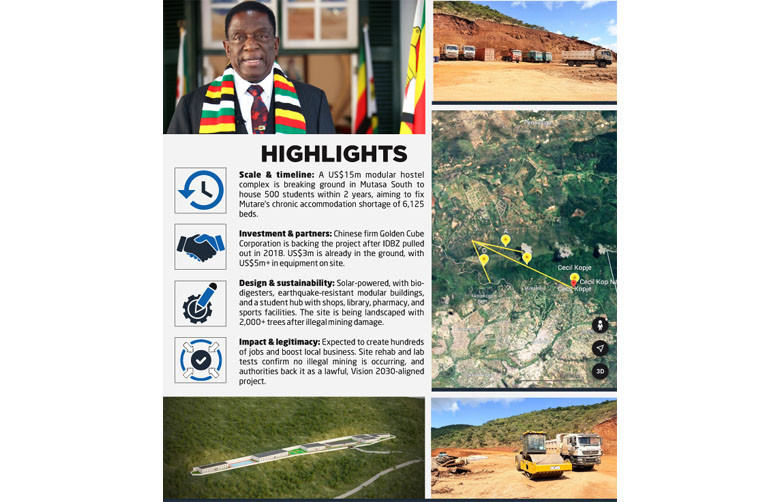
Samuel Kadungure
News Editor
A SEVEN-YEAR-OLD vision to end Mutare’s chronic student accommodation crisis has finally roared back to life, with heavy machinery already on site and US$3 million injected into project preparation, rehabilitation and civil works of a US$15 million state-of-the-art hostel complex.
The project, set to house 500 people within the next two years, promises to transform the city’s higher education landscape and ease the long-standing burden of inadequate housing for the students.
The ambitious 700-metre, one-storey modular complex at the Remaining Extent of Subdivision A of Mount Sinia, Toronto, in Ward 22, Mutasa South, has reignited hopes of ending Mutare’s chronic student accommodation crisis.
First conceived in 2018, the project stalled when the Infrastructure Development Bank of Zimbabwe (IDBZ) withdrew funding amid a policy shift. Its resurrection this year signals renewed investor confidence and a broader sense of economic stability.
After years of searching for partners, the landowners have struck a landmark deal with Chinese construction giant, Golden Cube Corporation, renowned for delivering smart-city projects across China, Europe, and Africa.
Already, more than US$5 million worth of plant and equipment has been deployed on site, as crews rehabilitate sections of the 50-hectare property that had been vandalised by 800 illegal miners, while mobilising for full-scale construction.
By injecting US$15 million into student accommodation, the investors are, not only tackling Mutare’s housing crunch, but also creating hundreds of construction jobs and jolting local supply chains.
The complex will provide safe, modern housing for 500 students, offering a lifeline to learners who have long been forced into squalid and unsafe lodgings.
Crucially, the development dovetails with the Second Republic’s Vision 2030 under President Mnangagwa, which seeks to transform Zimbabwe into an upper middle-income economy. It also anchors the National Development Strategy (NDS2) Infrastructure Development and Utilities Cluster, championing affordable housing, clean energy, and public-private partnerships to crowd in fresh capital.
At the same time, the project mirrors the City of Mutare Master Plan and embraces the smart city concept.
The structures will be deliberately designed to blend seamlessly into the natural environment, with careful attention to height, colour, and configuration.
Early retaining walls will be built where necessary, while the entire north-facing slope of Mount Sinia will be landscaped and replanted with trees to preserve the original scenery, flora, and fauna.
At ground level, the complex will feature a bustling one-stop hub open to students and the wider public. Food courts, a library, pharmacy, laundromats, supermarkets, and modern sporting facilities will seed a vibrant, self-contained community.
Sustainability is hard-wired into the design. A dedicated solar farm will power the residences, bio-digesters will process waste and provide heating, and earthquake-resistant modular structures will guarantee safety. Together, these innovations position the project not just as a hostel, but as a model of future-proof urban living.
Given the site’s historical mining legacy, proximity to the Indian Ocean, and a record of earth tremors, engineers have opted for lighter, modular structures that are faster to assemble and significantly reduce construction costs.
Clean water will be supplied through the Odzani pipeline, which passes directly through the property en-route to Mutare.
The land itself carries a long history, held under a private title deed and traceable previous owners dating back to 1945.
The Department of Physical Planning has already issued 18 subdivision permits for the site, paving the way for development.
What many had misconstrued as clandestine gold mining on Mount Sinia of Toronto, was in fact, revealed this week as a meticulously regulated engineering project. During a media tour of the construction site, journalists discovered that no illegal mining was taking place. Instead, they witnessed the foundations of a US$15 million student village rising from decades of environmental damage.
The Manica Post can confirm that the soil heaps being shifted were not gold-bearing ore, but gravel used to rehabilitate, compact, and stabilise platforms for 150 temporary employee housing units, offices, and warehouses. Access roads are also being opened to support full-scale construction.
To dispel lingering doubts, soil and water samples collected during the tour were sent for laboratory testing.
Results came back negative — no traces of gold-bearing ore, mercury, or cyanide were detected.
The findings underscore that the project is not only legitimate but also environmentally responsible, marking a turning point for Mutare’s student housing crisis.
The landowner, Mr Max Chard, said the property does not share any boundaries with the Christmas Pass Mountain, Cecil Kop National Park, telecommunication masts perched on the peak of Christmas Pass Mountain and Hillcrest Group of Schools.
“We stress that the development is at Mount Sinia, of Toronto, not Christmas Pass Mountain. Mount Sinia is independently located approximately six kilometres by road from Christmas Pass, with two mountain peaks in between. The Cecil Kop National Park lies six kilometres east of the project, and does not share any boundaries with it and Hillcrest Group of Schools. “Telecommunication masts perched on the Christmas Pass Mountain peak are located three kilometres away from the works and are not threatened in any manner by the current project works. Any suggestion that this project endangers the local community, Christmas Pass Mountain, Cecil Kop National Park, or telecommunication equipment is factually incorrect.
“Prior to the rehabilitation, the mountain was invaded by over 800 illegal miners, some with sophisticated machinery, causing significant environmental damage. Penhalonga police were overwhelmed with reports of social ills, including damage to private property, burglary, assaults, drug abuse and even murder. To date, the reports have been significantly reduced by 90 percent.
The illegal mining activities were being sponsored by some members of the Greater Toronto Residents Association, who are now driving a negative media campaign against the project. Some of the leaders remain hostile, being beneficiaries of the previous illegal mining activities. The investment is transparent, lawful, and undertaken with guidance and approval from all stakeholders,” said Mr Chard.
To conquer the site’s treacherous past, engineers are benching the slopes to modern safety codes and erecting lightweight, earthquake-resistant modular buildings that sit lightly on ground honeycombed with 1940s-era mining shafts.
“Golden Cube Corporation is providing US$15 million in capital investment and technical expertise. Conceived in 2018, the project is now progressing, with preliminary construction works under way to deliver world-class accommodation for at least 500 students from higher and tertiary institutions in Mutare, where safe, affordable housing is in critical shortage. The facilities will not be mere dormitories, but will adopt a one-stop
▶ To Page 6
US$15m student city breaks ground
▶ From Page 1
shop model. The ground floor of the two-storey complex will house commercial units accessible to students and the public, including food courts, library, pharmacy, laundromats, supermarkets, and sporting facilities, to foster a vibrant community around the residences. The design integrates sustainable, resilient features – a solar farm for energy generation, bio-digesters for waste management, and earthquake-resistant modular buildings. Given the site’s proximity to the Indian Ocean and historical earth tremors, lighter modular structures are a deliberate safety measure. They are also faster and more cost-effective to build,” said Mr Chard.
A feasibility study of the project, conducted by Dr Maxwell Mutema on behalf of the bank, revealed that Mutare, home to several tertiary institutions faces a dire shortage of safe and affordable beds.
“Demand growth, spurred by demographic and college attendance trends, has been robust, while at the same time new dormitory capacity has been limited by constrained university budgets. This means student accommodation is an investment opportunity. Despite a 6 125 total deficit of student accommodation, the viability of student accommodation on the proposed site hinges on students from Africa University and Magamba Vocational Training Centre, which are within commuting distance. (Other institutions) also have a high student housing deficit, but are distant from the proposed site. Distance constraint can be overcome by a student shuttle bus. With bus shuttle services, all tertiary institutions can be serviced. The net effect of this is to contribute towards the city’s economic and human capital development,” reads the feasibility study.
Director of Economic Affairs and Investment Promotion for Manicaland, Mr Munyaradzi Rubaya, said the city needs such investment to cater for the rising demand.
“That is the kind of investment that we need and fully supports because we are in a student accommodation crisis as a province. Our student population is more than 5 000, yet on-campus accommodation at these institutions cannot cover half of the students. We need a five-star student accommodation hostel to cater for the rising demand,” said Mr Rubaya.