Chronicle Editor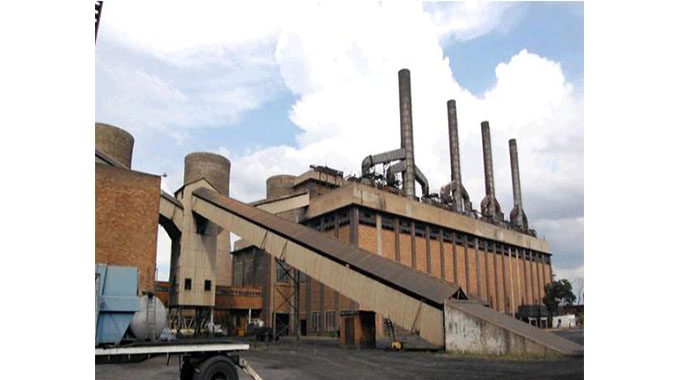
Fairness Moyana in Hwange, Sunday News Correspondent
THE Zimbabwe Power Company (ZPC) has borrowed US$50 million to kick-start the repowering of Hwange Power Station Units 1 to 6 as part of a significant move to enhance the country’s power generation capacity. The development will go a long way in addressing the surge in power demand that is being witnessed nationwide spurred by increased industrial activity.
The planned repowering project is expected to extend the generation life of the units and meet the escalating demand for power following the commissioning of Units 7 and 8 with a combined capacity of 600 megawatts. Units 7 and 8 were commissioned by President Mnangagwa last year in August.
Updating members of the Parliamentary Portfolio Committee on Energy who were on a fact-finding mission recently, ZPC general manager Engineer Shepherd Mukundu said they were in talks with the project financier where a total of US$500 million was required for the five-year project which is anticipated to commence in the third quarter of this year.
“To this end, we are still talking to Exim Bank of India who are going to be the financier for that repowering initiative, it’s going to come in two tranches, one of them is US$310 million and another one US$110 million which was originally meant for Bulawayo Power Station,” he said.
“So, we have taken it upon ourselves to borrow money from Stanbic, a US$50 million facility to kick-start the repowering process such that when we eventually get funding from Exim Bank of India it will find us somewhere. But what we would have wanted is to get all the money that we want so that we can then increase traction.”
He said the Ministry of Finance, Economic Development and Investment Promotion was assisting them to engage with Exim Bank of India so that once the money comes they can start with that programme. Eng Mukundu said it was not a programme that would take one day to complete, while they estimate the repowering programme to take them four to five years.
“In terms of power generation, our low-hanging fruit currently is the repowering of Units 1 to 6, we are producing 420MW which is not easy to sustain given the conditions of the plant but we thank God that we are doing that capacity currently.
“One of the deliverables that we expect to see coming from repowering is increased capacity, increased reliability and also extension of life from 15 to 20 years that is what we seek to achieve in terms of repowering,” he said.
He said as ZPC they have also started using their own resources to champion repowering. Eng Mukundu said in Unit 5 they have a supplier who has manufactured two turbine rotors for them and they also have a team that will be going to Italy for what they call factory assessment tests sometime next month.
He added: “Our revenues remain subdued compared to critical obligations such as financing operations that include offsetting loans, spare parts purchase as well as the import bill. ZPC requires US$5m for spare parts that are imported.”
In the first quarter of this year, Hwange Power Station generated an impressive 1 696.4 gigawatt-hours (GWh) of electricity, accounting for a remarkable 75.4 percent of the total electricity generated during that period.
The output surpassed the generation from other major power sources, such as the Kariba Hydro-Power Station, which contributed 19.6 percent (440.5 GWh), and Independent Power Producers (IPPs), which provided the remaining 5.1 percent. Despite the ageing infrastructure, Hwange Power Station units 1 to 6 have been operating at an average of 400MW, falling short of their installed combined capacity of 900MW.
This development has placed additional pressure on the country’s power supply, especially with the inactivity of the thermal power stations in Bulawayo, Munyati, and Harare, as well as subdued power generation at Kariba Hydro due to low water levels. Consequently, Hwange Power Station has emerged as the primary source of power generation in the country.
With Zimbabwe’s peak power demand standing at under 3 000MW and current local production at approximately 1 200MW, the shortfall is being met through imports from the regional power pool and Independent Power Producers.
The Government forecasts that the electricity demand is set to increase particularly in the agricultural, manufacturing and mining sectors with the continued resuscitation of industry.
The developments are part of the economic deliverables born out of President Mnangagwa’s engagement and re-engagement policy being implemented by the Second Republic.



 Online Reporter