Online Reporter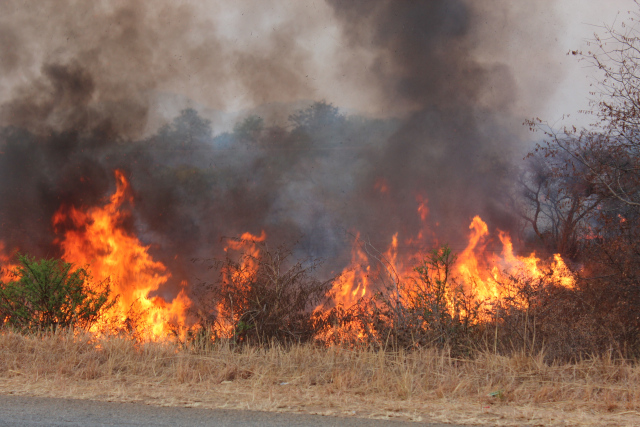
Fungai Lupande-Mashonaland Central Bureau
A devastating veld fire swept through Chiweshe and Nyombwe Estate in Mazowe District last week, destroying homes, crops, and grazing land, leaving more than 100 villagers counting their losses.
The inferno, which broke out on September 2 and 3, gutted 26 huts in Chiweshe, displacing 24 families and leaving 104 people stranded.
At Nyombwe Estate in the Iron Duke area, the fire consumed approximately 2 000 hay bales, scorched 1 000 square metres of standing wheat, and destroyed 50 treated fence poles.
Two villagers sustained injuries during the fire; one has since been discharged, while the other remains admitted at Howard Hospital.
Mr Maxwell Mupotsa, provincial environmental education and publicity officer for the Environmental Management Agency, stated that more than 1 000 hectares of land were destroyed, wiping out pastures and threatening livestock survival.
At Nyombwe Estate alone, 35 hectares were reduced to ashes.
“The situation was worsened by strong winds that carried the fire over long distances, making suppression extremely difficult,” he said.
The fire is suspected to have been started by a mentally challenged individual in Chiweshe’s Ward 12, while the cause at Nyombwe Estate remains unknown. Investigators also noted the absence of fireguards and the presence of invasive Lantana Camara, fuelled the flames.
Among the hardest-hit communities were Munongerwa, Mapfumo, Marimo, Sangare, Chitaguda, Katakwa, and Mazhombwe villages.
In response, the Civil Protection Unit, working with EMA, police, and local leaders, launched a fire awareness campaign in Chiweshe, sensitising villagers on the importance of fireguards and prevention measures.
An Environmental Protection Order was also issued to Nyombwe Estate, directing the construction of a standard fireguard across its 350-hectare farm and the removal of all Lantana Camara.
Authorities have urged immediate assistance for affected families in the form of food, shelter, and clothing, while long-term measures are needed to rebuild homes and restore grazing land.
Mr Mupotsa urged communities to develop emergency response plans, conduct regular fire drills, and intensify education on veld fire risks to prevent future disasters.
“The destruction witnessed in Chiweshe is a wake-up call for collective action,” he said.
“As we enter the dry season, coupled with the windy conditions we have experienced in recent weeks, it is crucial for everyone to stay vigilant and implement pre-suppression measures to prevent veld fires.
“Many instances of destruction could be avoided if people established standard fireguards and helped one another on the day of a fire, rather than assuming it won’t affect their property. Let’s work together to ensure safety for all.”
He added that without fireguards, awareness, and preparedness, the province will continue to lose lives, property and the environment to veld fires.