peter
peterRutendo Nyeve, Features Reporter
THE United Nations (UN) commission on the status of women suggests that women’s empowerment has five components.
These being the women’s sense of self-worth, right to have and to determine choices, right to have access to opportunities and resources, right to have power to control their own lives, both within and outside the home, and ability to influence the direction of social change to create a more just social and economic order, nationally and internationally.
In this context, education, training, awareness raising, building self-confidence, expansion of choices, increased access to and control over resources, and actions to transform the structures and institutions that reinforce and perpetuate gender discrimination and inequality are important tools for empowering women and girls to claim their rights.
In Zimbabwe significant strides have been made to empower women with developments dating back to the turn of the millennium that saw the country ensuring that it fulfilled the Millennium Development Goals (MDGs) and subsequently the Sustainable Development Goals (SDGs). And from there, women seem to continue to benefit from a number of opportunities that are being availed by both the Government and the private sector. Sunday News recently visited Bubi-Lupane Irrigation Scheme in Lupane, Matabeleland North Province which has been described as one of the largest community managed irrigation schemes.
The scheme has empowered women from surrounding villages who are its beneficiaries in line with the Second Republic’s set Vision 2030 which seeks to attain an upper-middle income economy through different set out guidelines and objectives. These are clearly stipulated in the National Development Strategy 1 (NDS1). One of the cardinal anchors towards achieving this vision is agriculture. Agriculture is observed to be at the epicentre for transformation, precisely because 70 percent of the country’s population is in the rural areas. The NDS1 realises the need for agriculture to power the livelihoods of the rural population out of poverty into food security, and subsequently into income generation for the realisation of Vision 2030.
Agriculture is not only prioritized for food security but to also spearhead rural industrialisation. It is rural industrialisation that must lead to rural development and it is rural development that must facilitate the attainment of Vision 2030. Bubi-Lupane irrigantion scheme has thus taken a lead in that regard. “Ever since I joined this scheme my life has been transformed. Last year we harvested wheat and I got ZW$250 000. From that money I managed to buy building material, paid school fees for my children. Actually, when one is now looking at the standard of living at my home, they will realise that it has really changed.
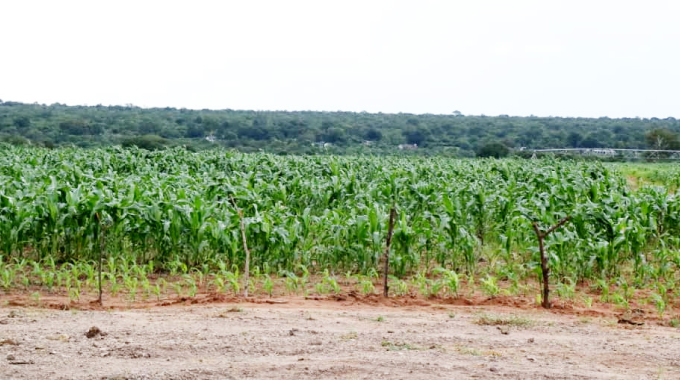
“I am able to go to the shops and buy whatever I want. As a mere NaLanga I never thought I will have a bank card but now I have it and I’m able to go and swipe what I want and provide what my children desire. As we speak, we are looking forward to getting money from our maize harvest which will also help us achieve our set goals,” said Mrs Sikhulile Moyo who is the vice-secretary of the Bubi-Lupane Irrigation Scheme.
The scheme has 90 household members from Ward 18 in Lupane and the Government chose the Bubi-Lupane Irrigation Scheme model to spearhead the rural industrialisation programme and is working towards replicating the model countrywide.
Under the model, community members provide labour at irrigation schemes while the Agriculture and Rural Development Authority (ARDA) provides technical expertise.

When Sunday News visited the scheme, women were packaging their maize harvest. They are set to be paid a dividend of nearly US$1 000 and ZW$600 000 each after delivering 900 tonnes of maize to the Grain Marketing Board (GMB). This is the second time the scheme members are being paid a dividend as they received ZW$250 000 each in December last year after they harvested their wheat crop. The villagers are also paid monthly salaries of ZW$25 000 which assists in their upkeep.
“This gift that we were given by the Government is a very good initiative that has changed our lives and our families. Our children used to be sent back home after we failed to raise school fees, but not anymore. We didn’t even have livestock but we managed to buy some and we now able to pay school fees and plan on what we can do at our homes. We no longer ask for money even for salt from our husbands. We are now mothers who wake up, do chores and come to the irrigation scheme. We want to urge other women to get serious with such initiatives as they are empowering,” said Ms Shelly Nkomo.
Mrs Siphathisiwe Makuwi also weighed in saying: “This is beautiful, it has transformed our lives as we are now able to pay fees, buy books, and uniforms. Our children no longer get chucked out of classes for non-payment of fees which used to give us stress. At times my partner will be getting limited wages, however, since I joined this scheme, we can now help each other to provide for our family. We now have bank cards. From our wheat produce last year, I managed to buy 12 asbestos sheets, bricks as well as school learning resources.”
Following these and other success stories the Bubi-Lupane Irrigation Scheme has attracted members from Matabeleland South, Midlands, Masvingo and Manicaland on a learning visit. — @nyeve14



 Online Reporter