Online Reporter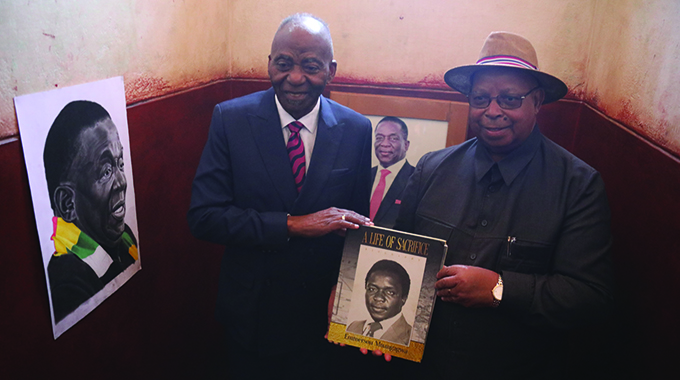
Raymond Jaravaza, [email protected]
In September 1962, a young Professor Peter Katjavivi, accompanied by two fellow Namibians and two South Africans, found himself thrust into the back of a Rhodesian police vehicle. The group stood accused of illegally crossing the border and suspected of plotting acts of terrorism—a charge that reflected the tense, repressive atmosphere of Southern Africa at the time.
A few days later, the five foreigners stood in front of a magistrate in Plumtree and were charged with entering Rhodesia illegally without valid travel documents.
That would be the start of a three-month prison ordeal in a Plumtree jail for the five ‘convicts’ until the intervention of a United Nations committee at the request of the South West Africa People’s Organisation (SWAPO), a liberation movement in Namibia that operated mostly in the shadows during that time after being banned by the white minority regime.
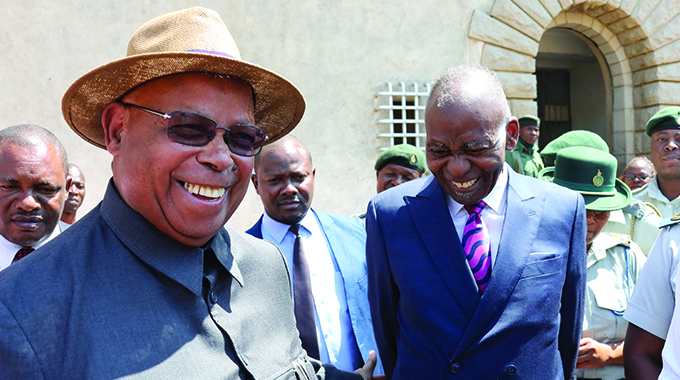
Yesterday, Prof Katjavivi was part of a delegation led by Speaker of the National Assembly, Advocate Jacob Mudenda, that visited Khami Prison Complex, on the outskirts of Bulawayo, and the Plumtree Prison in Matabeleland South Province.
Prof Katjavivi is the former Speaker of the Namibian Parliament and an author.
“Professor Katjavivi is writing a book about his life and there is a section that deals with his contributions to the liberation struggle as a freedom fighter for Namibia.
“In 1962, on his way to the then Rhodesia with other comrades from Namibia, they ended up in Plumtree, where they were arrested. Today (yesterday) he asked me to accompany him to Plumtree Prison to see and revisit the prison cell where he was incarcerated,” said Adv Mudenda.
The delegation also visited a solitary confinement cell where President Mnangagwa was imprisoned for leading a team of liberation fighters that sabotaged a railway line and infrastructure in what was then known as Fort Victoria (Masvingo).
President Mnangagwa spent 10 years at Khami Prison.
“We agreed that it would be good to also visit the cell where His Excellency President Mnangagwa was imprisoned in 1966. It was quite an experience to get into that cell here at Khami Prison Complex and have an appreciation of how it would have looked when the President was in that dark cell for years,” said Adv Mudenda.
The two countries continued to foster deeper bilateral relations that include cooperation in improving prisoner welfare and rehabilitation programmes.
“There has been a regional conference in which senior officers from SADC have been sharing notes on how our countries can be transformative in terms of the rehabilitation of inmates.
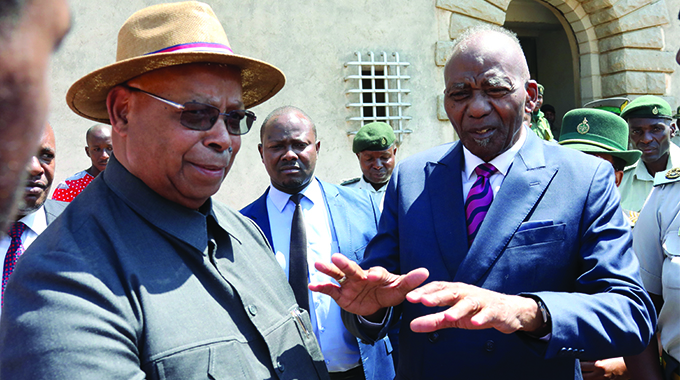
“This is being done so that when the inmates are released after serving their sentences, it is easier for them to be part and parcel of society,” said Adv Mudenda.
“I was impressed that prison authorities allow activities such as agriculture for inmates to learn how to feed themselves by growing a wide variety of crops and produce.”
Adv Mudenda said he was also impressed by the nearly completed construction of a school at the Khami Prison.
“The inmates, guided by prison officers, are now almost completing an Advanced Level School here at Khami Prison Complex using construction skills that they learn while serving their sentences.
“The issue of self-sustainability for our inmates is commendable because it reduces the demand for financial resources on the national fiscus in terms of expenditure to run prisons across the country,” he said.
Prof Katjavivi was born on 12 May 1941 in Okahandja, Namibia. He went into exile in 1966 and was part of the Dar es Salaam exiles that helped transform SWAPO into an international force in the struggle for the liberation of Namibia.
Until 1979, he was a full-time SWAPO activist running the London office and holding the movement’s Information and Publicity post. From the 1980s, he pursued his academic career, which saw him gaining a Master’s Degree in 1980 from the University of Warwick, UK and a Doctor of Philosophy in 1986 from St Anthony’s College, University of Oxford.
In 1989, he was elected to the Constituent Assembly and served as a National Assembly member until 1991.
In 1992, he was named the first Vice-Chancellor of the University of Namibia, a post he held for eleven years. He was appointed as Professor in History by the UNAM Academic Council Staff Appointments Committee in 1994. He was given a diplomatic posting in 2003 and has been very active as SWAPO’s documentor of the liberation struggle.
“One of the areas that Zimbabwe and Namibia have continued to improve on is the achievement of greater unity among the people of the two countries and the SADC region as a whole.
“The first critical step towards achieving that goal was the creation of strong institutions in the SADC region that promote cooperation in a wide range of issues,” said Prof Katjavivi.
He said the establishment of a SADC Parliament was also a step in the right direction.
“But we don’t stop there, we also have to look at trade and standing up together to defend our sovereignty as the SADC block against the interests of other international blocs such as the European Union.
“It’s important to build a single solidarity stance that puts our SADC interests as a unified block. We have to stand for what is important for us as SADC,” he said.