Online Reporter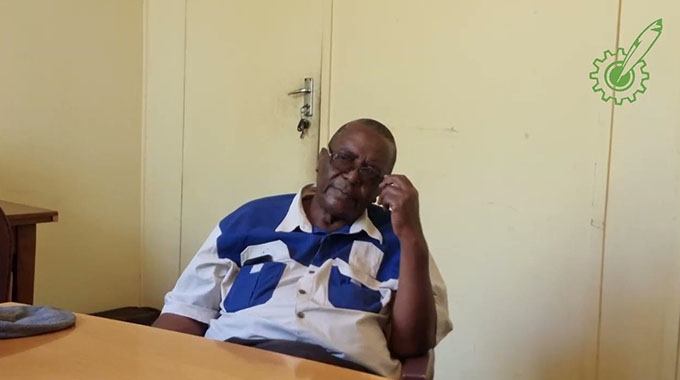
THE name Sivako is associated with business enterprises dotted around Bulawayo and places surrounding Plumtree Town. The proprietor of those businesses, the late William P Sivako Nleya, was also a close friend of the late Vice-President, Dr Joshua Mqabuko Nkomo. Despite growing up in a privileged family, William Sivako’s son, Mthabisi, abandoned all the luxuries of home and crossed the border into Botswana en route to Zambia, after completing his Ordinary Level at Mzingwane High School in Esigodini, in January 1978. Our Assistant Editor, Mkhululi Sibanda (MS), caught up with Cde Mthabisi Sivako on Wednesday last week, where he recounted his participation in the armed struggle. His story is unique ,in the sense that he was not immediately thrown into guerrilla warfare training.
Instead, he was among a pioneering group of 75 recruits sent to Liyali Police Training School, to be trained as police officers. He was later sent to the National Security and Order (NSO) School of Intelligence, known as Moscow, also in Zambia, to be trained as an intelligence officer. After Independence, Cde Sivako was integrated into the country’s police force and later deployed to the motorcade of then Prime Minister, the now late former President, Cde Robert Mugabe.
Below are excerpts of the interview. Read on…
MS: As is always the case, may you please start by giving us your background?
Cde Sivako: I was born on 17 March 1960 at Mpilo Central Hospital in Bulawayo, to William P. Sivako and Diana Moyo. I grew up in Mpopoma suburb, where I attended the local primary school, Mpumelelo. After that, I went to Dombodema Mission in Bulilima, before moving to Mzingwane High School in Esigodini, where I completed my secondary education, obtaining my Ordinary Level in 1977. The following year, on 3 January, I left Bulawayo, headed for Botswana, on my way to Zambia to join the armed struggle.
MS: Before you take us through your journey, tell us how you got into politics.
Cde Sivako: I would not say I became interested in politics — no! I was born and grew up in a political system. My father, William Sivako, was a close friend of many nationalists, particularly the late Vice-President Joshua Mqabuko Nkomo. My father and Nkomo were very close. When nationalists, including Nkomo, were detained in Gonakudzingwa, my father used his resources to take care of their families. He also visited them regularly to check on their welfare. On his part, Mdala Josh used to visit our home in Mpopoma, as did many other nationalists. Therefore, my political beliefs were shaped by the conditions and interactions I grew up under.
MS: Then tell us about your journey to Botswana.
Cde Sivako: As I said, I left Bulawayo on 3 January 1978.
MS: How many were you when you left Bulawayo?
Cde Sivako: I was alone. At that time, I felt mature enough to join the armed struggle, and I had seen some guerrillas visiting our home — those involved in urban warfare operations. I boarded a Pelandaba bus at Renkini that plied the Bulawayo-Ndolwane route in Bulilima District. My father had a store there at Ndolwane, managed by my sister. It was 500 metres from our homestead. Besides his businesses in Bulawayo, my father also owned stores in Bulilima, in areas such as Moza, Ndolwane, Butshe and Kungubo. When I arrived at Ndolwane, my sister looked at me and said, Usuzohamba kwabanengi, meaning I was on my way to join the armed struggle like many before me. She then told me that the guerrillas could arrive at our business premises anytime, so I could wait for them.
MS: How long did you wait?
Cde Sivako: A group of five guerrillas arrived after three days, and I remember the name of one of them — he was called Cde Prince. They did not come to the store, but went to the homestead to organise food. When they got there, our domestic worker informed them that I was willing to join the armed struggle. They then came to the store to collect me. We did not waste time — I gathered a few belongings and we set off. We crossed Thekwane River, which was 200 metres from the stores and had water, as it had been raining. We headed to the Hingwe area, where we were joined by a group of 10 guerrillas escorting over 30 recruits from the Lupane area. The recruits were both males and females.
MS: How long did you stay at that base?
Cde Sivako: We were there for some days. I became impatient. Things were happening at the base that I cannot disclose on this platform. So, another recruit and I decided to detach ourselves from the group and find our own way to Botswana. The guerrillas had warned us not to leave, as they would escort us. They said that if anyone was caught leaving the group, they would deal with them. Despite this, we managed to slip away and cross into Botswana. We had not realised we were so close to the border until we asked an old man who was passing by. He informed us that we were right next to the border, which gave us the courage to proceed.
MS: After crossing into Botswana, what did you do?
Cde Sivako: We walked to Chief Mengwe’s area, where we were accommodated. After about four days, the group we had left behind arrived — without the guerrillas. The guerrillas had only escorted them across the border, before returning to Rhodesia for their operations. Botswana did not allow our freedom fighters to move through its territory while armed.
MS: Alright, please continue with your journey.
Cde Sivako: We did not stay long at Chief Mengwe’s area as transport was arranged to take us to Francistown. When we arrived in Francistown, we found about a 100 other recruits. We were then moved to Selibe-Phikwe, where over a thousand people were waiting to be transported to Zambia for training. I stayed in Selibe-Phikwe for about three weeks. We were eventually flown to Zambia, boarding a commercial flight, which meant our group was reduced to about 20 people.
MS: How were you received upon arrival in Zambia?
Cde Sivako: When we landed at Lusaka International Airport, we were met by comrades from the ZPRA security department. From the airport, we were driven in Zapu trucks, called Kraz, to Nampundwe Transit Camp. Nampundwe was a receiving camp.
MS: A lot has been said about the conditions and initiation of recruits at Nampundwe. How did you handle the situation?
Cde Sivako: That place was not for the faint-hearted; it was where all traces of civilian life were erased. First of all, I was shocked to see everyone looking like ghosts. People’s clothes were torn, they had lost weight—the situation was dire. The physical training, which was the main focus at Nampundwe, had taken its toll. Nampundwe was also a centre where male recruits were vetted and screened. There was also the notorious trick where we were told that Joshua Nkomo was coming to meet the new arrivals, but it was sort of a prank on the new arrivals.
MS: Tell us more about that.
Cde Sivako: We were told to wear our best attire for a meeting with the party’s leader and Commander-in-Chief, Joshua Nkomo. I had a nice T-shirt with “11 Bullets” printed on it, a jersey and denim jeans. However, instead of a meeting, we were subjected to gruelling drills. By the time we were done, my clothes were torn,and my T-shirt was in tatters.
To be continued next week, with Cde Sivako discussing his training.