Chronicle Editor
Raymond Jaravaza, [email protected]
FOR the past two years, residents in a section of Luveve suburb have been left without access to water from Bulawayo City Council taps, forcing them to dig shallow wells in their backyards.
The city is battling a severe water crisis that has made it difficult to manage its 120-hour water-shedding programme, leaving residents in high-lying areas without supply for weeks.
While council-owned water bowsers help in some areas, they are inadequate to meet demand, leading residents to fetch water from unsafe open sources such as streams and burst pipes.
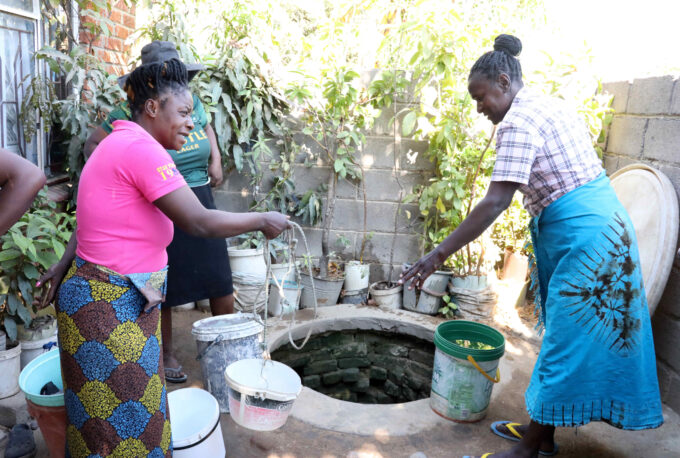
Just a walking distance from Luveve Stadium, residents have found innovative ways to survive without tap water from the municipality. They have resorted to digging shallow wells in their backyards as a source of household water.
The shallow wells vary in depth, with some residents getting up to 100 litres of water each morning, while others receive as little as 40 litres.

Mrs Sithembile Ndlovu said she gets 100litres from her well every morning for household use before allowing her neighbours to also fetch the precious liquid.
“My neighbours will be queuing outside the gate waiting for their turn to fetch water as early as 6am and I can’t turn them away because we are all facing this serious water crisis which started over two years ago,” said Mrs Ndlovu.
“If I don’t lock the gate, some of them even come here at 4am to fetch water. I’m one of the lucky few who get over a dozen 20-litre buckets of water each morning. We don’t fetch water at night to give the well time to fill up until morning when water demand is high.”
Another resident, Mrs Sukoluhle Ncube, said people she hired to dig her shallow well encountered a rock about three metres into the job and this has resulted in the well accumulating less than 40 litres of water each morning.
“We don’t get much water from the well but it’s better than going for days on end without a single drop of water. It’s been two years since we got water from our taps but despite our cries to the Bulawayo City Council, nothing has been done to address our situation,” said Mrs Ncube.
Surprisingly, residents continue being charged water bills by BCC despite not accessing tap water for two years, which they feel is unfair.
“When we pay our utility bills, the part that is indicated as water consumption is the most expensive and we ask ourselves why we are paying for water that we last got from our taps more than two years ago. The city council must fix the water problem in our area then charge us for water consumption,” she said.
Despite the varying output, these shallow wells are the only source of water that the residents depend on. The wells are covered with improvised lids to prevent young children from falling into them. The residents live with this risk but worry that the wells could become contaminated, putting their families at risk of contracting water-borne diseases.
The residents have called on the local authority to find a lasting solution to the water challenges they face, saying they are tired of waiting for the council to address the issue.
In 2020, over 200 residents were infected with water-borne diseases, including typhoid and dysentery, causing 13 fatalities.
The Ministry of Local Government and Public Works attributed the outbreak to contaminated water pipes, stating that human waste seeped into the pipes, leading to the outbreak. This case served as a wake-up call for the local authority to fix the issue urgently.
“We know that the city is facing water shortages but all we are asking for is that the city council fixes our water challenges so that we can also receive it at least two days a week.
“We have not forgotten the disease outbreak that killed some residents here in Luveve and we are scared that once our wells get contaminated then our families are at risk of dying from water-borne diseases,” said one resident, Miss Simelokuhle Mpofu.
Luveve/Emakhandeni Constituency legislator, Descent Bajila, has appealed to the city council to address the issue urgently.
He has called for a lasting solution to the problem saying water is a basic human right.
He said the Government has an obligation to avail bulk water, and local authorities have a responsibility to deliver potable water to the people.
The continued unavailability of water, he said, also affects meter readings, which distort future water meter estimates.
“Meter readings must be calculated based on consumption. In the meantime, the council must install a water kiosk in the affected area to service that community,” Bajila said.
Ward 16 councillor, Greater Gumede, reassured residents that her office is aware of the challenge and is continuously engaging with the council to fix it.
She said the director of engineering services, Engineer Sikhumbuzo Ncube, had promised to investigate the issue, and when findings were available, he would implement a lasting solution to the problem.
Until the council fixes the water challenges in the affected area, Cllr Gumede has also suggested that the council install a water kiosk to service the community.


 Online Reporter