admin
admin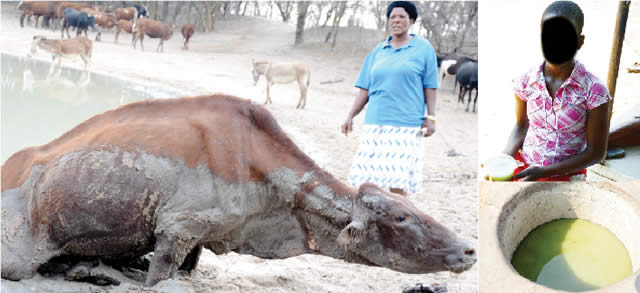
Obey Sibanda Features Reporter
Villagers in Tsholotsho District are questioning the merits of a “universal” truth readily accepted at kindergarten level that water is colourless and tasteless. For months on end the villagers have been drinking greenish and greyish substance as clean water sources dried up. Villages in ward seven comprising Donda, Matopo, Pelela, Khumbula, Gulalikabili, Tembile, Tsetsere, Donda, Phambuka and Butshena are the worst affected.
Most of the water bodies that keep the ecosystem thriving and feed a growing human population are stressed. Rivers, dams, and aquifers have all dried up. The villagers’ challenges are encapsulated by 13-year-old Siphosenkosi Mdluli of Donda village. Every morning and evenings at times, Siphosenkosi, a pupil at Tembile Primary School, fetches the greenish water for domestic use at home.
The water is from an unprotected source that cuts through the heart of her school yard. Each time she inspects her bucket at home, she sees a sickening mixture of dirt in the form of green residue, feathers and water insects. Birds, cattle and donkeys get trapped in mud and die foraging for the rare precious liquid at the village water source.
It’s been a couple of years since Siphosenkosi and her family tasted clean water. Villagers in the ward are trapped in a vicious circle of peril and despair due to the absence of safe water sources. They share the same water source with animals putting their health at risk.
“We are faced with a humanitarian crisis. The water that we drink is unsafe yet we have no option. We last received pills for water purification last year from the local clinic. Worse still, the pills had already expired. Since then we’ve been drinking unpurified water,” said Siphosenkosi.
Teachers at Tembile Primary School are concerned by the effects the water might have on the children and community’s health. They have a second headache: how to convince pupils that water, in its natural form, is colourless and tasteless.
“For purposes of passing examinations we tell our pupils that water is colourless and tasteless. This is no easy job. The water that they know is green in colour and has a funny taste. Our school attendance figures have been immensely affected by the water situation,” said a teacher at the school.
Boys are coming to school in their numbers running away from the daily chores of fetching safe water from a borehole that is eight kilometres away. Girls, on the other hand, are missing lessons as they join their mothers to fetch water.
A villager, Siphilanzima Ncube, regrets relocating to Tsholotsho through marriage. She says being a daughter-in-law in Tsholotsho has become a nightmare owing to the water crisis. “My brother, being a daughter-in-law in this village is a tough call. We travel long distances at night and we usually come across elephants while searching for water,” said Ncube.
The “coloured” water is suspected to be causing stomach problems among villagers. Teachers and pupils sometimes miss lessons because of diarrhoea. “Pupils’ performance has been negatively affected by stomach problems caused by the water they drink. I think villagers have developed some kind of immunity because the water should have killed someone by now.
“Our lives are under siege, something catastrophic will happen if there is no intervention by the government or non-governmental organisations,” said the teacher. Teachers bring their own water from Bulawayo in small quantities that they use for bathing and washing undergarments. They are reluctant to use the local water to wash their undergarments as they fear it might infect them with diseases.
Pupils are battling their own fear of contacting diarrhoeal diseases. The local clinic is overwhelmed with serving the village. Only less than 50 percent of the children in the village have access to the health facility which locals say is under stocked. A local health expert attributed a significant number of illnesses affecting mainly children, pregnant women and the elderly in the village to drinking unsafe water and dehydration.
The effects of drinking contaminated water can cause severe illnesses or even death, according to the health expert. “Some of the effects of drinking contaminated water, such as stomach illnesses, can be immediate, or go unnoticed for many years. The district is sitting on a health time bomb. Authorities need to act fast before it is too late,” said the health expert.
Tsholotsho district boasts of natural resources in the form of wildlife and timber. However, it remains one of the least developed districts in the country with very little or nothing done to alleviate the living standards of the locals. Traditional leaders are worried by the long distances that villagers are undertaking to fetch water.
They walk at night, risking their lives. “Most of the boreholes in the village are no longer functioning forcing villagers to fetch water from a single borehole in Pelela Village. Some from nearby villages walk long distances at night in search of water. The water in most villages is not safe since the water bodies are infested with dead animals.
“Authorities need to utilise the vast resources in our area. If properly managed, the resources could help develop our district. Authorities can use the proceeds to construct dams since the district is largely a semi-arid area. The dams will save villagers from travelling long distances in search of water. Villagers are also losing livestock due to water challenges,” Mzimutsha village head, Major Ntini said.
Former Kusile Rural District Council (RDC) councillor, Cont Mhlanga, challenged rural local authorities to up their game in service delivery. Most problems in rural areas, he argued, stemmed from RDC officials lacking understanding of their role. During his tenure as a councillor, Mhlanga realised that RDCs had the capacity to develop their areas using the readily available natural resources.
“As the guardians of natural resources RDCs are sitting on resources worth millions of dollars that they could use to develop the whole country. If all rural councillors followed the Rural Councils Act to the letter, everything will had be alright. The Act clearly states that the function of a RDC is to drive development in the district,” said Mhlanga.
Every year some councils are given 20 elephants and other different animals by the government under the Campfire project. Mhlanga said many simply kill the animals and take the meat after burying the skins. “An elephant’s trophy is worth $10,000, while the hide could fetch an extra $4,000.
“The youth could be taught to make coffee tables from the elephant legs, which fetch upwards of $5,000 abroad. All this can come from one elephant, but able-bodied people await handouts from government,” he said.
Ward Seven households scramble for the rare clean water from a single operational borehole in Pelela Village. Animals are too weak to pull the carts forcing the few boys and young men who occasionally move in to help the women fetch water to push the scotch carts. Villagers and animals are drinking from the same unprotected water sources.
Tsholotsho’s altering weather patterns have affected villagers and livestock who have to cope with the effects of drought and floods depending on their geographical location. Villagers continue to lose their livestock mainly because of drought. The animals are thin and weak.
Matabeleland North provincial veterinary officer Dr Polex Moyo said the department of veterinary services has received 12 cases of cattle that succumbed to the effects of drought in Tsholotsho district. He attributed the deaths of cattle to inadequate water.
“The water table is very low in most areas. Cattle drink once or twice a week. As a result, 12 animals have been lost to water shortage. The number could be more than this because other cases go unreported. We are also having a challenge where people are competing with livestock for water,” said Moyo.
Matabeleland North Minister of State for Provincial Affairs Ambassador Cain Mathema has been advocating for clean and safe drinking water for Tsholotsho for years. He said plans are underway to improve water situation in the district.
“Unlike Bulawayo, most Rural District Councils (RDCs) including Tsholotsho, don’t priotise water projects. Nevertheless, we want to construct new dams and de-silt some of them which are unable to hold water anymore owing to siltation. This will help provide clean and safe water to the increasing population,” he said.
According to estimates from the WHO/Unicef Joint Monitoring Programme for Water Supply and Sanitation (JMP), 32 percent of the world’s population – about 2,4 billion people – lacked improved sanitation facilities while 663 million people still use unimproved drinking water sources. Lack of access to safe water and sanitation services, coupled with poor hygiene, kills and sickens thousands of children every day, and leads to impoverishment and diminished opportunities for thousands more.
Poor sanitation, water and hygiene have many other serious repercussions, according to the WHO/Unicef JMP. Children, particularly girls, are denied their right to education because their schools lack private and decent sanitation facilities.


 Online Reporter