admin
admin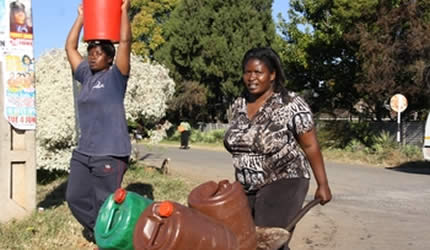
Mayor Muchadeyi Masunda said yesterday the Harare City Council requires US$20 million to upgrade its aging and crumbling water and sewer pipe infrastructure.
The CBD has gone for almost three days while some residential areas have gone for weeks without tap water.
Most areas such as Glen View, Glen Norah, Budiriro, Highfield, Kambuzuma, Avenues, Mabelreign, Bluffhill, Monavale, Avondale and Milton Park have been forced to resort to unprotected sources for water exposing themselves to waterborne diseases.
Angry residents have slammed the MDC-T run Harare City Council for failing to supply water.
A Glen View resident only identified as Ms Tawana said she had resorted to buying purified water at local shops which is very expensive considering that she has a big family.
“Imagine we are eight in my family and we all need water to drink everyday which we are buying in local shops and this situation is an unnecessary expense being thrown to me by the water woes,” she said.
A Mbare resident Ms Zodwa Magaisa said they have now resorted to Mukuvisi River for drinking water and laundry.
Read More . . .
The situation has become desperate and an outbreak of water borne diseases is looming.
Harare city spokesperson Mr Leslie Gwindi said the water shortages were a result of maintenance work in progress. “We are carrying out maintenance work on the old pumps that are bursting one after another at Morton Jaffray because of their old age, but we should expect to receive normal water supply soon after we finish our maintenance work any time soon,” he said.
Mr Gwindi said the water shortages have also been worsened by demand that has exceeded supply.
“People should know that water demand has exceeded its supply as the population in the city is always increasing and this increase in demand overloads our old pumps at Morton Jaffray and as a result the pumps are overwhelmed that’s why they are bursting from time to time,” he said.
City of Harare director of health Dr Prosper Chonzi said he was worried about the prevailing water crisis saying they were putting people’s lives at risk as they ended up fetching water from unprotected sources.
“The prevailing water woes are not even good at all as people end up drinking water from unprotected sources therefore exposing themselves to water borne diseases,” he said.
He said under normal circumstances, each person is supposed to have at least 20 litres of water per day for personal use but because of the prevailing water woes people are being forced to squeeze 20 litres for the whole family which is not normal.
“To create a health environment a person should use 20 litres per day unlike the prevailing situation whereby the whole family is using 20 litres for per day,” he said.
Meanwhile, speaking at a ceremony to commission two fire tenders which were donated by Mr Peter Lobels to the Harare Fire Brigade, Mayor Masunda said: “The Harare City Council requires a total of US$20 million. US$14 million is for pipe replacement covering 115 km through Harare, US$4 million dollars is for the engineers and US$2 million for pressure reducing valves.
“So far, we have issued out US$2 million for pipe replacement and US$20 million will replace pipes in the whole city of Harare.”
Pipes which were installed in the 1970s had reached the end of their effective life. The aging water and wastewater infrastructure has resulted in unreliable water supplies and inadequate wastewater treatment in the city.
The council spent US$12,5 million in 2009 to upgrade its water pipe infrastructure and has secured a grant from multilateral institution to improve water supply in the city.
Aging infrastructure illustrated what some see as the failure by local authorities to invest in replacing infrastructure or to undertake regular replacement programmes.
Deferred maintenance has brought untold hardships to city residents who in some parts were going for several months without water.
Eruptions of water mains or sewer lines have angered residents and brought into focus the failure by local authorities to maintain infrastructure. The council is now relying on private setor support to maintain its assets and to enhance service delivery.
Mr Lobels donated fire tenders worth US$300 000 to enhance the city’s fire unit, cement manufacturer Lafarge refurbished a city ambulance while Delta Beverages pledged to refurbish the city’s emergency fleet.
Retail chain store, OK Supermarket, donated US$50 000 to the fire department for the maintenance of broken trucks.


 Online Reporter