Online Reporter
IT IS now 62 years to the day when revolutionary men and women huddled together in Addis Ababa, Ethiopia, for a consequential indaba that was presided over by Emperor Haile Selassie for the express purpose of establishing the Organisation of African Unity (now the African Union), which ultimately became a Pan-African bulwark against colonialism and a rallying point in the decolonisation of the continent.
Among the men gathered in Addis were six nationalists from our teapot-shaped country — Joshua Nkomo, Ndabaningi Sithole, Robert Mugabe, Jason Moyo, Leopold Takawira and Washington Malianga — whose mission was to canvass for moral, material, financial and logistical support to overthrow the racist and exploitative white minority regime in the then-Southern Rhodesia.
Remember, the host country, Ethiopia, was an inspirational symbol of African military might and resistance after it decisively vanquished the Italian army and its Eritrean askaris at the Battle of Adwa (March 1, 1896) during the Abyssinian War (First Italo-Ethiopian War).
They say this victory of the Ethiopian army, led by Emperor Menelik II, particularly at a time when colonialism was beginning to take root on the continent, was one of the major defeats of a European army by an African fighting force.
One of the major outcomes of the Addis Ababa Conference that founded our continental body was the formation of the OAU Liberation Committee led by Tanzanian Brigadier-General Hashim Mbita, which was to play a major role in the prosecution of our liberation struggle(s).
The young ones must never forget that it was the establishment of this institutional body that progressively led to the defeat of colonialism and the concomitant independence of African states.
The AU, therefore, stands as a timeless and enduring reminder that unity is strength.
A turning point for Zimbabwe
It will, however, be remiss for Bishop Lazi not to mention the schism that was developing among our nationalists as they convened in Addis Ababa in May 1963.
By that time, two nationalist movements had already been banned by the Rhodesians — The National Democratic Party (NDP), launched on January 1, 1960, was banned on December 9, 1961; while the Zimbabwe African People’s Union (ZAPU), which had risen from the NDP ashes on December 19, 1961, was outlawed on September 20, 1962.
While Nkomo, as the leader, still believed that independence could be achieved through peaceful means, most of his fellow comrades were convinced that only through force of arms could the colonialists and colonialism be upended.
These differences climaxed in Ethiopia.
The Bishop will let Nkomo tell the tale in his own words.
“The OAU offered us a splendid opportunity to gain the attention of the world’s press, and our press conference was booked for 2pm one day, the best time for the news media throughout Africa and Europe,” Nkomo was to write in his autobiography “The Story of My Life”.
“Our publicity committee had already agreed on a formal statement on the case for Zimbabwean independence, which I was to read before answering questions. The typing and copying of the statement as a press handout was the responsibility of the publicity secretary, Robert Mugabe.
I arrived with one-and-half hours to spare to get ready and prepare the answers to likely questions — but by the time the journalists arrived, neither Mugabe nor the copies of the statement were available. I had to make some impromptu remarks and apologise for the lack of the press statement that had been promised.”
Kikikikiki.
As it later turned out, this was just the beginning of birth pangs for another formidable liberation movement, ZANU, which was subsequently launched on August 8 later that year at Enos Nkala’s house in Highfield.
Within two days of its formation, Nkomo announced the formation of the People’s Caretaker Council (PCC) at Cold Comfort Farm near Salisbury (now Harare).
He maintained that the PCC was to all intents and purposes ZAPU.
Its content and character remained the same as the party that had been banned in 1962.
All these events in 1963 materially shaped our liberation struggle and politics.
So, Africa Day, which we commemorate today, holds immense significance to us.
A luta continua (the struggle continues)
Yes, the OAU did achieve its mission by accomplishing the decolonisation project.
However, we have not fared well as a continent when it comes to lifting our people out of poverty and improving the quality of life of our citizens, be it through world-class infrastructure, service delivery and the pursuit of happiness.
They say 60 percent of people on the continent live in poverty, with extreme poverty rates being embarrassingly high in most sub-regions, except North Africa.
They say for a continent where youths constitute the bulk of the population, unemployment among this demographic, at 25 percent, still remains worryingly high.
They also say 85 percent of Africa’s population faces food insecurity, which is made worse by inefficiencies in agriculture and the growing scourge of climate change.
It is further claimed that 600 million people on the continent — about half the population — lack access to electricity.
This is sobering.
How can we even begin powering ourselves out of poverty when we spend inordinate hours of the day without electricity?
Instructively, the first two critical epochs in modern history — the First Industrial Revolution (1765-1870) and the Second Industrial Revolution (1870-1914) — were driven by the discovery of steam power and electricity, respectively, while the Third Industrial Revolution (post-1960s) and ongoing Fourth Industrial Revolution were, and are, being spurred by digital technologies and automation, as well as artificial intelligence and the internet of things, among other innovations.
Without electricity, we are woefully lagging behind on most, if not all, these fronts.
Again, without the control of the primary means of production, which is the land, out of which all agricultural produce and minerals come from, we can forget about achieving any meaningful development.
Little wonder that scions of white settlers who occupied our rich agricultural lands and multinational corporations that are rapaciously feasting on our mineral wealth continue to grow obscenely wealthy, while ordinary wananchi, under whose feet our minerals are mined, remain dirt poor.
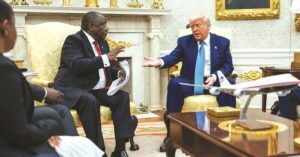
This, folks, explains the cringeworthy and disgusting optics that we were subjected to from the Oval Office in the past week when Donald Trump, in his usual grotesque contortion of diplomatic etiquette, unashamedly did the bidding of white Afrikaner farmers in South Africa by fantastically claiming there was a genocide against them that was underway.
Clearly, Washington, now with the prodding of South Africa-born plutocrat Elon Musk, has been ratcheting up diplomatic pressure and threats against Pretoria ever since the signing of the Expropriation Bill — which allows for the expropriation of land without compensation in certain instances — on January 23 this year.
But forget the drama, the recent developments at the meeting with South Africa’s Cyril Ramaphosa should be described for what they were: A chilling chastisement or warning against all those countries that might even flirt with the idea of reclaiming land that was taken over by colonisers.
Thank God Zimbabwe has since undergone this historic and seismic shift by restoring land to its rightful owners.
As Bishop Lazi writes this, the majority of our smallholder tobacco farmers, who contribute the bulk of the deliveries, are reaping handsome rewards from working the land. You see, we are creatures whose lives are inextricably linked to the land.
Genesis 3 verse 19 tells us: “By the sweat of your brow you will eat your food until you return to the ground, since from it you were taken; for dust you are and to dust you shall return.”
And out of the land also comes riches.
Deuteronomy 11:8-14 says: “You shall therefore keep the whole commandment that I command you today, that you may be strong, and go in and take possession of the land that you are going over to possess, and that you may live long in the land that the Lord swore to your fathers to give to them and to their offspring, a land flowing with milk and honey.
“For the land that you are entering to take possession of it is not like the land of Egypt, from which you have come, where you sowed your seed and irrigated it, like a garden of vegetables. But the land that you are going over to possess is a land of hills and valleys, which drinks water by the rain from heaven, a land that the Lord your God cares for.”
Way forward
After reclaiming our land, we have already made a significant head start.
Increased output in agriculture has already begun enriching our people by boosting their incomes and improving their living standards.
On the power generation front, President ED has made commendable headway through spearheading the construction of Hwange Units 7 and 8, which are underpinning current local power generation.
He has also broken ground on the US$1 billion Titan New Energy power project in Hwange, which is expected to generate close to 1 000 megawatts.
There is, however, need to aggressively expedite the floating solar power plant at Kariba and other power projects in wind and gas. But, as ED has always observed, leveraging technology can leapfrog our development. This entails computerising and connecting the Government to eliminate corruption and waste, efficiently deliver services and promote accountability.
Technology has the welcome impact of making things readily and conveniently available and, in most cases, for free.
There is no reason for our people to queue for basic services in 2025 when e-services have become ubiquitous around the world.In an age where the frontiers of technology continue to advance, with artificial intelligence changing the world at breakneck speeds, our systems, operations and services are unhelpfully laborious, manual and suspiciously murky.
It is a handicap that ED has continued to highlight and which needs urgent attention.
Accelerating the development and absorption of technologies will help spur development in Zimbabwe and beyond.
Through the OAU, our forebears showed us that it was possible to achieve political independence; through the AU, we must push to ensure prosperity of the continent.
It is our generational duty.
Africa must prosper now!
Bishop out!



 Online Reporter