malvernmugadzikwa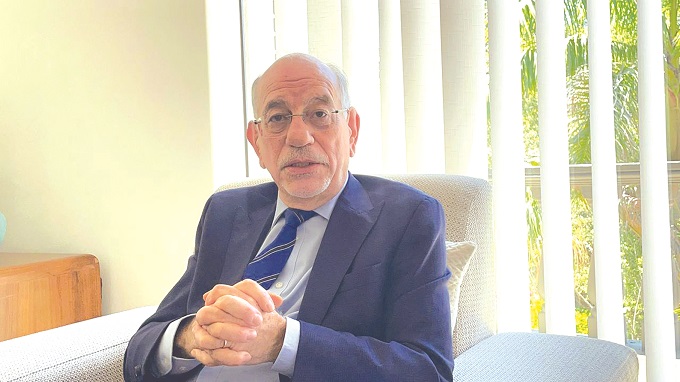
OVER the past few years, bilateral relations between Zimbabwe and Brazil have continued to grow. Brazil, which is the fifth-largest country in the world by area and the seventh most populous, celebrated its Independence Day on September 7. The Sunday Mail’s TANYARADZWA RUSIKE recently talked to Brazilian Ambassador to Zimbabwe VILMAR ROGEIRO COUTINHO JR on the current state of bilateral relations between Harare and Brasilia.
**********************
Q: Can you outline the state of bilateral relations between Zimbabwe and Brazil?
A: Our relations are transforming. Things are moving and changing. In March this year, we had a visit to Zimbabwe by Brazil’s Secretary for Africa and the Middle East in the Ministry of External Affairs, Ambassador Carlos Duarte. He engaged Zimbabwe on several important issues that will make our relations move forward. More recently, I had the opportunity to welcome two important Brazilian delegations for the Zimbabwe Agricultural Show (ZAS). One was a delegation from the sugar and ethanol sector, visiting Zimbabwe for bilateral talks. I have been working in this country for two years now and feel extra motivated to contribute to enhancing bilateral relations between Brazil and Zimbabwe.
I shall hopefully stay for two or three more years in Harare and give my contribution to the efforts to bring our two countries closer. Brazil stands in solidarity with Zimbabwe in the promotion of its social and economic development. Given the potential for our bilateral cooperation, we are still beginning; we still have a lot before us to do.
Q: What is the current state of bilateral trade between the two countries?
A: Historically, and for several reasons, Brazil and Zimbabwe have recorded low levels of trade, rarely going above US$10 million or $20 million annually, with some occasional jumps in isolated years, for instance, when Embraer planes were sold to Air Zimbabwe. However, slowly but surely, things are beginning to change.
By August this year, we had already reached US$6 million in Brazilian exports to Zimbabwe. We hope that this year we exceed US$10 million.
This year, imports into Brazil from Zimbabwe are also on the rise, in tobacco products and ferrochrome from the iron and steel industry.
Q: What areas of cooperation are flourishing between the two countries?
A: It is the agriculture sector. It is important to understand that we do not view Zimbabwe as a market for our agricultural products. Yes, we can occasionally sell agricultural products directly to Zimbabwe. This year, there were some imports of maize because of the drought.
What we view here is a market for our agricultural machinery, implements and equipment.
The delegation which came here to visit ZAS came for that. We established many contacts with local companies.
We had meetings with the Zimbabwe Commercial Farmers Union and the Ministry of Agriculture, and we talked about many projects that can be thought of for the future. We discussed sales of agricultural machinery from Brazil to Zimbabwe. There are some opportunities and commercial conversations already taking place.
We hope to be able to supply agricultural machinery here. Also, we deliberated on whether we can replicate here in Zimbabwe an experience which has been very successful in Brazil: The setting up of service centres to support small farmers.
If a small farmer has a very small plot, sometimes it may not be economical for him/her to buy a machine. Instead of buying a machine, what the farmer can do is resort to this service centre with all the machinery and implements.
There will also be technical assistance.
The small farmer would pay the service centre to render its services using the machines and equipment. This is an idea which has been very successful in Brazil that we want to replicate here.
There was a lot of talk about Zimbabwe needing technical assistance and also equipment for irrigation, coupled with solar energy.
We also have our people who are supporting irrigation here. The idea is that we are organising to send a technical mission here — if possible, this year — to make a sort of a diagnosis of the needs for irrigation equipment and systems by small farmers.
The team could arrive in November or early next year. Then, after we have this diagnosis, we will see what arrangements can be made for us to supply the necessary equipment here.
So agricultural machinery is an area of cooperation that is flourishing between the two countries.
There are also other things. For instance, among the contacts we had here, there were people interested in importing genetic material from Brazil to increase milk production.
Zimbabwe has also benefitted from Brazilian technical cooperation projects in cotton and cattle production. These are now in their final stages and should be completed mid-next year. The Brazilian government remains open to discussing any further requests for assistance that might be of interest to Zimbabwe.
Q: How have Brazilian investors responded to the “Zimbabwe is open for business” call?
A: Brazilian investors are trying to explore what the opportunities are, particularly in the ethanol sector.
Q: The Zimbabwe Sugar Association recently signed a memorandum of understanding with the ethanol cluster of Brazil. What is the significance of this in improving the competitiveness of the sugar sector in Zimbabwe?
A: Recently, we had this visit by a group of representatives of the sugar and ethanol industry from Brazil. This was the first visit by a Brazilian group here to Zimbabwe under this memorandum. There was a visit to Brazil last year by a delegation of the Zimbabwe Sugar Association and now these people came here.
So, the cooperation has started, it’s moving in this sector. And this memorandum of understanding is the basis on which we are working. A number of actions were discussed here. There will be further exchanges, further missions from Brazil . . . This is a programme of cooperation which has started, and it’s going on very well. People from the Zimbabwe Sugar Association seem to be very happy with the results achieved so far. We are going ahead.
Q What are the mechanics of this deal?
A: We discussed with the Zimbabwean side; we told them, well, you see, what happens is that in Brazil, there is no longer a sugar industry. Now, what exists is a dual industry, which produces sugar and ethanol. It’s an integrated industry which produces both products as their final products. There are no longer in Brazil sugar mills which only produce sugar. So, obviously, this was achieved with time, with developing technology and techniques and several things. This is the key issue here because here in Zimbabwe, the sugar industry is still pretty much a sugar industry and not a dual industry operating on both markets.
Our cooperation is aiming at enabling the Zimbabwean sugar sector to achieve this point in which they would be producing both products as their final products, one being a by-product of the production of the other.
This is very interesting because, as I said, the technology was developed in Brazil and we are willing to transfer this development here, coupled with obviously commercial operations like the sale of our industrial equipment for the mills, for the distilleries for the ethanol production. This is what we want to help Zimbabwe with.
Ethanol is not a product that you produce and then take to the market and sell it. Ethanol is something which helps to improve, to protect the environment, to reduce gas emissions and it’s basically a fuel.
Therefore, it’s not just a common product that you put on a shelf.
What I mean by that is, it is no use if Brazil comes here and helps the Zimbabwean sugar industry, and the Zimbabwean sugar industry then learns and achieves the point in which to be a dual producer of sugar and ethanol, but if the Government has not put in place an appropriate policy to support the use of ethanol, this will not work.
One thing is being able technically to produce it; the other is that you need the right conditions to create an ethanol market, otherwise, the effort will not be useful.
So, an important part of the discussions was that there were people from the Government, from various ministries, also involved in these discussions.
Q: Can you outline Brazil’s position on Zimbabwe’s engagement and re-engagement drive?
A: We are very happy that Zimbabwe is embarking on this engagement and re-engagement effort and we are open to cooperating and helping as much as we can. So, we don’t have to judge whether this is right or wrong. This is a policy decided by the Zimbabwean Government. If we are to have a position about it, it is to support, try to help and see what we can do and use this strategy to improve relations between the two countries.



 Online Reporter