

 Online Reporter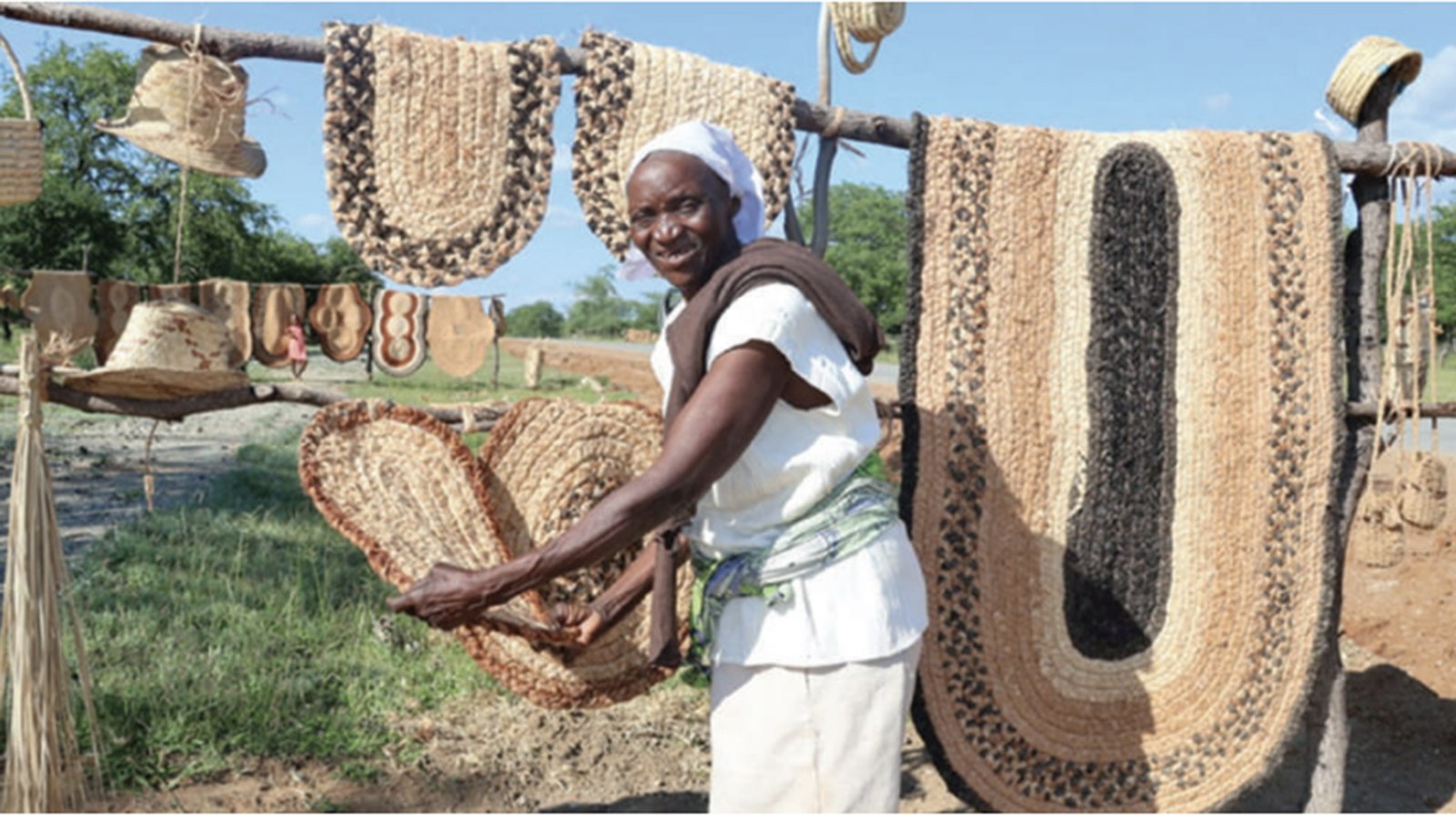
Theseus Shambare
Features Writer
FOUR decades of weaving have taught Collerta Mharadze that survival can be shaped by patience.
She has raised children and grandchildren from what nature gives, not by cutting forests, but by listening to them.
As she sits quietly by the roadside along the Mutare–Masvingo highway, Collerta is grateful to the trees, the grasses and the seasons that have sustained her life.
“At my age, these hands have done everything,” said the 70-year-old from Nechikwira Village under Chief Muusha in Manicaland.
“They fed my children, paid school fees and carried this family through years when the rains did not come,” she added, her fingers tightening a strand of palm grass into a perfect curve.
Collerta began weaving in the early 1980s, learning to shape baskets, mats and household artefacts from palm grass, bamboo and wild reeds gathered from nearby wetlands and hillsides.
“When the fields failed us, this work never failed,” she said. Her baskets are not rushed products of lack but carefully balanced objects of symmetry and beauty, shaped slowly in rhythm with the land.
“What we take from the forest must grow again,” Collerta said, pausing briefly. “If it does not return, then tomorrow our children will suffer.”
Collerta said she was taught never to remove baobab bark in a complete ring, but to peel narrow vertical strips from one side of the trunk and then leave the tree untouched for years so it can heal naturally.
“If you go around the tree, you kill it,” she said.
“But if you go up and stop, the bark closes again. This was the lesson I got from my mother when I was still young.”
Forestry scientists explain that baobabs survive such careful harvesting because their bark is fibrous, elastic and capable of regenerating, unlike timber trees that die when girdled. According to a study by the International Centre for Research in Agroforestry (ICRAF) titled “Baobab (Adansonia digitata L): A review of Traditional Uses, Phytochemistry and Pharmacology” by Dr Gerald Wickens and Dr Patricia Lowe, the baobab’s spongy trunk stores large volumes of water and nutrients, enabling it to recover from bark loss and survive prolonged droughts. Researchers note that baobab trees can live for 500 to more than 1 000 years, making them among the longest-living flowering trees in the world.
“This tree is built to survive harsh conditions,” said Dr Wickens.
“That resilience is why, when harvested correctly, baobab bark regenerates without killing the tree.” Collerta said this knowledge has been passed down through generations, long before it was explained in scientific terms.
“Our elders said the tree is alive like a person. That is why the baobabs we used when I was young are still standing today,” she said.
That principle, practised instinctively by Collerta, echoes across Nyanyadzi and Gudyanga areas along the Mutare–Masvingo highway, where roadside stalls of woven mats, baskets and hats are a familiar sight. Towering above this dry landscape is the baobab tree, one of Africa’s most distinctive and resilient indigenous species and a silent pillar of rural survival in Chimanimani District.
“For us, the baobab is not just a tree. “We grew up eating mauyu, during droughts and even when there was food,” said Brain Mutindori, a villager from Nyanyadzi.
Mutindori said the baobab fruit pulp sustained families during repeated droughts, while its fibrous bark enabled households to earn income through crafts without felling trees.
“The baobab has always fed us,” he said. “It feeds us with fruit, with fibre and even with shade.” Beyond food and crafts, baobab trees in the area serve as ritual sites, water storage points and cultural landmarks, embedding conservation within belief systems.
Traditional leaders say such cultural attachment has shaped unwritten rules that govern how bark is harvested and when.
“We do not allow complete debarking,” said Sabhuku Nechikwira. “You remove strips, then you leave the tree to heal.”
He insists that long-established craft communities have protected baobabs for generations and that most environmental damage comes from outsiders chasing quick profit.
According to the Forestry Commission of Zimbabwe, non-timber forest products such as baobab fruit, fibre and seed oil support the livelihoods of more than 1,3 million rural Zimbabweans, most of them women.
“Trees like baobab are strategic to climate adaptation,” reads the 2025 report by the Forestry Commission. “When communities earn from trees without cutting them, forests are protected.” Zimbabwe loses an estimated 330 000 hectares of forest annually, largely due to fuelwood harvesting and illegal logging.
In Nyanyadzi, commercialisation has transformed baobab products into cash commodities, with fruit pulp supplying urban food industries and seed oil exported to South Africa’s cosmetic sector. Yet rising demand has also brought environmental concern.
“I am worried about the wanton destruction of baobab trees in some areas,” said Zimbabwe National Tree Planting Ambassador Never Bonde.
“We need stronger controls and deterrent penalties to protect these indigenous species.” Craftswoman Chioniso Mwabhuyangeyi, who has woven baobab fibre mats since 1997, agrees sustainability matters but says livelihoods must remain central. “This work built my five-roomed house.
But after Covid-19, business collapsed and many people were forced into mining,” she said. Mwabhuyangeyi recalled how roadside markets once thrived on tourists and long-distance travellers.
“Since the lockdowns, sales have never fully recovered,” she said. Others, like Takesure Gudyanga, earn income by processing baobab fibre and selling it to craftsmen locally and abroad. “I de-bark carefully and soak the fibre for a week,” Gudyanga said.
“Before Covid-19, I sold more than five bundles every day.” Collerta and these baobab-dependent communities demonstrate that sustainable forest management often exists without formal labels, rooted instead in lived necessity.
This principle stretches beyond Manicaland to Binga District in Matabeleland North, where forests sustain livelihoods through carefully managed woodcraft.
At Chemba Craft Centre along the Bulawayo– Binga road, drums, basins and carvings made from selected indigenous wood species greet passing motorists.
“We formed this centre in 1993, so harvesting could be controlled,” said a committee member under Chief Saba. “No one just cuts trees anyhow.” The centre, which has 20 members, sources timber communally and works within Forestry Commission guidelines to ensure regeneration.
Here, organised craft production acts as a buffer against illegal logging by creating value without forest destruction.
In nearby Siantungwani II Village, Mrs Notani Munkuli has spent more than 26 years harvesting palm grass near streams to weave baskets.
“Every summer I walk long distances with a sickle,” said the 48-year-old mother of four, showing scars on her hands.
“Sometimes I cut myself, but I must continue.” Despite decades of skill, Munkuli said challenges persist because producers rarely control markets.
“We exchange baskets for groceries or clothes. Middlemen take them to towns and sell them for a lot of money,” she said.
A Food and Agriculture Organisation (FAO) study on non-timber forest products notes that such resources contribute up to 40 percent of rural household income in semi-arid regions, yet producers capture the smallest share of value.
Binga baskets, woven using over-and-under techniques and finished with distinctive herringbone rims, can take up to three days to complete. “These baskets are not just products,” said a local elder.
“They are who we are.” Across Zimbabwe, from Manicaland’s grasses and baobab fibre to Binga’s regulated woodcraft, the principle remains the same: use without destruction.
Forestry Commission data shows that community-managed forests experience significantly lower deforestation rates than open-access woodlands.
“These women are practising sustainable forest management daily,” Bonde said. “They are our first line of defence.”
As climate change tightens its grip on rural livelihoods, such indigenous knowledge systems are increasingly relevant to national policy conversations.
Back in Nechikwira, Collerta finishes her basket and sets it aside, sunlight catching its tightly woven curves.
Her granddaughter, Emily, is now adopting social media platforms to market the wares. “I am teaching my granddaughter this work,” she said softly.
“These hands will not last forever.”
In her hands, grass becomes beauty, survival becomes dignity and forests remain standing. As long as those hands keep weaving, Zimbabwe’s forests still have a future.



