admin
admin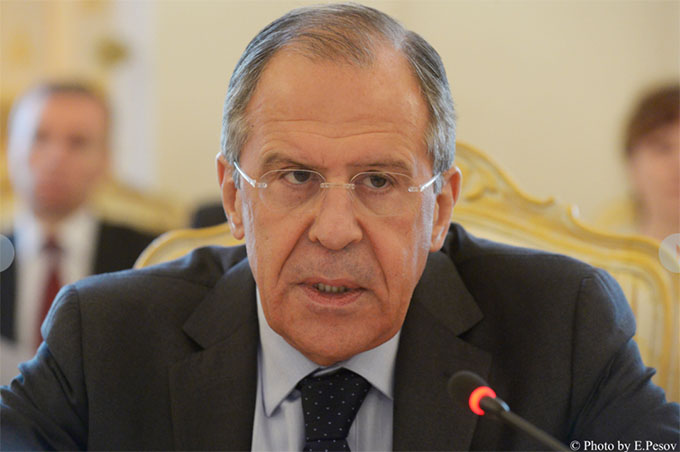
Foreign Minister Sergey Lavrov’s remarks at a news conference on Russia’s foreign policy performance in 2021, Moscow
President Vladimir Putin detailed policy-setting statements at the expanded meetings of the foreign and defence ministries’ collegiums, as well as at his annual news conference on December 23, 2021.
The situation has not improved. Conflict potential is building up, and our Western colleagues have largely shaped this trend.
Their policy consists of undermining the architecture of international relations based on the UN Charter, as well as replacing international law with their own “rules” and imposing them on others to build a new world order.
All kinds of international formats have been emerging on matters which have long been on the agenda of universal UN agencies.
These are narrow formats of like-minded countries who are cast as trail-blazers dictating “much-needed” new approaches to all others.
Those refusing to join these initiatives are labelled as reactionary countries seeking to impose a revisionist agenda in international affairs.
However, it is the West that currently promotes a revisionist agenda. It is the West that seeks to revise the UN Charter.
Russia and other nations who are our allies and strategic partners have been standing up for the UN Charter, its principles, purposes and structure to defend them from revisionist aspirations.
The most notorious project of this kind was the Summit for Democracy on December 9-10, 2021. The way Washington prepared this meeting, held it and announced its “outcomes” is a telling example of the policy line adopted by our American colleagues to bring ideology back into international relations (while we got rid of ideology in international affairs not that long ago) and draw new dividing lines.
The United States and NATO openly declared their goal of containing the People’s Republic of China and the Russian Federation. Attempts to artificially expand NATO and draw Ukraine into it continue unabated.
In December 2021, we sent two documents to the United States and NATO countries, and we also made them public: a draft treaty between Russia and the United States on security guarantees and a Russia-NATO agreement on security measures.
It is a package proposal aimed at precluding absolutely any further eastward movement of NATO and the deployment of threatening weapon systems near Russian borders.
Frankly, everyone knows that reaching an agreement depends on the United States. Whatever they are telling us about the need to consult with their allies and involve all OSCE members in the talks, those are excuses and attempts to drag out the process.
Russia’s position presented to the Americans and NATO is based solely on a balance of interests. These documents are aimed at ensuring security in Europe as a whole and in each country, including the Russian Federation.
The position of the United States and its allies is that they want to secure dominance in Europe and create military footholds around the Russian Federation and irritants for us along our borders.
When Russia and NATO were establishing relations, when they signed the Founding Act and reached a decision to establish the Russia-NATO Council – Moscow and the North Atlantic Alliance reached some political agreements in the process, which had to do with how we would behave in terms of the configuration of armed forces and weapons going forward – no one had to be consulted.
It never occurred to anyone.
Neither with the OSCE, nor with the European Union, which now gets bitter whenever it feels left out (as conveyed by Josep Borrell). This is a whole new topic for discussion.
The Western reaction has consisted primarily of a categorical rejection of ending NATO’s open door policy. But Russia is not bound by any agreements within NATO.
We, the Americans, Europeans, NATO members, and neutral states, are firmly bound by agreements and political commitments within the OSCE framework.
In this context, OSCE provides us with a legal framework solely because in the 1990s, an agreement was reached to the effect that undermining indivisible European security and strengthening one’s own security at the expense of others is unacceptable.
Those documents (in particular, the Charter for European Security signed at the highest level in 1999 in Istanbul) contain three components. Everyone shared them and signed off on them.
The first of them, which the West loves talking about now, is the right to freely choose how to ensure one’s own security, including treaties of alliance. After all, these documents say that each state has the right to be neutral.
This should not be forgotten, either. Then follows a paragraph that is an inalienable part of this compromise, notably, the agreement binding each state to respect the rights of other countries and not to bolster its own security at the expense of the security of others.
There is a special stipulation that no single state, group of countries or organisation can be primarily responsible for the maintenance of peace and stability in the Euro-Atlantic region and cannot view any part of it as a sphere of its influence.
We clearly outlined [our requirements] and provided detailed arguments on the need to focus on stopping the expansion of one block of countries at the expense of the interests of other states on the European continent.
I would like to point out that we need legally binding guarantees.
Our Western partners never honoured the political commitments they made in the 1990s, not to mention their verbal promises. It appears that they are not going to do this now either.
We clearly explained why this approach is counterproductive and why a lopsided interpretation of the political promises on NATO’s non-expansion and indivisible security is unacceptable. We will continue working to prepare for any eventuality.
During the five waves of expansion, NATO has come right to our borders. When we formalised our relations with NATO in 1997, Poland was the only candidate for accession.
Look at how the situation has changed since then. Moreover, all these territories are being actively militarised.
Our proposals are aimed at reducing military confrontations and de-escalating general tensions in Europe, whereas the West is doing the opposite.
NATO is building up its ground troops and aviation on the territories directly adjacent to Ukraine. Exercises in the Black Sea have grown in scale and frequency many times over in recent time.
We have heard blustering statements of late to the effect that if Russia does not obey Western demands on what to do with its own troops on its own territory (which is an absurd demand in its own right) the West will intensify the activities of NATO’s rapid reaction and special operation forces around our borders in the next two or three months.
Replying to your question, I will say that much has changed. The real configuration of weapons, military hardware and troops in Europe has changed.
We are faced with unacceptable demands to return our troops to their barracks on our own territory, while the Americans, Canadians and Brits have permanently deployed their troops in the guise of rotation in the Baltic states and other countries in the North of Europe.
Bases are being set up in the Black Sea. The Brits are building bases in Ukraine, in the Sea of Azov area. We are categorically opposed.
We are convinced that mutually acceptable solutions can be found when there is good will and readiness for compromise. I would like to remind you that in early 2021 the New START Treaty was extended for five years without any preconditions, just as the Russian Federation had proposed.
We appreciate that it was one of the first steps made by the Biden administration after it had assumed office.
During their meeting in Geneva on June 16, 2021, President of Russia Vladimir Putin and US President Joseph Biden agreed on the need to hold a dialogue on all issues of strategic stability and the weapon systems that have a bearing on it.
There was an important statement confirming the principle that a nuclear war cannot be won and must never be fought.
I am delighted to say that on January 3 the leaders of the five permanent members of the UN Security Council adopted a relevant joint statement on the inadmissibility of a nuclear war and on the nuclear-weapon states’ pledge to do everything in their power to prevent it.
This move will help to prepare a summit of the five nuclear states proposed by President Putin.
We cited the documents, including the Charter for European Security and other documents, which spell out the need to observe the indivisibility of security principle.
We made clear that we want to translate the political commitments that we all assumed into a legally binding form. Their answer said it all: legally binding security guarantees can only be granted to Alliance members.
This philosophy goes back on everything that has been done by the OSCE since the end of the Cold War, including the principle I cited that no Euro-Atlantic alliance has the right to dictate its will to everyone else.
We are aware that the West is betting on a scenario where the Americans can relieve themselves of the main responsibility for resolving these issues during the talks with us.
First, they will try to water it down in the Russia-NATO Council with the help of their own (I’ll use a more polite term) “comrades-in-arms.”
As for the OSCE, it is impossible to conduct any talks there in principle. If an organisation wants to host negotiations, it has to become an organisation to begin with, and this one doesn’t even have a charter.
We have been proposing to begin talks on such a charter for 15 years now in order for the OSCE to become a legal and internationally accepted statutory subject. We are told (primarily by the Americans) that the beauty of the OSCE lies in this “flexibility.”
We are strongly against NATO right on our borders, and all the more so given the policy that is, unfortunately, being pursued by Ukraine (both former and current leaders). Moreover, this is really a red line, and they are aware of it.
Even if Ukraine remains outside NATO, bilateral agreements with the Americans, the British, and other Western countries are always possible, and they are creating military facilities there and bases on the Sea of ??Azov, something we also find unacceptable.
Deploying attack weapons that pose a threat to the Russian Federation on our neighbours’ territories, in this case Ukraine, is another red line.
The EU has rushed there as well. We talked about the European Union and Ukraine. They are now actively promoting their plans to send a military training mission to Ukraine; that is, they also want to contribute to the training of, in fact, anti-Russia units.
More and more troops are being concentrated on the line of contact, including, as I understand it, their most combat-ready units – the “volunteer battalions” – which the West used to consider extremists, but does not any more.
Ukraine is moving its military across its territory, and has amassed an unprecedentedly large number of troops near the line of contact. But the West is not concerned about this. Instead, it is concerned about what Russia is doing on its own territory.
But Russia has never, not once, anywhere, either publicly or behind closed doors, threatened the Ukrainian people whereas Mr Zelensky and his associates are doing so directly. I gave the example of Zelensky asking the Russians to get out of Ukraine.
This is a direct threat. What if he seriously decides to use the Ukrainian armed forces that have amassed there to drive the Russians out?
We are working in the Western vector and are active in other areas of Russian foreign policy. In 2021, integration cooperation was developing within the EAEU, and the integration process within the framework of the Union State of Russia and Belarus was being strengthened.
This helped to promote President Vladimir Putin’s initiative to form the Greater Eurasian Partnership.
In this context, we were developing relations with partners in the Asian continent. We celebrated the 20th anniversary of the Treaty of Good-Neighbourliness, Friendship and Cooperation between Russia and China.
We were promoting the specially privileged strategic partnership with India, and with the majority of partners in the Asia-Pacific Region (APR), as well as with states of Africa and Latin America.
In the APR, we were focusing on active ties with member states of ASEAN in the context of forming the Greater Eurasian Partnership.
We made the most of opportunities for constructive dialogue as provided by such associations as the G20, BRICS, and the SCO.
We were involved in the work to help settle various conflicts (Nagorno-Karabakh, Syria, Afghanistan, Libya), the Iranian nuclear programme, the Palestinian-Israeli affairs, the situation on the Korean Peninsula and other hotspots.
In this context, I would like to note the mission performed by the CSTO peacekeeping forces (the residual matters are being addressed).
Following a request from President of Kazakhstan Kassym-Jomart Tokayev, the peacekeepers helped to remove a clear terrorist threat that sprung up in the territory of Kazakhstan not without outside influence.
We were focusing on providing diplomatic support to the effort to fight the Covid-19 pandemic and its consequences.
The Sputnik V vaccine was registered in 71 countries. In our contacts with foreign partners, we continue to explain the obvious practical importance of President Vladimir Putin’s initiative on the reciprocal recognition of national vaccine certificates, which he put forward at the G20 summit on October 30-31, 2021.
Agreements of this kind have been reached with a number of countries.
In 2022, we will continue to work in all these areas. We will defend the central role of the United Nations and the need for a strict regard for international law as it is enshrined in the universally coordinated and accepted documents, this without attempts to break it up into separate articles and interpret them in order to please just one group of countries.
We will fight terrorism and cybercrime. Important decisions on this score have been made over the past year at the UN and in other formats. We will support and promote the Russian World’s consolidation as a multi-ethnic and multi-religious movement.
We will continue to keep matters such as freedom of expression and equal access to information under special review.
In the last few years, President of Russia Vladimir Putin has focused on strengthening Russian sovereignty. We are seeing the attacks the West is making on the sovereignty of Russia and many other countries that pursue a more or less independent policy.
These are hybrid attacks, as they say nowadays, in all areas, direct military deterrence (we have already discussed Russia-NATO relations), aggressive information campaigns, the use of soft power mechanisms for improper purposes, and NGOs that are directly financed by the state, to name a few.
Such concepts may work in some countries but Russia finds them completely unacceptable.


 Online Reporter