admin
admin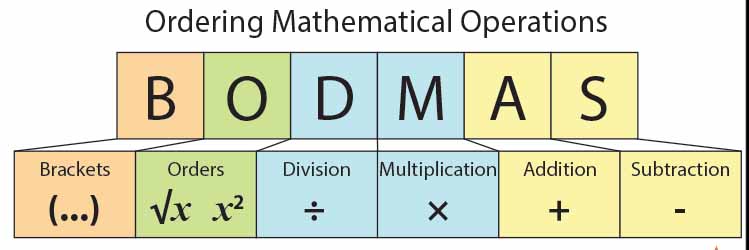
BODMAS is an acronym to help children remember the order of mathematical operations — the correct order in which to solve maths problems.
BODMAS stands for:
Brackets
Orders
Division
Multiplication
Addition
Subtraction
What is the BODMAS rule
The Bodmas rule states that division and multiplication must be done before addition and subtraction in any mathematical example.
And if there are brackets (or parentheses) and orders (of powers or roots), these must be done first of all.
For example in the question 47 + 54 ÷ 9, the answer is 53 and not 11.2r.
The BODMAS rule follows the order of the BODMAS acronym ie B — Brackets, O — Order of powers or roots, D — Division, M — Multiplication A — Addition, and S — Subtraction.
Mathematical expressions with multiple operators need to be solved from left to right in the order of BODMAS.
Division and Multiplication are considered as interchangeable and depend on which comes first in the expression, as are Addition and Subtraction.
BODMAS meaning
When presented with a number sentence containing more than one operation (such as 3 + 4 x 2), the operations cannot be completed from left to right, but instead in their order of “importance”, which is what BODMAS stands for.
“Orders” means square roots and indices (which you may know as square numbers, powers or exponents).
What does order of operations mean?
This is the order in which certain operations must be completed, from brackets (also known as parentheses) first to addition and subtraction last.
It is important that division and multiplication are represented alongside each other as they are of equal importance (so must be completed from left to right, whichever appears first) — this is the same for addition and subtraction.
BODMAS examples
Below are some examples of BODMAS questions and answers children might see in schools.
We’ve given you the right answer and at least one different answer to show you where children might go wrong.
BODMAS (BIDMAS) Questions and Answers
Question 1: 6 + 2 x 7
The correct answer is 20.
The multiplication must be completed first (2 x 7 = 14) and then the addition (6 + 14 = 20).
This may be commonly miscalculated as 56 by working from left to right (6 + 2 = 8, 8 x 7 = 56).
Question 2: 3 x (2 + 4) + 52
The correct answer is 43.
The BODMAS rule states we should calculate the Brackets first (2 + 4 = 6), then the Orders (52 = 25), then any Division or Multiplication (3 x 6 (the answer to the brackets) = 18), and finally any Addition or Subtraction (18 + 25 = 43).
Children can get the wrong answer of 35 by working from left to right.
Question 3: 5 – 2 + 6 ÷ 3
The correct answer is 5.
The division must be completed first (6 ÷ 3 = 2) which then leaves addition and subtraction; as both are of the same importance, we can then work from left to right.
5 – 2 + 2 (the answer to 6 ÷ 3) = 5.
This may be commonly miscalculated as either 3 by working from left to right, or as 1 by wrongly assuming that addition should be completed before subtraction. — thirdspacelearning.com.


 Online Reporter