
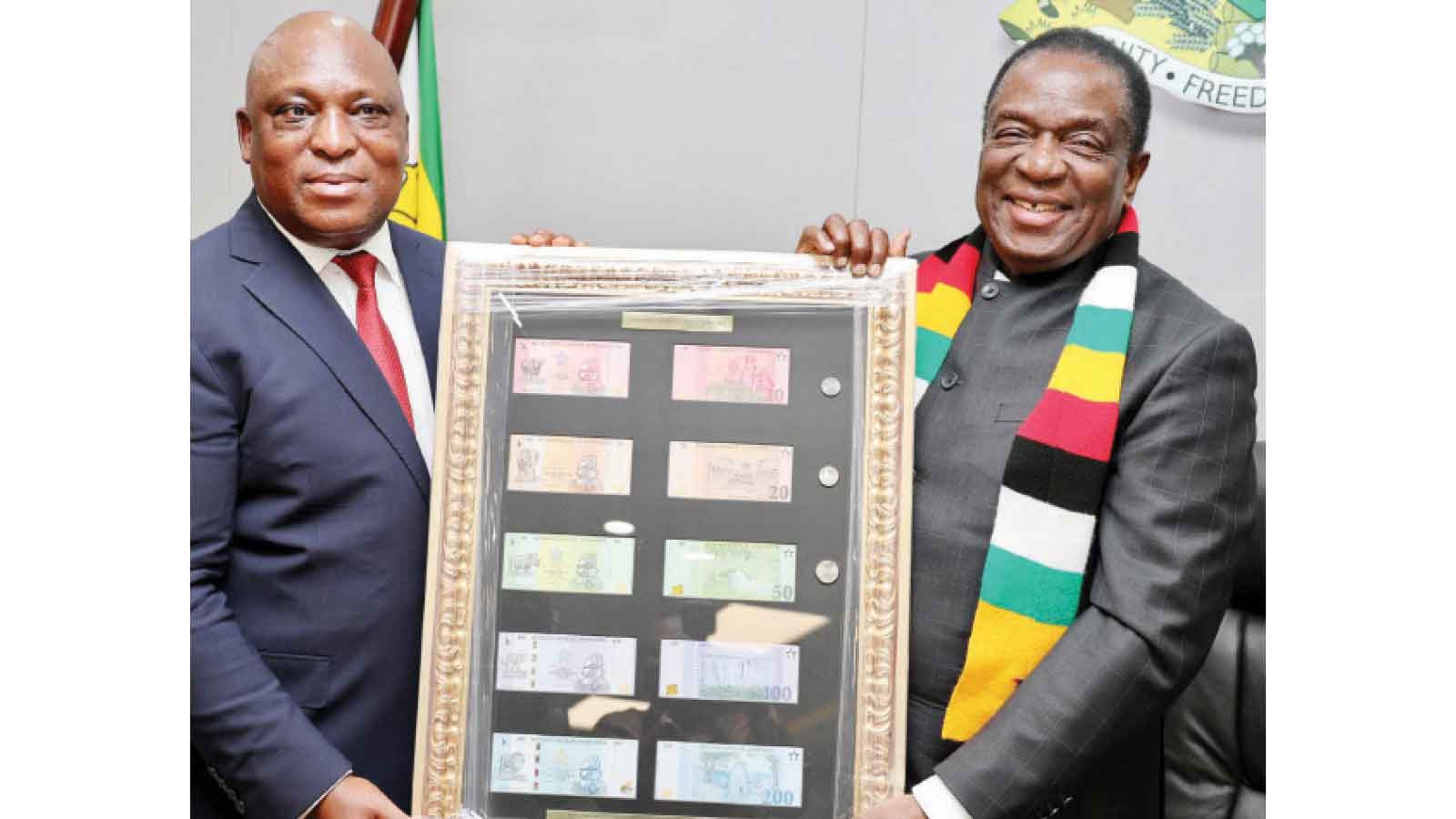
Dr John Mushayavanhu
The transition to the exclusive use of Zimbabwe Gold (ZiG) for settling all domestic transactions will be a gradual process anchored in macro-economic stability.
AS such, the transition is not date-based but is dependent on the achievement of the conditions precedent (CPs).
From the cross-country experiences with migration to mono-currency, the following conditions precedent are key to a successful transition to mono-currency:
Durable macroeconomic stability, characterised by low and stable inflation at single-digit levels.
Evidence from international and regional experience shows that inflation above single digits is inimical to growth.
In this regard, a low and stable inflation environment supports greater predictability, which is critical for planning, investment and inclusive growth.
Realising the importance of a single-digit inflation level, regional economic blocs such as the Southern African Development Community (SADC), the Common Market for Eastern and Southern Africa (COMESA) and the African Union (AU) have set a macro-economic convergence criterion for an inflation target range of between 3 percent and 7 percent.
Adequate foreign currency reserves of at least three to six months of import cover in the medium to long term.
Imports play a critical role in supporting economic activity by providing raw materials for production and finished goods, and empirical evidence supports a positive relationship between imports and economic growth.
Substantial shocks, emanating from domestic and external factors affecting imports, can have significant negative effects on the economy, leading to internal and external imbalances.
As such, adequate foreign currency reserve buffers are essential to ensure the stability of imports to sustain the economy in the event of a shock.
International and regional benchmarks for foreign currency reserves are between three and six months of import cover.
This means that the country can sustain imports for three to six months even if there are no foreign currency inflows.
Importantly, this guarantees the stability of the exchange rate in the short to medium term.
Stable exchange rate dynamics with minimum overvaluation/undervaluation of ZiG.
A stable exchange rate is critical in supporting production, efficiency and competitiveness of the country.
Significant exchange rate misalignment, characterised by overvaluation or undervaluation of the real exchange rate, is detrimental to economic activity.
For instance, exchange rate overvaluation results in imports becoming relatively cheaper, thus negatively impacting the productive capacity and causing an influx of imported goods.
Further, greater exchange rate variability results in currency substitution, where economic agents transact and save in foreign currency.
A stable exchange rate is, therefore, important in ensuring stable prices by reducing the exchange rate pass-through to inflation.
Efficient forex (FX) management system that promotes ease of access to foreign exchange by importers.
Availability of foreign currency for importation of raw materials and capital goods is important to support overall macroeconomic stability.
As such, an efficient FX management system ensures easy access to foreign currency at a market-determined exchange rate, thereby stimulating domestic production.
Increased demand for the local currency (ZiG) — recalibration of the percentage of Government taxes and broadening the payment of public sector goods and services in the local unit.
As the largest economic agent, Government’s demand and supply have an economy-wide impact, transcending all sectors and markets. As a result, the recalibration of Government taxes and payments will steer the rest of the economy towards the increased use of ZiG.
Financial sector stability is important to guarantee macroeconomic stability.
In addition, the financial sector plays an intermediary role critical to supporting savings, investment and growth.
Generally, instability in the financial sector erodes confidence in the formal banking system and trust in the domestic currency, resulting in pervasive informalisation.
Efficient and secure National Payments System (NPS) to promote ease of payment in ZiG locally.
An efficient and secure NPS enables transactional convenience and promotes the use of electronic means of payment.
Increased use of electronic means of payment supports more efficient revenue collection, minimises leakages and supports financial inclusion.
Fiscal and monetary policy cohesion with non-monetisation of the budget.
Monetisation of the fiscal deficit results in excessive money supply growth, ultimately leading to high inflation and exchange rate volatility, which could trigger significant macroeconomic instability.
In this regard, the main aim of the CPs is to take a market-led approach based on the restoration of market confidence and trust, as well as monetary policy credibility.
Milestones achieved
The country is on course to meet the conditions precedent, as evidenced by sustained single-digit inflation.
Important to note is that the country has already achieved most of the CPs and has made significant progress towards achieving the remaining ones.
The following are milestones achieved on CPs:
Inflation has been sustained within single-digit levels since January 2026, with annual ZiG inflation averaging 4,4 percent for the first six months of 2026.
Inflation is expected to remain low and stable within single-digit levels in the medium to long term.
In this regard, the first CP on low and stable inflation has been met, and the Reserve Bank only needs to sustain it to make the stability durable.
The adoption of a market-determined exchange management system engendered an efficient foreign exchange trading system under the willing-buyer, willing-seller (WBWS) arrangement.
The willing-buyer, willing seller market accommodates all economic agents with bona fide foreign payments and, currently, all foreign payments are being honoured, thus ensuring the market clears at all times.
In addition, the Reserve Bank is finalising the development of an automated foreign currency trading system, with the assistance of the World Bank, to be launched in the fourth quarter of 2026.
The exchange rate has remained relatively stable, oscillating between ZiG26 and ZiG27:US$1 since 2025.
In this context, the fourth CP on an efficient foreign currency system has been met and needs to be sustained to become durable.
The real effective exchange rate has been estimated as being closer to its equilibrium since the beginning of January, thus eliminating significant overvaluataion or undervaluation of the exchange rate.
Moreover, the parallel market premium has been contained below 20 percent during the first half of 2026.
In this context, the third CP on stable exchange rate dynamics has been met and only needs to be sustained to become durable.
In terms of financial sector stability, the banking sector has remained safe and sound, with adequate capitalisation, satisfactory asset quality and high liquidity buffers.
In this context, the sixth CP has already been met.
The National Payments System remained efficient, with an average uptime of about 98 percent, catering for both ZiG and US-dollar transactions.
Additionally, the National Payments System has had no reported incidents of cybersecurity breaches and loss of value to market participants.
In this context, the seventh CP has been met.
Reflecting enhanced monetary and fiscal complementarity, there has been zero central bank financing of fiscal deficits since April 2024.
CPs in progress
The two CPs that are yet to be met and are in progress are on the adequate foreign currency reserves and on the increased demand for the local currency.
The country is on course to meet the critical conditions precedent for adequate foreign currency reserves as measured by the import cover.
Foreign currency reserves stood at US$1,6 billion as at the end of June 2026, equivalent to 1,6 months of import cover.
The Reserve Bank expects to reach between 1,7 to 2 months of import cover by the end of 2026, which is close to attaining the minimum threshold of three months’ import cover.
The country is also on course to meet the CP on increased demand for the local currency.
The demand for ZiG has been on an increasing trend, as evidenced by a significant rise in ZiG transactions in the National Payments System from 26 percent in April 2024 to current levels of between 35 percent and 40 percent of electronic transactions.
The Government has also made significant efforts to support the local currency through the requirement to pay 50 percent of QPDs (quarterly payment dates) in ZiG and the settlement of public sector suppliers in the local currency.
To complement Government efforts, the Reserve Bank has issued attractive ZiG-denominated instruments.
Furthermore, the effective management of inflation, coupled with ongoing ZiG awareness and education campaigns on the back of the high-quality BiG5 ZiG banknote series, has enhanced confidence in ZiG.
Market reception
The recent nationwide ZiG awareness and education campaign conducted by the Reserve Bank showed that there has been an overwhelmingly positive reception of ZiG by economic agents.
Businesses are accepting ZiG for payment of goods and services, and prices have been stable.
There has also been a shift in the way the local currency is perceived in the market, as most companies are no longer charging discriminatory prices at more depreciated exchange rates.
As a result, the exchange rates being used by supermarkets have been gradually moving towards converging with the interbank exchange rate, and the observed difference now merely reflects transaction costs as opposed to the uncertainty premiums.
The Reserve Bank has also noted increased demand for ZiG to settle payments to cotton farmers and to meet mandatory tax payments in ZiG at the QPDs.
The Reserve Bank expects demand for ZiG to continue increasing in tandem with increased economic activity across the country.
About the indicators to measure confidence, the Reserve Bank monitors the use of ZiG in the economy through administrative national payments data, surveys and regulatory surveillance.
The National Payments System data shows transactions split between ZiG and USD.
The evidence has shown that ZiG usage has improved significantly from 26 percent in April 2024 to a level of around 35-40 percent in 2026.
The proportion of ZiG transactions peaked at around 45 percent in May 2026, during the height of the agricultural marketing season.
In addition, the Reserve Bank conducted the ZiG Confidence and Perceptions Survey II in 2025, which revealed that confidence in ZiG has improved. Specifically, the survey showed that economic agents are now keeping ZiG for longer in their bank accounts.
Notably, all banking institutions have been issuing the new upgraded ZiG banknotes through automated teller machines (ATMs), thereby supporting increased use of physical ZiG cash in the economy.
Furthermore, monitoring by the Financial Intelligence Unit (FIU) has shown that most companies are now accepting payments in both ZiG and the US dollar.
Importantly, there has been a reduction in discriminatory pricing practices where businesses were using a more depreciated exchange rate to price goods in ZiG.
The Reserve Bank and the Government will continue to explore options to increase demand for ZiG through additional tax heads to be settled in ZiG, in line with the transition to mono-currency.
Quarterly payment dates
The requirement by the Government for companies to settle tax payments for QPDs on a 50:50 basis for ZiG and US dollars has boosted the demand for ZiG.
The Reserve Bank has observed that companies are selling goods and services in ZiG, which they were previously selling exclusively in US dollars in order to meet the 50:50 QPD rule. Companies and businesses are fully compliant with the 50:50 QPD directive.
The policy has been a success, and the Government is committed to ensuring that in the future, more taxes and levies will be paid exclusively in ZiG to boost its demand, in line with the conditions-based approach for the transition to mono-currency.
Gold reserves
Gold holdings supporting the local currency have steadily increased from 1,5 tonnes in April 2024 to 4,5 tonnes in June 2026, representing a 200 percent rise.
The significant build-up of foreign currency reserves is a critical success factor for restoring market confidence, entrenching macroeconomic stability and supporting the transition to mono-currency.
In this regard, one of the eight conditions precedent is to hold adequate foreign currency reserves of at least three to six months of import cover.
Ordinarily, foreign currency reserves would include a mix of foreign currency, gold holdings and other foreign assets.
To date, gold holdings account for around 40 percent of the foreign currency reserve’s portfolio.
The reserve portfolio mix is determined by both domestic and global dynamics, including the price of gold, development in the US dollar and other global factors.
Important to note is that the Reserve Bank joined the World Bank’s Reserve Advisory and Management Partnership (RAMP) programme in 2025, which is expected to enhance foreign currency reserves portfolio management, especially in the context of greater uncertainty in the global economy.
This, notwithstanding and barring any major changes to the current portfolio mix of 40 percent gold, at the likely time of transition to mono-currency, the Reserve Bank will hold above 11 tonnes of gold in its vaults.
The accumulation of gold to levels of around 11 tonnes alongside other foreign currency reserves will put the country on a firm footing to maintain macro-economic stability.
Specifically, sufficient foreign currency reserves enable the Reserve Bank’s strategic intervention in the foreign exchange market to smoothen any exchange rate volatility.
In addition, maintaining import cover of between three and six months will boost confidence in the country and support its alignment with regional macroeconomic convergence criteria.
Dr John Mushayavanhu is the Governor of the Reserve Bank of Zimbabwe. He was responding to questions from our Senior Reporter Debra Matabvu.