Online Reporter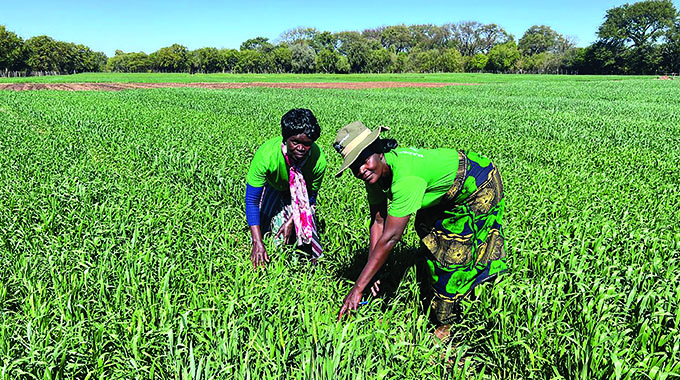
Sukulwenkosi Dube-Matutu, Features Writer
GOVERNMENT’S call for farmers to embrace wheat production this year has received a positive response in Matabeleland South Province, with even small-scale farmers at community gardens taking up the challenge.
Among those who responded are the Madema Garden Farmers in Patana Village, Gwanda. The group planted 2.5 hectares of wheat within their eight-hectare garden. Despite facing water challenges — relying on a silted dam for irrigation — the farmers have remained highly productive.
In addition to wheat, the farmers have cultivated watermelons, butternuts, vegetables and lucerne, using a canal system to manage irrigation.
Madema Garden chairperson, Ms Eggie Mazibeli, expressed satisfaction with the wheat crop, which has performed well despite the water constraints.
“We put 2.5 hectares under wheat in response to the call for farmers to participate in wheat production. Our crop has performed well and we expect a good yield. We received good rains, which brought significant inflows to our dam.
“We took advantage of the water to produce not only wheat but various crops as well. We will deliver some of our harvest to the Grain Marketing Board and share some of the crop amongst ourselves to ensure that we feed our families,” she said.
The province had been given a target of 3 500 hectares for wheat production, and the strong uptake saw it surpass this goal, achieving 3 648 hectares — an increase from last year’s 2 554 hectares.
This year, the province is targeting a yield of over 21 000 metric tonnes, compared to last year’s 11 000 metric tonnes.
Major contributors to this target include Arda Ngwizi with 578 hectares and Arda Antelope with 588 hectares. Several irrigation schemes across the province, recently rehabilitated under the Green Climate Fund Programme, have also played a key role in boosting production. These include Midlo and Masholomoshe irrigation schemes.
Harvesting is expected to commence in mid-September.
Among those with the most promising crop in the province are farmers at Mankonkoni Irrigation Scheme in Ward 19, Gwanda District. The scheme, which has 39 farmers, had previously been idle but was recently revived under the Green Climate Fund Programme.
The scheme’s chairperson, Ms Kiliboni Ndlovu, said they have 3.8 hectares under wheat, with an expected yield of around six tonnes per hectare.
“We have 3.8 hectares under wheat production, which is at the booting stage. We are expecting a bumper harvest as we received inputs on time. We had stopped operating at the scheme as elephants were troubling us, but the Green Climate Fund Programme intervened and a perimeter fence was erected around the scheme.
“We are glad that we can now produce. Some of the wheat we have grown will be delivered to the Grain Marketing Board. We are proud to be contributing to the nation’s breadbasket,” she said.
In an interview, Matabeleland South Agritex Deputy Director Mr Bhekilizwe Ncube said the province has produced a good crop, especially considering its location in Regions 4 and 5. He noted that the department is promoting wheat production among smallholder farmers and will continue to offer technical support to enhance productivity.
“The uptake of winter wheat production in the province has improved over the years and we are proud of what we achieved this year. We have more individual farmers taking part in wheat production as well as smallholder gardens.
“We have seen schemes such as Mankonkoni, which had previously been idle, now participating in this year’s wheat production. As a department, we made it a point to encourage all farmers with reliable water sources to take part in wheat production,” he said.
Mr Ncube added that a recent assessment showed most irrigation schemes are expected to harvest more than they did last year.
Farmers have also been encouraged to deliver their harvests to the Grain Marketing Board.
Wheat production has steadily emerged as a cornerstone of Zimbabwe’s agricultural economy — not only as a means of ensuring food security but also as a key contributor to national economic growth.
As the second most important cereal after maize, wheat plays a vital role in closing the gap between a growing population and food supply, while stimulating agro-industrial development.
Wheat production has become a key agricultural activity in Zimbabwe, contributing significantly to both food security and economic development.
Government has made wheat self-sufficiency a strategic goal, targeting annual production levels of around 360 000 metric tonnes.
Last year, the country exceeded its annual wheat requirement of 360 000 tonnes, reaching a record harvest of 563 961 tonnes.
This achievement is attributed to strategic Government interventions and supportive policies, including improved access to financial services for farmers. Government’s proactive measures — such as ensuring timely input delivery and providing financial support — have been crucial.
Improved access to financial services, combined with Government initiatives, has significantly boosted production.
@DubeMatutu