admin
admin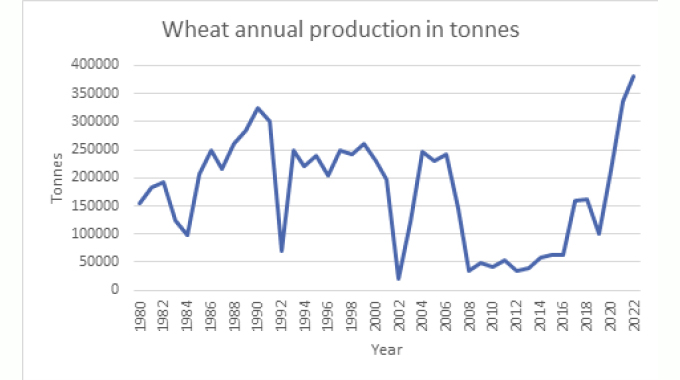
Elton Manguwo
THE thrust by the Second Republic to actualise wheat self-sufficiency and its twinning goal of import substitution has been fulfilled this year, as a record breaking 375 131 tonnes of wheat were harvested.
With 375 131 tonnes harvested as at December 12, from 78 063ha, the country is set to achieve its 380 000 tonnes when all the 80 885ha are reaped.
As wheat is the second most important cereal crop after maize with an annual consumption of about 360 000 tonnes and cognisant that in past years the country was importing 80 percent of wheat annually, the Government put on the radar import substitution and wheat self-sufficiency.
Annual wheat production in Zimbabwe has been hovering above 50 000 tonnes between 1980 and 2007 and remained around the 50 000 tonnes mark over the period 2008 and 2016.

Value of Zimbabwe wheat imports (2010-2021): Source: ZimStats.
In Zimbabwe wheat is mainly used for consumption in the form of bread, paste products, breakfast cereals, cake, and many others. Whereas wheat consumption demand has been dramatically increasing due to population growth, increase in urban population and changes in consumer tastes and consumption pattern, local production supply did not meet demand, the gap between production and consumption being filled by imports.
The importing of wheat involved the expenditure of foreign currency, hence the call by Government for local farmers to increase production as a healthy way of import substitution. The geopolitical developments in Eastern Europe came as a blessing in disguise as the country became inward looking in sufficiency in local production.
Intervention by the Second Republic through the Presidential Input Scheme (PIS), coupled with the Government’s call for private players to fund procurement of 40 percent of their raw material needs saw wheat annual output rising from a low value of 100 044 tonnes in 2019 to the current expected high of 380 000 tonnes.
What made the difference?
Government policies of import substitution, announcement of a lucrative pre-planting producer price as well as the call requiring private sector players to source at least 40 percent of their annual raw materials needs from local farmers through contracting, joint ventures and corporate farming, saw area under wheat production increasing from 24 186ha in 2019 to 80 885ha in 2022.
For the 2022 winter season the Government initially set a target of 75 000ha as a bold move to achieve wheat self-sufficiency and this eclipsed the previous peak value of 70 585ha achieved in 2004. Government set a lucrative pre-planting wheat floor producer price of $175 741,86 per tonne for ordinary grade at a 15 percent return on investment while the premium grade was $193 316 per tonne to incentivise farmers to commit more land to winter wheat production.
The Presidential Winter Wheat Programme that was targeting to contract production on 5 500ha funded wholly by Government to the tune of US$9 293 820 was oversubscribed with 10 241 prospective farmers registering to plant wheat. The Government paid attention to the prospective farmers’ needs and increased the sponsored area to 10 000ha.
The combined 2022 wheat hectarage of 80 885ha was sponsored by PIS, CBZ Agro-Yield, AFC Land Bank, Food Crop Contractors Association (FCCA) — a private sector initiative, as well as self-financed farmers. The expected wheat harvest of 380 000 tonnes against an average national requirement of 360 000 tonnes ensures that the country meets its domestic consumption needs.
The country is set to save foreign currency on wheat imports this year, as over the years expenditures on wheat imports were gobbling a lot of foreign currency.
A former banker and beneficiary of the land reform programme and current Zimbabwe National Farmers Union (ZNFU) vice president Mr Fidelis Gweshe of Belleview Farm in Goromonzi district has scored big in wheat production since 2021.
“I am predominantly a tobacco farmer with 13 years’ experience but in the past two seasons I ventured into winter wheat programme taking heed of the clarion call by Government for the country to be inward looking in terms of wheat production.
“In my first year of wheat production, I was contracted by a miller and grew the crop on 10ha and got an unbelievably high yield of 8, 2 tonnes per hectare. I saw that this was another income enhancer and last year I expanded the hectarage to 30 and I achieved 8,1 tonnes per hectare, again under contract,” said Mr Gweshe.

Annual wheat hectarage: MLAFWRD.
Mr Gweshe cited Government policy support in terms of producer price, good agronomic practices and contract farming as the game-changer in his farming business.
“My contractor supplied me with all inputs timeously and provided working capital for labour. They brought in their combine harvesters, inspected my wheat and offered technical advice weekly until the crop was harvested. The other advantage with contracting is low loan interest rates of about 4,5 percent against the 13-15 percent currently obtaining from financial institutions,” added Mr Gweshe.
Another beneficiary of the land reform programme soaring high in wheat production is Dr James Chipunza, an A2 farmer at Mubvakacha Farm in Headlands who, again is mainly involved in tobacco production but started wheat production under the new dispensation.
“I took heed of the Government’s food security call and started wheat production in 2019 on 16ha getting an average yield of between seven and eight tonnes per hectare. Buoyed by this achievement, I doubled the hectarage to 32 in 2020, then to 60 in 2021, which I maintained in 2022. My yields have remained in the seven to eight tonnes per hectare range.
“My advice to Government for increased wheat production in years to come is for the Grain Marketing Board (GMB) to swiftly pay farmers upon delivery of their wheat, as farmers need to plant other summer crops. The CBZ Agro-yield also needs to offer farmers subsidised interest rates as their loans are a bit on the high side,” said Dr Chipunza.
A commercial farmer who requested anonymity and based at Enterprise Valley in Mashonaland East province said he had given up growing wheat because of relentless electricity challenges that made irrigation almost impossible but made a U-turn after the Second Republic brought stability in power supplies.
“We resumed wheat production on six hectares three years ago. We followed up by increasing it to 25ha in the second year and this year we moved to 30ha,” he said.
Bindura farmer Mr Remigias Matangira commended the Government for launching the Presidential wheat scheme, saying it had addressed the input requirements for many farmers.
“That programme helped us reduce the costs of production since in the absence of subsidies that could have played such a role. We hope the Government upholds such programmes that are designed to push the country towards wheat self-sufficiency. The programme demonstrated that with the right support the country can produce to meet its requirements and do away with imports,” he added.
A smallholder farmer, Mrs Faina Rusipambi of Village 23, Manyoni old resettlement scheme in Kadoma district who started wheat farming four years ago said she planted the cereal on a small piece of land in her first year and harvested 750 kilogrammes.
“I tried again the following year and got 800 kilogrammes before scoring a tonne in the third year. I was using my own resources then. Things took a turn for the better when I registered for the Presidential input scheme this year. I was given five bags of basal fertiliser and the same number for top dressing. My crop yielded four tonnes,” said Mrs Rusipambi proudly.



 Online Reporter