
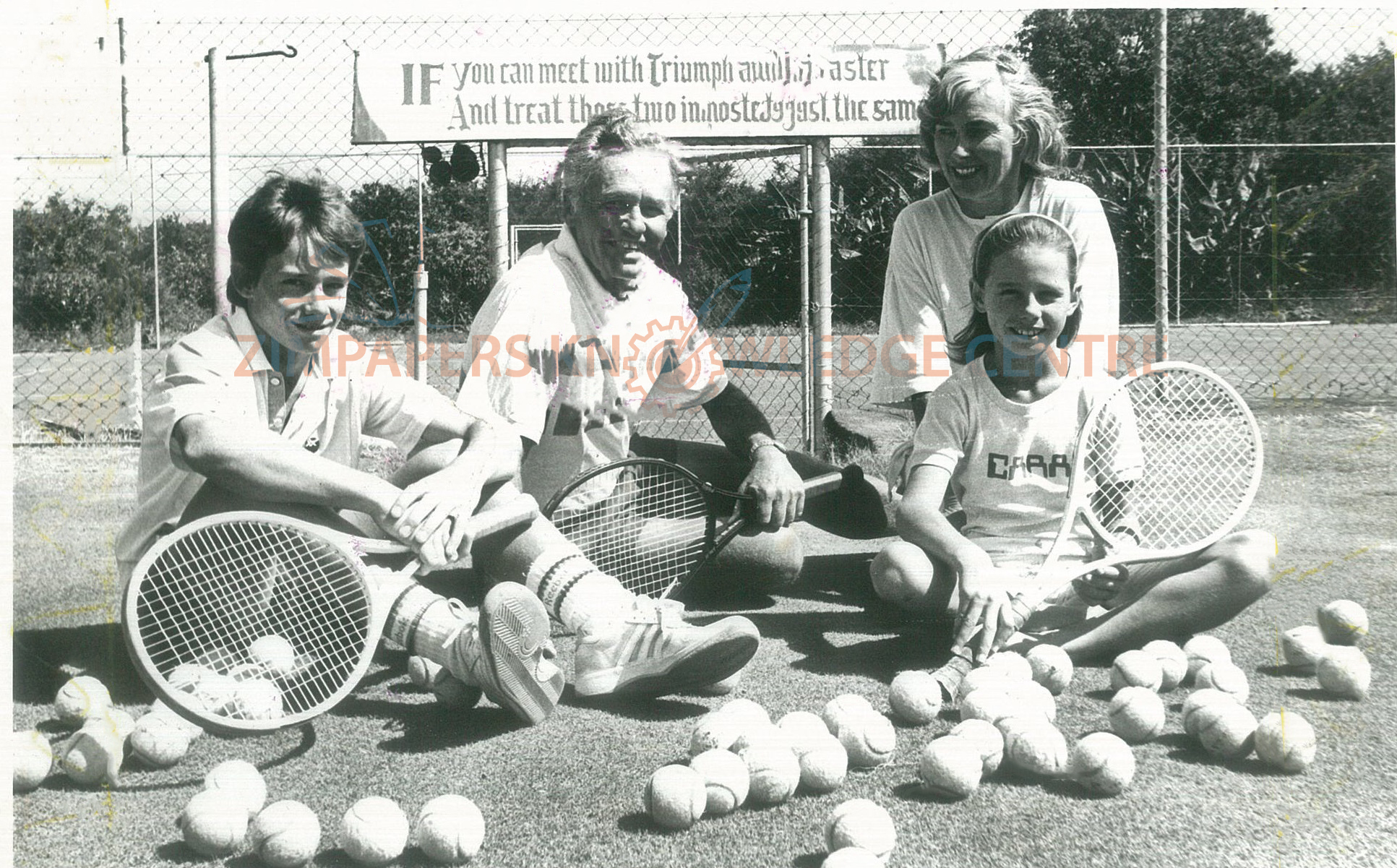
“I had no doubt that they (my kids) were going to be tennis players, as I knew the richness, enjoyment and privilege that I had playing the game and representing my country.
“We were blessed with four kids, and I took it upon myself to coach them. From the age of three, I had them on the tennis court, and for the next 12 years, I just trained them as best as I could.
“We took them to tournaments, would wake up as early as six in the morning, train a bit and then go to work afterwards. The minute I came back home, we would train again.”
Langton Nyakwenda and Tinashe Kusema
ZIMBABWE was once a Mecca for big-name tennis pilgrims.
The sight of a surprisingly balding 29-year-old Andre Agassi – who was ranked sixth in the world then – making his way up the City Sports Centre auditorium to join Zimbabwe fans in song and dance is likely to be indelibly etched in the minds of local tennis lovers who witnessed the once-in-a-lifetime spectacle.
And this happened on February 6, 2000.
While the 15 000-seater City Sports Centre was packed to the rafters, it is the vociferous gang of youths from the high-density suburb of Mufakose that caught the attention of the American tennis star.
Shortly after his compatriot and rookie Chris Woodruff – who subbed in for Pete Sampras, who had failed to make the trip to Zimbabwe – had defeated a brave Wayne Black 6-3, 6-7 (2) 6-2, 6-4 to give the United States a 3-2 victory, Agassi decided to let his hair down (no pun intended) and have a little fun.
Although more popular for his exploits on the tennis court rather than his dance moves, the elite athlete, however, decided to throw caution to the wind and enjoy the moment.
Unsurprisingly, Zimbabwe fans did not quickly file out of the auditorium, even when the tie was over, as they took time to take in the rare moment.
These were the good old days of Zimbabwe tennis.
It was an era when Zimbabwe danced with the stars as a member of the World Group, which had countries such as Romania, Australia, Italy, the Czech Republic, Spain, Netherlands and, of course, the United States.
Led by the talented Black family (Bryon and Wayne), the Zimbabwe Davis Cup team duelled with some of the top players in the world like Agassi, a then-rookie Woodruff, Romanian Andrei Pavel, Italy’s Albert Costa and Aussie great Mark Philippoussis. They even welcomed the ever-eccentric John McEnroe to these shores.
However, since the retirement of the Black siblings, the sport has been progressively sliding.
The team have fallen by the wayside, as they have been relegated from the World Group to the Euro/Africa Zone and World Group II.
They now often find themselves playing countries such as Namibia, Egypt, Nigeria, Japan, and, most recently, Uruguay.
Fans have seemingly turned their back on the sport and cannot even fill Harare Sports Club.
The Blacks
The dissimilarities of the two eras can best be summarised in three words – the Black family.
The siblings – Byron, Wayne and Cara – singlehandedly transformed Zimbabwe from a relative unknown to one of the sport’s aristocrats.
And the world took notice when the trio were at the peak of their powers.
Byron and Wayne, together with Kelvin Ullyet, formed the core of the country’s Davis Cup team.
On the other hand, Cara enjoyed success as the doubles and mixed doubles specialist.
However, Bryon and Wayne were the mainstay of the team that beat Austria (3-0) to qualify for the prestigious World Group stage for the first and only time in the country’s history.
They went into the 1998 edition of the competition and beat Australia in, arguably, the biggest upset victory in the country’s history.
They also went as far as the quarterfinals, where they eventually lost to Italy.
As individuals, the three won Grand slams and a couple of ATP Tours, with Cara, the youngest of the three, a five-time Grand Slam winner.
She has three Wimbledon titles (2004, 2005 and 2007), an Australian Open title (2007) and a US Open title (2008), which included two she won with her brother Wayne in the mixed doubles.
Wayne won two men’s doubles titles at the US and Australian Open with fellow compatriot Ullyet.
Byron holds 22 doubles titles and a Grand Slam, which he won at the French Open with American Jonathan Stark in 1994.
“The Black brothers, Byron and Wayne, are a once-in-a-generation kind of talent,” said The Herald sports editor, Colin Matiza, who was among the journalists who covered the Black family.
“Byron was good in both the singles and the doubles, while Wayne was more of a doubles player, and together they complemented each other well.
“They were both exceptionally good. Byron was the first Zimbabwean to reach the second week of Wimbledon (in the singles), and one of his advantages was that he was based in the US, where he was on a scholarship, and it helped him a lot.
“We had two brilliant players, and this was an era we may never go back to.”
On the world map
“The Blacks were just unbelievable,” said former Zimbabwe Davis Cup player Gwinyai Tongoona.
“To have three siblings playing on the professional circuit, making it into the top 100 and winning Grand Slams was just massive for Zimbabwe tennis.
“Their achievements put us on the map, flew the country’s flag high and gave some of us something to aspire to.
“It inspired a lot of players and a lot of people.
“While the Williams siblings, Venus and Serena, did well, I think the Black siblings deserve some recognition for the work they did.
“How many times do you hear a story of three siblings reaching such lofty heights, competing on the world stage, getting into finals, winning Grand Slams and carrying their country on their backs like what Byron, Wayne and Cara did?
“That was just absolutely massive.”
It goes without saying that Zimbabwe tennis only became vibrant when the Black siblings were on a roll.
The trio brought gold home, put the country on the map and opened doors for players like Martin Dzuwa, Genius Chidzikwe, Nigel Badza and, more recently, Takanyi Garanganga, as well as the Lock siblings – Benjamin and Courtney.
Behind all this fame and glory is the work of Donald and Velia Black, the parents who put in the hours to raise the tennis champions.
Martin Lock, father of the Lock brothers, is now following the same template.
“When we juxtapose the golden era and the modern game, it’s plain to see that there is no comparison,” Martin Lock, also a former tennis player, told The Sunday Mail.
“Byron, Wayne and Cara were just exceptional talents.
“I think they had an exceptional father who trained them well, and they were unique in that all the three kids reached number one in the world at one point or another.
“My boys have moulded their game and their attitude to Byron and Wayne, and they have been working quite closely with the latter from a coaching point of view.
“There are two criteria to success in tennis in this modern era, with the first being that you need the strong support of family.
“You need a family that is driven, one that will help these kids both emotionally and financially.
“Unlike most team sports, you go at it alone in tennis, and parents must be proactive, forking out the money for lessons, tournaments and travel.
“The second one is that you must have a strong local federation.
“If you look at the big countries like Australia, America and France, they hold a lot of tournaments.
“In these tournaments, the local federations have wildcards, and this allows you to introduce young players and give them the much-needed exposure and experience that will mould them into great players.
“It doesn’t matter if they lose; all that is important at that development stage is the exposure and experience they get from playing against some of the top players in the world.”
In limbo
Tennis Zimbabwe does not have any big tournaments to talk of now, what with the country’s premier tennis tournament, the Zimbabwe Open, off the radar since 2011.
Although the country did not have many local high-profile tournaments back in the day, the Black siblings profited from getting scholarships to play tennis in the US.
Both Byron and Wayne attended the University of Southern California.
It is the same script the senior Lock has followed with his kids.
“The year I won the Zimbabwe Open is the very same year my eldest son, Benjamin, was born, and, for me, it was a very good omen,” said Martin.
“I had no doubt that they (my kids) were going to be tennis players, as I knew the richness, enjoyment and privilege that I had playing the game and representing my country.
“We were blessed with four kids, and I took it upon myself to coach them. From the age of three, I had them on the tennis court, and for the next 12 years, I just trained them as best as I could.
“We took them to tournaments, would wake up as early as six in the morning, train a bit and then go to work afterwards. The minute I came back home, we would train again.
“The most beautiful thing was the passion these boys had; from a young age, they said to me they wanted to be professional tennis players and represent our country,” he said.
Soon enough, the International Tennis Federation (ITF) would come calling and offer Benjamin and Courtney Lock scholarships to attend their academy in Pretoria, South Africa.
The two then left home at the age of 12 for the academy.
Benjamin later enrolled at Florida State University, while Courtney headed to the University of Nevada in the US.
The two form the core of the current Zimbabwe Davis Cup team.
However, they have not been able to emulate the Blacks.
But does Tennis Zimbabwe (TZ) have a succession plan?
Will tennis ever rise to the same level it did between 1997 and 2000?
“The Black siblings were just exceptional players, and that is an era we will never get back,” added Matiza.
“Tennis is an individual sport where you get support from your family, much like what Don and Velia Black did for their kids.
“They invested their time and resources into moulding their kids into champions, and after that, you can see we have not found someone who can replicate that template . . .
“I don’t think you can credit Tennis Zimbabwe for the success we attained during those years . . .
“Having that family play for us was a unique and rare case, as those that came after struggled.
“The likes of Genius Chidzikwe, Martin Dzuwa and Gwinyai Tongoona, while talented, paled in comparison to the talent of Wayne and Byron.
“The same goes for the current crop.”
Conversely, Martin Lock is optimistic.
“It is possible,” he says.
“Motivation, discipline and sacrifice are what is needed from the players. We also need a proactive federation.
“If the federation does not do something to curb this decline, we will certainly not get there.
“They need to look and count how many players they have at university in the US; (and) who is at college that we can develop.
“I don’t think they are many, as we used to have plenty of players waiting in the wings, and now, we hardly have any whom I can name . . .
“We must get sponsors on board and we must get development going.
“We must have a lot of tournaments, coaches and centres in every province, (and) invest in the youth.
“I will give them (TZ) credit in that we have had a couple of ITF junior tournaments recently, but those two or three are not enough.
“We need more, and we also need the Government, through the Sports ministry, to play their part and invest,” he said.