admin
adminwhere so much of this and that is running around, including absurdities.
Then, there is the Libyan crisis where the one-sided story continues unabatted.
But, the one that tops the bill is that of Dominique Strauss-Kahn, the International Monetary Fund boss who has been in the slammer since weekend for an alleged rape case.
He tried to rape a maid in the US$3 000 hotel room he was booked en route to France. He was denied bail. And this is where the media astounds you!
When high profile figures like the IMF boss are accused of committing such offences, the repor-tage never runs of stuff to say, with most of it so subjective, just because an ordinary woman said that the IMF boss wanted to rape her.
Most of what I have read or listened to so far is pity poured out on Strauss-Kahn, never mind the true position, as of now, the man abused his position and authority to access whatever he wants in life, women included.
Strauss-Kahn as the representative of one of the Brettonwoods institutions is important.
How many times has the IMF denied Zimbabwe loans? Check also what Strauss-Kahn has said about Zimbabwe.
Then we have former Governor of California, body builder and actor Arnold Schwarzenegger admitting on Tuesday that he fathered a child with their maid, 10 years ago.
So, sungura maestro Alick Macheso is not alone in this, but at the end of it all, some lose and others gain.
But these are matters for other days. I turn to this week’s issue – identity crisis and how it is killing the Zimbabwean and African spirit.
To give me a better leverage, I purchased a book I studied many moons ago – “Ndakatongwa neNyika mbiri: Nedzimwe nyaya fupi”, which is a collection of short stories in Shona written by O. Makani Kabweza and others.
Loosely translated, “ndakatongwa nenyika mbiri” means that I was judged by two worlds, whose viewpoints are diametrically opposed. We see that on a daily basis.
Before an accused goes to court, the court of public opinion will have given its verdict.
These two worlds are part of life, and it’s up to the individual to use their wisdom to make informed choices.
The two worlds referred to in the short stories are our traditional way of doing things versus the Western way.
John Haasbroek who wrote the English commentary said about the short stories: “Although these stories are very realistic and close to domestic man in that they are about ordinary people caught up, in their everyday lives, in the demands of two conflicting cultures, I find that they never become banal or trite, but are in fact greatly enriched by the traditional philosophical and theological notions of the Shona people’s past, which blend in very well with modern realism”.
Haasbroek, a white man realised that in 1973 when the book was published, but it seems elusive to the black person.
As we start the second decade of the 21st century, we see that the black man is still mired in conflicting cultures, and in some cases giving alien cultures a better position than his or hers.
I’ll centre my argument on the term “murungu”, a Shona term which means a white person, but which is also a metaphor implying privilege, status, affluence and means.
Many times this writer has wondered why people speak as though they know the white person’s ways of doing things and lifestyle.
Most people are so attuned to the 8am to 5pm work timetable. If people see someone going to work after 8am, they initially ask whether they are not going to work.
When the person tells them that he or she is going to work, the immediate response is, “Inga munoshandira pachirungu”. (Your work timetable resembles that of white people).
This writer has asked inquirers ad infinitum, “What is the white person’s work timetable like? Have you ever worked with them to know that they have flexy hours or they don’t work at all?”
A whole perception was created that white people either do not work, and if they do, they do it leisurely.
Maybe they created that impression themselves, especially when they were always supervising people performing back-breaking chores.
The other thing is food. If one does not eat pork, people have no problem with that.
But the moment you have a dietary plan that is different from everybody else, then such remarks like, “Anodya zvechirungu or vanodyira pachirungu”, are made. (He or she eats white people’s food or eats like white people).
Food is food, and with the multi-culturalism that is endemic in most countries, is it possible to say this type of food is for white and/or black people only?
These are remarks that are made by people who don’t know white people’s eating habits, and who fail to recognise that skin colour does not pool a people into one group eating the same foodstuff.
Russians eat different food from the English, and that’s normal. In the same manner that all black people on the continent do not eat the same food stuffs.
Although sadza is eaten in most parts of Africa, it’s not the staple food everywhere.
Some have rice, while others have bread as their staple food. But it doesn’t stop Africa from being Africa, because black people in other parts of the continent do not eat sadza or nsima or ugali
The final example, popularised by youths is calling other blacks be they employers or wealthy “varungu”. This flies in the face of what being black stands for – culturally, socially, historically, religiously and economically.
To this writer this means that “murungu” is not just a racial attribute, but it also refers to someone with means, and also implies affluence. To be called “murungu” for some is a promotion – they have made it.
And, those that accept this are the generation that was liberated from white domination and oppression that runs out of terms on what to call the entrepreneurs, and instead settle for “murungu” (white man and/or white woman). And some of them are the continent’s liberators!
Many times I’ve heard people being told by youths: “Ndimi varungu vacho, saka mukasatipa mabasa, mahwani” (You’re the white people – people with means – so if you don’t get us jobs, we are in trouble).
What does this all mean?
What does this say about us vis-à-vis white people, our history, especially our identity?
And, why have people allowed themselves to be called “murungu”, and not felt that it is a term full of negative and positive connotations?
If you want to be a “murungu” today because you have made it why was that term not used on the few blacks who also made it before 1980?
How many black people would have answered to being called “murungu” before independence, and would the whites have taken lightly?
Does being called “murungu” raise one’s status and boost confidence, or it actually translates to “black skin, white mask”?
In short, spineless and a front for whites in various sectors?
We cannot blame whites for appropriating that which is what they are (varungu), and make it ours. In fact it is laughable that we now aspire to be like the person we fought to the extent of being called like them (murungu).
What France and Portugal did with its former colonies (having assimilados) has creeped in.
Like Professor Ali Mazrui once argued, this desire to be “white” is so evident in Africa because only in Africa do we still have Anglophone, Francophone and Lusophone to describe the continent’s indigenious people – who would forever want to be tied to Britain, France and Portugal.
This mindset is so endemic to the extent that the attainment of national Independence and sovereignty was not seen as an opportunity to out-do what the few whites in the country could do.
Instead of improving infrastructure and housing in places where blacks were relegated to, the post-Independence era saw people falling over each other to go and live in the leafy suburbs where white people lived.
And, it became a status symbol and mark of success, while those at the bottom of the heap cry out that only “varungu” (whites) can work efficiently and effectively.
With that raised “status” places like Highfield, Mbare (cradles of nationalism), Mufakose, Mabvuku, Tafara, and Kambuzuma were relegated. It is even worse with rural areas.
The only time you realise that these places raised these people who are not fazed when called “murungu” is when there is a funeral, and you see all manner of sleek car parked in the townships’ narrow streets.
Or, you see them at weekends drinking publicly and braaing, and ordering young people to wash their cars, or get them drinks.
And, the poor youths thank God for those weekend moments when “varungu” come, because they can get breadcrumbs from the “varungu’s” high table?
How pathetic? I could go on and on, but although I see these two worlds everyday, a few weeks ago when I covered an event in Old Highfield, I walked around, looked at some of the houses where probably important decisions that shaped today’s Zimbabwe were taken, and guess what, they are in a sorry state, while “varungu” moved to Borrowdale Brooke, etc.
The same with Mbare, Mufakose, etc. A rich history reduced to misery, while people are happy to be called “murungu”!
Is it a wonder that in some countries where there are civil strifes and the West intervenes, when they kill residents of such places, they think that they have not killed civilians?
This is the black man’s dilemma, and it is only the black man who can extricate himself or herself out of it. This pretence will not get us anywhere.
Our African-American brothers and sisters have made emphatic statements that they do not want to be called nigger, with Mark Twain’s Adventures of Huckleberry Finn being recently revised, with the expurgation of “nigger” being replaced with “slave”.
But, guess what, when they are amongst themselves, they freely call each other “nigger” – a case of people surviving in two worlds, and wanting to enjoy both sides of each world, or hating both worlds with a passion?
Maybe it’s enslaved minds whose deprogramming is taking longer than expected, but whose knock-on effect on Africa’s standing leaves a lot to be desired.
[email protected]


Online Reporter
- Bmetro , businessweekly , Chronicle , Herald , Hmetro , Kwayedza , Manicapost , SundayMail , SundayNews , uMthunywa
- July 30, 2026
- 62 views
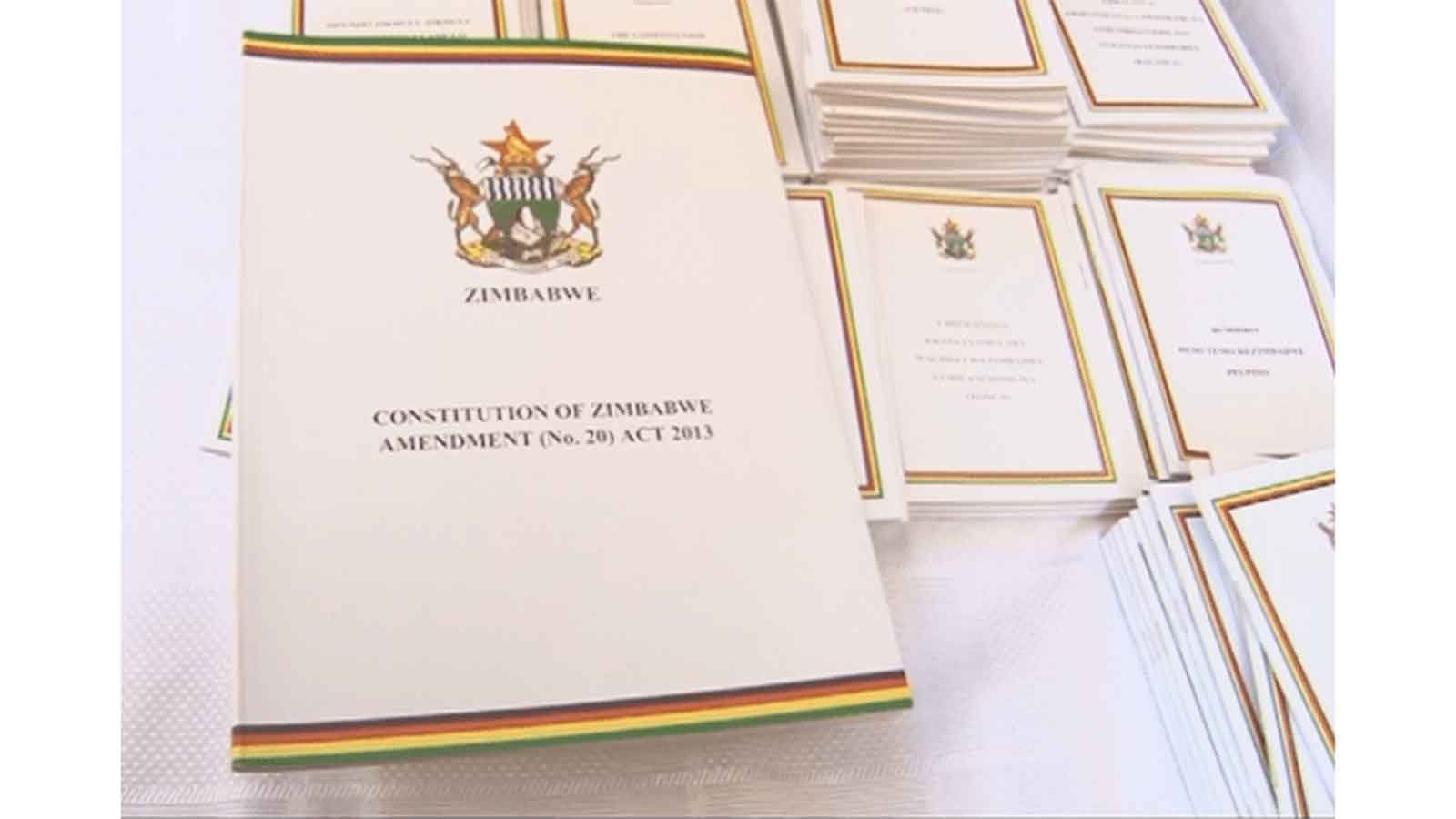
Is the Personal Benefit Rule about ‘Any Amendment’ or ‘An Amendment to a Term Limit Provision’?
An Intimate Reading of Subsections (1) and (7) of Section 328 of the Constitution of Zimbabwe (2013) By Nomuzikayise Ngwenya This piece is confined to one question, a question of…