Elliot Ziwira
At the Bookstore
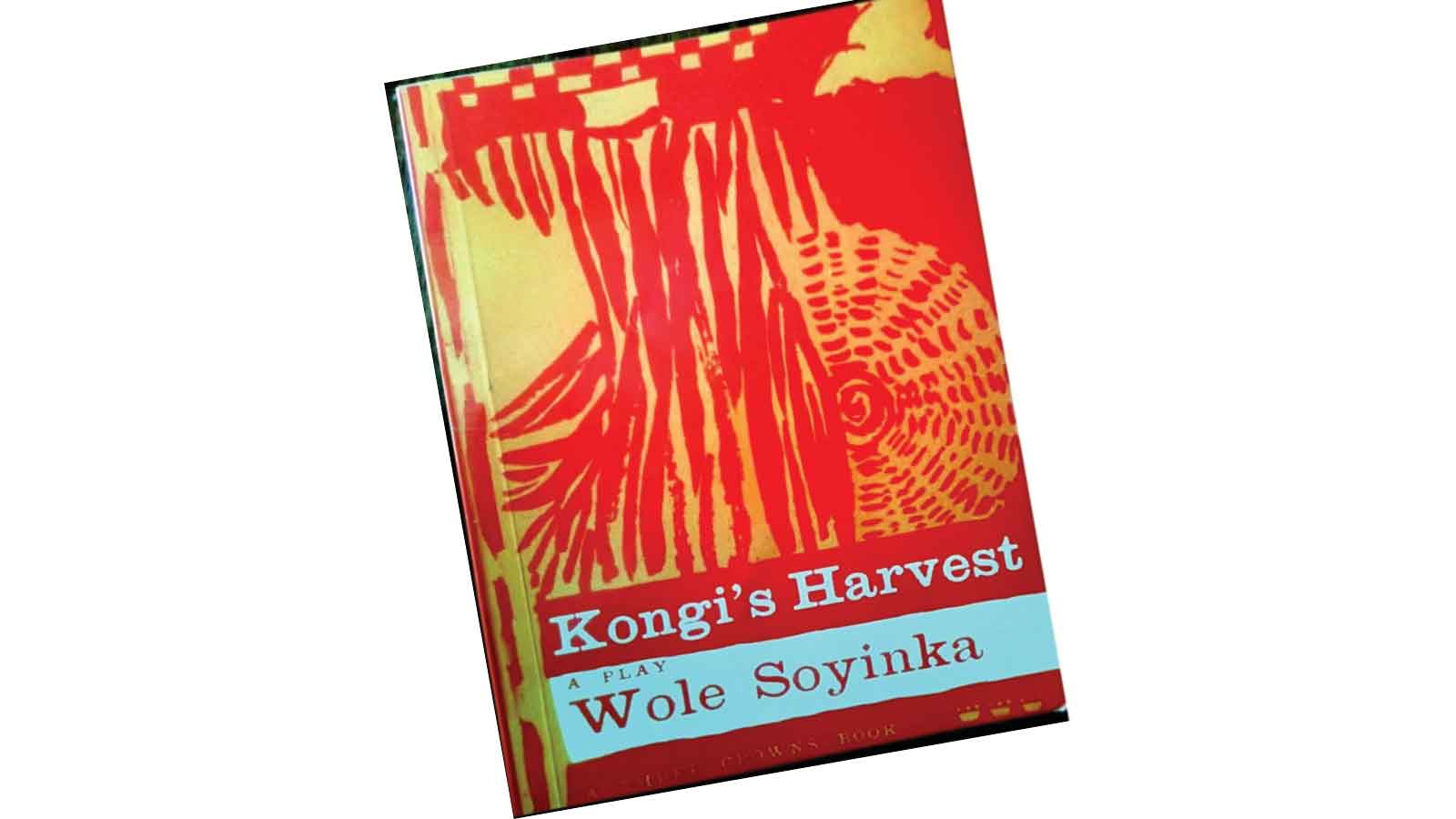
Wole Soyinka’s timeless play, “Kongi’s Harvest”, speaks to a question that refuses to disappear from the African landscape: what happens when supremacy turns culture, ritual and spectacle into instruments of control?
The play is not just an exercise in dramatic form, but a meditation on power, ideology and tradition.
This makes “Kongi’s Harvest” more than a prescribed literary text. It becomes a mirror through which the relationship between political power and society can be examined.
Soyinka’s drama contributes immensely to African theatre since it combines elements of the European dramatic tradition with the aesthetics of African performance. As Wilson (1976) observes, African drama draws heavily from the vernacular tradition, characterised by ritual, communal concerns, music, poetry, dance, mime and spectacle.
These elements go beyond decorative power but carry meaning as well.
Music, for instance, has always occupied an important place in African communal life. It accompanies weddings, funerals, harvest ceremonies and other rites of passage, with different rhythms and tones communicating different emotions and messages. The drum itself can become a language, its pitch and rhythm conveying meanings understood within a particular cultural setting.
Soyinka exploits this cultural power of music in “Kongi’s Harvest”.
As Bob Marley once observed, “One good thing about music: When it hits you, you feel no pain.” In Soyinka’s hands, however, music does more than entertain. It exposes ideological differences, reinforces ritual and reveals the competing worlds inhabited by Kongi and Danlola.
At the centre of the play is an ideological struggle between the old order, represented by the traditional leader, Danlola, and the new political order represented by Kongi, the unembellished president.
Danlola embodies traditional kingship, with its attachment to ancestral wisdom, ritual and communal values. Kongi, on the other hand, represents modern political authority at its most severe, with his appetite for control, adulation and the creation of a personality cult.
Therefore, their conflict extends beyond two individuals.
It becomes a contest between two systems of thought, two forms of authority and two visions of society.
This is where “Kongi’s Harvest” speaks powerfully to the present more than five decades after its publication. Across societies, political authority can become dangerous when leaders cease to see themselves as servants of the people and begin to regard public institutions, ceremonies and cultural traditions as extensions of personal power.
Kongi seeks precisely this kind of transformation.
He attempts to appropriate the traditional harvest ceremony and bend it towards his own political purposes. Hence, the sacredness of the past is placed alongside the ambitions of the present, producing an ideological tension that drives the play.
The ritualistic structure of the drama is central to this process.
African communal life is traditionally marked by ceremonies in which the past, present and future converge. Harvests are not simply about food. They are celebrations of survival, continuity, gratitude and communal belonging.
However, in “Kongi’s Harvest, this communal meaning becomes entangled with political ambition.
The ceremonial role of the traditional leader is given a sacred dimension through praise and eulogy:
“None but the king
Takes the oil from the crossroads
And rubs it in his ‘awuje’
The king is a god.”
The words capture the traditional conception of kingship, while simultaneously establishing a contrast with Kongi’s political project.
Soyinka’s genius lies in allowing ritual to become a battleground.
Danlola’s world is rooted in proverbs, poetry and folkloric wisdom. His language is connected to the lived experiences of his people and to a cultural universe in which nature, history and spirituality are intertwined.
Kongi’s language, by contrast, is abstract, political and divorced from the communal values that Danlola represents.
The distinction is significant in an age when political language can become detached from ordinary people’s lived experiences.
Although words can be used to inspire, they can also obscure. Political rhetoric has a way of illuminating reality or manipulating it. Soyinka understands this power and makes language one of the weapons through which the ideological battle in the play is fought.
Danlola’s use of proverbs gives his speech the authority of accumulated communal knowledge as captured thus:
“The rude shanks of a king
Is not a sight for children
It will blind them.”
The statement operates at several levels. It is humorous, metaphorical and political, while also pointing to the loss of status suffered by the traditional leader.
Kongi’s language, meanwhile, reflects the modern political order and its attempt to impose itself over older systems of authority.
Music reinforces this distinction.
Danlola’s music is melodious and socially oriented, while Kongi’s is discordant and serves the interests of political deification. The music of the Carpenters’ Brigade becomes an extension of the political machinery, while the Reformed Aweri Fraternity ironically picks up on its discordant character.
Through music, Soyinka demonstrates that culture can either bind society together or be appropriated to serve narrow individual interests.
This is particularly significant today, when music, art, social media and popular culture have become powerful vehicles for shaping public opinion.
The play also uses realistic and non-realistic dramatic techniques; mythology, symbolism and imagery to deepen its critique.
The New Yam Festival, for instance, becomes a symbol of traditional values and communal renewal.
Yet Soyinka does not romanticise tradition. He places it under pressure from modernity, political ambition and ideological conflict.
The use of Yoruba mythology, particularly the invocation of Ogun, also roots the play firmly in Soyinka’s cultural universe. This gives the drama its distinctive African aesthetic, although it can simultaneously limit its universality, for Africa is not culturally homogeneous.
The continent’s different societies possess their own mythologies, rituals and belief systems. What prevails within one cultural context may not carry the same meaning elsewhere.
This tension between particularity and universality is one of the fascinating aspects of African literature.
African drama, although influenced by European literary traditions, derives much of its aesthetic force from African experience. The issues explored by African playwrights emerge from societies that have endured colonialism, exploitation, political upheaval, cultural dislocation and the continuing struggle for self-definition.
Soyinka captures this reality through the artist’s social responsibility.
He argues, “The artist has always functioned in African society as the recorder of mores and experiences of his society and as the voice of vision in his own time.”
That responsibility remains relevant. The writer does not just entertain but records, questions and provokes too.
In “Kongi’s Harvest”, Soyinka records a society caught between the past and the present, between tradition and modernity, between communal authority and individual political ambition.
The unresolved nature of the conflict is what makes the play most compelling.
Kongi appears to have the upper hand, suggesting the temporary triumph of modernity over traditional authority. Yet his victory is hardly reassuring. A system built around personality, coercion and spectacle cannot easily become a foundation for genuine social regeneration.
Indeed, the contemporary reader may find “Kongi’s Harvest” even more revealing because the forms of spectacle have multiplied. The stage is no longer confined to the theatre. Political performances unfold everywhere, even on digital platforms and across social media.
Yet the underlying contest remains familiar: who controls the narrative, who defines culture, who speaks for the people and who benefits when communal values are appropriated for personal ends?
Soyinka’s answer is not simplistic. He does not simply romanticise the traditional order, nor does he celebrate modernity.
Instead, he places both under scrutiny. Danlola may represent cultural memory, but tradition itself has limitations. Kongi may represent modern political authority, but modernity without accountability becomes domineering.
The real tragedy lies in the failure to reconcile authority with responsibility.
For today’s reader, therefore, “Kongi’s Harvest” is not simply about Nigeria of the 1970s. It is about the enduring human temptation to turn supremacy into entitlement and culture into spectacle.
Its music, rituals, poetry and symbolism give the political argument a distinctly African voice, while its concerns remain universal.
The harvest Soyinka presents through his literary works seems to be ongoing. The question is not who sits at the centre of the ceremony, but who the harvest belongs to. That is where the enduring power of “Kongi’s Harvest” lies.
For an immersive reading experience, visit the DigiHub Retail Shop at Herald House, corner George Silundika Avenue and Sam Nujoma Street in Harare. Contact Leon on 0772739306.