Online Reporter
Lungelo Ndhlovu
WALK through the gates of the Zimbabwe International Trade Fair in Bulawayo this April and what greets you is not what memory prepares you for.
There is no immediate assault of scent, no rough sweetness of hay rising into the autumn air, no thunder of hooves or the muscular complaint of a bull announcing his presence. Instead, the moment is softer, almost contemplative. The fair opens this year with a different rhythm altogether — quieter, lighter, unmistakably changed.
For decades, ZITF made its presence known through weight and force. You felt it underfoot in the thud of hooves compacting sawdust, heard it in the deep, rolling voices of Brahman and Hereford giants, saw it in the dense, shoulder to shoulder crowds pressing against timber rails, eyes fixed on gleaming hides and impossible muscle. That spectacle was the fair’s pulse, its agricultural theatre.
However, the situation is different in 2026. This year, the heavy wooden cattle pens sit half empty, their broad frames casting longer shadows than before. The prize bulls that once brought foot traffic to a standstill are absent, their spaces swept clean and eerily orderly, as though paused mid sentence.
In their place comes a new choreography: the quick, nimble shuffle of goats, the sharp, insistent bleat of Dorper sheep, and somewhere just beyond the eye line, the soft, almost intimate tap of a farmer’s finger on a glowing tablet screen.
Where auctioneers once summoned bids with booming lungs and rapid fire cadence, HD monitors now hum with quiet authority, streaming livestock performance data, blockchain identification tags, and drone footage hovering over smart pens like watchful birds.
ZITF 2026 isn’t merely another trade fair rolled out on the calendar. It is a hinge moment, a visible turn in the story of Zimbabwean agriculture.
In January, an outbreak of Foot and Mouth Disease in Mangwe District brought the movement of cattle across Matabeleland South to a grinding halt, and the shockwave travelled swiftly to Bulawayo’s showgrounds.
FMD is ruthless in its efficiency, spreading at alarming speed from cow to cow and leaping species lines to pigs and sheep. It tolerates no complacency. And so, this year, the bulls stayed home.
But Zimbabwean farming did not.
What rushed in to fill the silence left behind is a glimpse of the road ahead: smaller livestock yielding greater returns, technology capable of placing an entire pedigree in the palm of your hand, and climate smart decisions that refuse to wait on perfect rains. The rawness of farming — its grit and gamble — has not vanished. It has simply been sharpened, upgraded, reimagined.
This is ZITF 2026 — less about the biggest animal strutting through the ring, and far more about the smartest idea flickering across a screen.
In January 2026, the disease was detected in the Mangwe District of Matabeleland South. This sickness remains every farmer’s worst nightmare, precisely because of how mercilessly fast it moves, slipping unseen from cow to cow and spilling over into pigs and sheep with equal ease. This specific strain, known as SAT1, is believed to have spread from wild buffalo that came into contact with domestic herds, a reminder of the fragile boundary between wilderness and livelihood.
To protect the national herd, the Government acted decisively, enforcing a strict ban on the movement of cattle in and out of affected areas — a necessary shield, but a painful one.
For farmers who had spent years preparing their finest bulls for this singular moment under the ZITF spotlight, the blow was deeply personal, the disappointment hard won and heavy.
Mr Promise Ncube, the President of the Bulawayo Agricultural Society, addressed the gravity of the situation during the 115th edition of the show at the Farmers Indaba, themed Transforming ZW Agriculture: From Raw Farming to Sustainable Value Addition. He did not shy away from the truth, acknowledging the scale of the disruption: “It impacted our pedigree livestock and the entrants in the cattle and sheep sections. Despite this setback, we are geared for a good show.”
And indeed, even stripped of its iconic cattle herds, the fair pulsed with life. Mr Ncube pointed to the crop section as quiet proof of resilience, heavy with excellent produce thanks to generous rains during the 2025–2026 season.
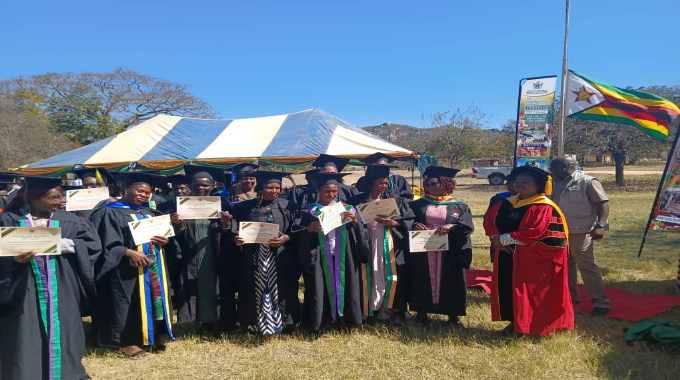
Schools such as St Thomas, CBC and Hillside Collective brought carefully tended projects to the fore, while a record number of home industries filled the halls with energy and invention.
“It shows that despite the headwinds against us, we have stayed in power. Our GDP 2026 growth is likely to grow by 5 percent, anchored by agriculture and mining.”
With cattle largely absent from the conversation, goats and sheep have stepped confidently into the limelight. For generations in Zimbabwe, these animals lived in the long shadow of cattle.
Traditionally, vast herds of cows were the only recognised symbol of agricultural success, while goats lingered at the bottom of the hierarchy, dismissed unkindly as “the poor man’s cow.”
At ZITF 2026, that tired hierarchy has collapsed. Goats are no longer an afterthought; they are centre stage. Farmers proudly display muscular Boer goats and richly coloured Kalahari Reds, not as consolation prizes but as deliberate, strategic investments. The shift is rooted in necessity and realism: Zimbabwe’s climate is no longer forgiving.
“A large cow needs massive amounts of water and grass every day. During a drought, cattle weaken quickly but goats, however, are ‘climate smart.’ They can eat a wide range of bushes and weeds that cattle ignore, and they need much less water. They also reproduce faster, allowing a farmer to grow their business quickly,” said one goat farmer from the Farmers Indaba.
Yet the most defining moment of the fair unfolded not in the pens but in the ideas exchanged at the Indaba, where Professor Obert Jiri, the Permanent Secretary in the Ministry of Lands, Agriculture, Fisheries, Water, and Rural Development — represented by Dr Dumisani Khutshwayo — delivered a speech that drew a bold line under the past and pointed unambiguously toward the future.
He told the assembled farmers and extension officers that the age of “raw farming” — the unadorned act of planting and praying — had reached its limits.
“Raw farming is no longer viable for the farmer who seeks dignity and wealth. Our ultimate metric is not merely yield per hectare. It is income per household and nutrition per plant.”
Professor Jiri spoke passionately about “bridging the gap” between inherited farming wisdom and modern geotechnology.
He cautioned against discarding ancestral knowledge, noting that when an elder observes the flowering of an umkamba tree to predict drought, this is not superstition but long term climatic observation honed over generations.
“The gap exists because we have treated this indigenous knowledge as inferior to the satellite image on my desk. National food security in 2026 requires a fusion of the two: indigenous knowledge systems and modern technology,” he said.
According to the Ministry, geotechnology is now being deployed to answer questions that once relied entirely on instinct: Where is the moisture in the soil? When, precisely, should seed meet earth?
Through a strategy referred to as agro ecological tailoring, farmers in arid regions are being guided toward drought resistant crops such as sorghum and millet, while maize is reserved for wetter zones. This approach is reinforced by hyper local weather data, replacing fixed planting calendars with precision timing drawn from satellites rather than tradition alone.
As Zimbabwe looks ahead to the 2026–2027 season, this transition stands firmly on three pillars: equipping extension officers with tablets capable of translating live soil and satellite maps; engaging youth as an intergenerational bridge who can operate drones while honouring the wisdom of their elders; and democratising data by delivering vital information straight to rural farmers via WhatsApp, SMS and local radio, in languages they live by.
This vision also embraces regenerative agriculture, emphasising soil pH balance and the protection of natural pollinators to safeguard productivity a century from now. It makes clear that the digital pixels and modest livestock showcased at ZITF 2026 are not temporary responses to a disease outbreak, but the essential instruments of a modern Zimbabwe.
By merging what Professor Jiri calls the “sage” wisdom of ancestors who once tamed the land with the satellite “bridge” of contemporary technology, the 115th edition of the Zimbabwe International Trade Fair stands as a confident leap forward — a moment where farming is defined not by brute size but by information and innovation, steering the nation toward food sovereignty and shared wealth for generations yet to come.