Online Reporter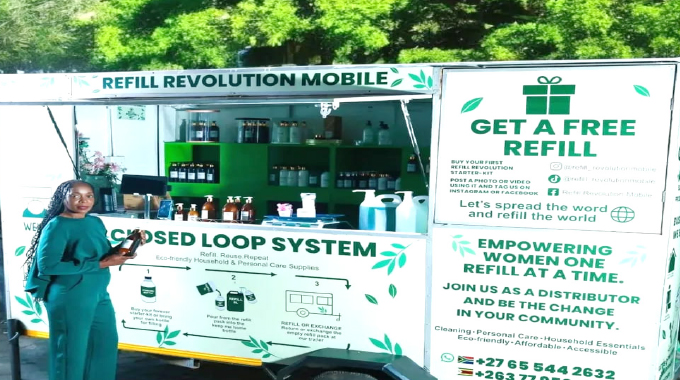
Mbulelo Mpofu, [email protected]
THE wide halls of the Zimbabwe International Trade Fair (ZITF) in Bulawayo have been buzzing since Monday, filled with the familiar clang of machinery, bursts of laughter from exhibitors and the low, steady murmur of deals being discussed in every accent imaginable.
Amid the polished chrome, branded banners and hurried delegates, one stand drew an unusually steady crowd, pulling people in not with noise or gimmicks, but with a story about where Zimbabwean industry might be headed next.
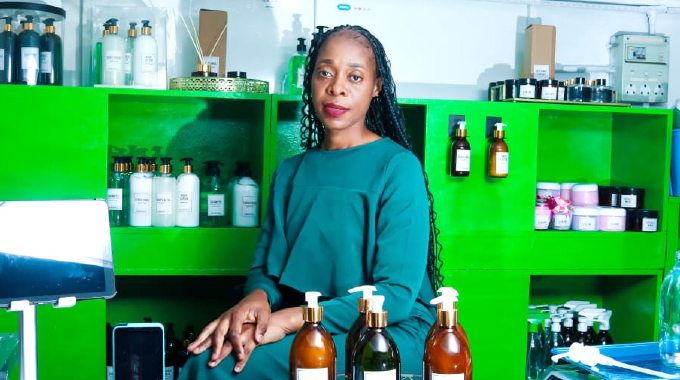
At the centre of it all was Mellisa Mandirahwe, a name that is steadily becoming shorthand for a new, more thoughtful chapter of “green manufacturing” in the country. She does not shout for attention, but once people begin listening, they tend to stay. Her ideas have weight, and at ZITF, that mattered.
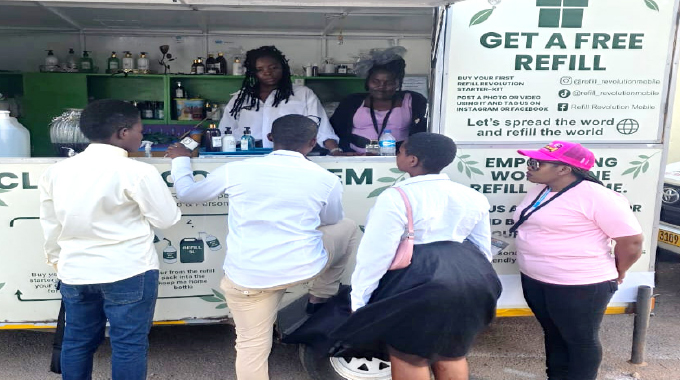
Mandirahwe is the founder of Refill Revolution Mobile, The Becoming Lab and Open Sky Resort, ventures that at first glance appear worlds apart, but together form a surprisingly coherent vision. She is not simply selling cosmetics or cleaning products; she is building a system that speaks to sustainability, community ownership and economic dignity. Her journey from running a small boutique to leading a manufacturing operation that now supplies more than half the country with beauty and hygiene products reads like a quiet lesson in resilience, adaptability and the enduring grit known locally as the “Bulawayo spirit”.
That spirit did not come out of nowhere. Entrepreneurship is stitched deeply into her personal history. As the daughter of the founder of Cathula Sandals, a once iconic Bulawayo shoemaking company, Mandirahwe grew up watching manufacturing done the hard way. She saw the long hours, the uncertainty and the pride that comes from creating something tangible with your own hands.
“My father taught me that business is about resilience and serving people. The ‘Bulawayo spirit’ means you build something with your own hands, you remain honest, and you never give up. I believe businesses must create value for communities, not just profit,” she reflected.
Her path, however, was not a straight climb from factory floor to factory ownership. In 2017, Mandirahwe was immersed in the refined world of high fashion wedding décor and accessories, running a boutique in a local shopping mall. The business was beautiful, carefully curated and, for a while, profitable. But markets change, and so does passion. When she realised the emotional energy she was investing no longer matched the returns, she made a decision many entrepreneurs avoid. “I learned that you should not have attachment issues when it comes to business. If things are no longer working, leave and start something else before you incur losses. It was one of the best decisions I ever made,” she said.
That decision ultimately led to Refill Revolution Mobile, now the most visible expression of her work. The concept addresses two everyday pressures Zimbabweans know well: the rising cost of living and the relentless accumulation of plastic waste. The idea itself is simple. Instead of buying new bottles every month, residents bring used containers to mobile refill trailers stationed in their neighbourhoods. They refill detergents and body lotions at prices far lower than retail shelves. Yet behind that simplicity is a structure that reaches deeper.
“We reduce the cost of living because refilling is significantly cheaper than buying new packaged products. But it goes deeper. The system creates a market for local youth and women who produce these detergents to supply the trailer. We are solving affordability, waste reduction, and community manufacturing all at once,” she said.
Mandirahwe understood early that no manufacturing model can survive without skills. Zimbabwe’s challenge, she realised, was not a lack of ambition, but a lack of technical know how. That insight led to the creation of The Becoming Lab, a youth innovation and skills development hub aimed squarely at closing that gap. Many young people dream of starting businesses, she said, but do not know how to formulate products, scale production or present them to the market.
“The biggest gaps are product formulation, small-scale production systems, and branding. ‘The Becoming Lab’ focuses on practical training — teaching youth how to make soaps and cosmetics, but also how to package and sell them. We want to turn job seekers into small-scale manufacturers who can eventually supply the Refill Revolution trailers.”
While manufacturing often feels rigid and industrial, Mandirahwe’s third venture offers a softer counterbalance. Open Sky Resort, set against Zimbabwe’s natural landscape, is built around eco tourism and nature healing. At face value, it seems far removed from production lines and chemical formulations. Yet in her mind, the connection is seamless.
“Everything I work on is connected by the idea of wellness for people and the environment. In manufacturing, we focus on safer, more natural products. At the resort, we promote wellness through nature. It’s all one vision: creating sustainable systems that improve lives while protecting the planet.”
This year’s ZITF marked a turning point in her journey. Her stand attracted the attention of the First Lady, Dr Auxillia Mnangagwa, whose interest in women’s empowerment and community driven development is well known. Their discussion centred on whether the refill model could be scaled nationally.
“It was truly an honour. I explained how the model allows women to manufacture products locally and supply the trailers, creating micro-economies within their own suburbs. The First Lady mentioned that Zimbabwe needs more initiatives that combine innovation with economic empowerment. She encouraged me to visit her office to explore how we can take this concept further for the nation’s youth,” she shared.
The excitement did not stop there. Visitors from neighbouring countries described the refill concept as a “continental solution”, prompting conversations about expansion beyond Zimbabwe’s borders.
Still, Mandirahwe speaks candidly about the strain behind the successes. Running a business that supplies more than half the country while raising a family is no small task. There have been moments, she admitted, when the pressure felt overwhelming.
“Juggling business and family has been difficult. There are weeks when the balance feels impossible, and I’ve thought about selling the business just to focus on my children. But I remind myself of my purpose. When I see the jobs being created and the communities being empowered, it gives me the strength to soldier on.”
Her advice to other women is direct and honest.
“Build support systems and be honest about the challenges. We grow stronger when we support each other.”
Looking ahead, Mandirahwe sees Refill Revolution trailers becoming a familiar presence in every Zimbabwean suburb, from Harare’s high density neighbourhoods to rural centres across Matabeleland. As the country works towards Vision 2030, her journey stands as proof that innovation does not have to abandon tradition.
“Our goal is to build a stronger economy through innovation and community. This isn’t just a business; it’s a movement.”
She is no longer simply the daughter of a shoemaker. She is the mother of a quiet revolution, carried forward one refill at a time.