Online Reporter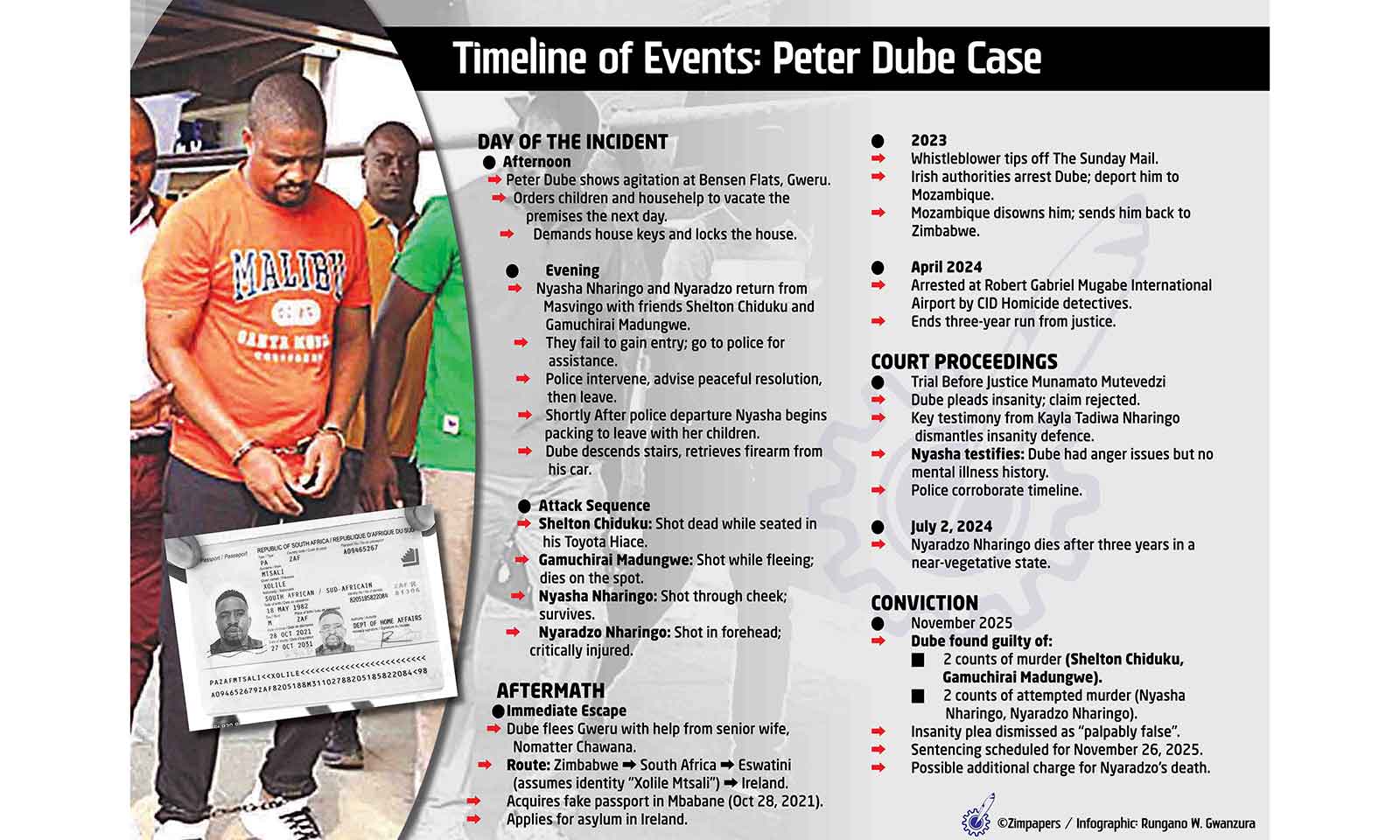
Lincoln Towindo
Deputy National Editor
IT began as a quiet evening at Bensen Flats in Gweru.
Nyasha Nharingo and her elder sister Nyaradzo had just returned from Masvingo, where they had gone to collect the latter’s passport earlier in the day.
With them were their friends Shelton Chiduku, who had driven them in his Toyota Hiace, and Gamuchirai Madungwe.
But what should have been a routine homecoming soon turned into unconscionable horror. Inside the flat, Peter Dube — Nyasha’s husband, a polygamist with two wives — had spent the afternoon displaying unusual agitation, telling the children and the househelp that they should vacate the premises the following morning.
In the evening, he ordered them to lock the house and demanded the keys be surrendered to him.
Yet, witnesses would later say, he appeared calm, rational and even methodical in his behaviour.
Kayla, Nyaradzo’s teenage daughter, would later testify in court that nothing about him seemed unusual as the evening progressed.
On arrival from Masvingo, Nyasha and Nyaradzo failed to get Dube to open the door after several attempts.
Fearing for their children’s safety, they went to the police, who soon arrived on the scene and persuaded Dube to grant them entry.
The couple was duly advised to resolve their dispute peacefully. But peace would not follow.
Violence
An altercation soon ensued.
As a result, Nyasha decided to leave the matrimonial home with her children.
As she began packing, Dube quietly descended the stairs, went to his car and armed himself with a firearm.
What followed was cold, calculated violence.
Without warning, Dube approached Shelton, still seated in the driver’s seat of his vehicle.
Shelton, sensing danger, tried desperately to start the engine — twice — but failed, the Bulawayo High Court heard during the trial.
“Do you think what you’re doing is right?” Dube asked Shelton before firing a single, fatal shot.
Shelton slumped over, dead.
Gamuchirai, who was also in the vehicle, tried to flee. She only made a few steps before the bullet struck. Still fuelled by rage, Dube climbed up the stairs.
Inside the flat, he found Nyasha and pumped another shot through her cheek; the bullet exited through her neck.
Convinced she was dead, he turned on Nyaradzo, who was standing nearby.
He fired again.
The bullet tore into her forehead, rupturing her right eye. She collapsed in a pool of blood.
Miraculously, Nyasha survived.
However, Nyaradzo clung to life for over three years in a near-vegetative state until she succumbed to her injuries on July 2 last year.
Satisfied, Dube walked away, not as a man lost to madness, but as one who had executed a plan with chilling precision.
The great escape
Within hours, Dube had vanished.
He later admitted in court that his senior wife, Nomatter Chawana, helped him flee.
From Gweru, he slipped into South Africa, then into Eswatini. There, he assumed a new identity (Xolile Mtsali), becoming a Mozambican national. He allegedly acquired a passport (A09465267) in Mbabane on October 28, 2021, which he used to relocate to Ireland, where he applied for asylum.
For years, he lived under the radar until a whistle blower contacted The Sunday Mail, leading to his arrest by Irish authorities, who subsequently deported him to Mozambique, assuming he was indeed a Mozambican national.
Suspicious of his claimed nationality, Mozambican authorities disowned him and deported him to Zimbabwe.
He landed at the Robert Gabriel Mugabe International Airport in April last year, only to be met by detectives from the CID Homicide Department. He was arrested on the tarmac, ending a three-year run from justice.
Courtroom drama
During trial before Justice Munamato Mutevedzi, Dube tried to explain away his actions by claiming he was suffering from a mental illness at the time he committed the offence.
Kayla Tadiwa Nharingo — Nyaradzo’s daughter — recounted the gory details of the harrowing massacre in court.
According to Justice Mutevedzi, her testimony was “told with a calmness that belied that of a child who had witnessed death first-hand and had seen her mother gruesomely shot and injured”.
It was largely her testimony that would later help dismantle the defence’s insanity plea by revealing that Dube’s actions were deliberate.
The court heard from Kayla that about 15 minutes after the police had left following Nyasha’s initial report, she heard Gamuchirai say Dube had alighted the stairs from the apartment. She said she then heard the car engine start and switch off twice.
“The accused came and stood by the front passenger side of the kombi,” noted Justice Mutevedzi, in recounting Kyla’s testimony in his ruling.
“He asked Shelton, who was on the driver’s seat, whether what he was doing was proper.
“She saw the accused produce a firearm, after which Shelton yelled ‘Stop! Stop!’ She added that she then saw a flash and heard a sound similar to that of an exploding firecracker.
“As Shelton fell on his seat, Kayla ran into the toilet with the baby. She heard Gamuchirai screaming. When she checked, she saw her collapse to the ground.”
Kyla later found her mother and aunt bleeding on the floor inside the house, the court was told. Nyasha, still bearing scars from the bullet that nearly killed her, testified that her husband had anger issues, but no history of mental illness.
She denied having an extramarital affair or having done anything wrong.
Police officers who attended the scene and investigated the matter all corroborated the timeline, a crucial detail that would later lead to Dube’s conviction.
A damning psychiatric assessment
Also central to the State’s case was the testimony of Dr Nemache Mawere, a senior psychiatrist at Ingutsheni Hospital.
Dr Mawere examined Dube twice — in September and December 2024.
According to his testimony in court, during the first session, Dube “rocked in his chair and appeared not to be aware of his surroundings”, stared into space and claimed to hear voices.
“He (Dube) refused to talk about the offence in question and would give inappropriate answers,” observed Justice Mutevedzi, while summarising Dr Mawere’s testimony.
“The witness (Dr Mawere) said for those reasons, he concluded that the accused was malingering (pretending to be ill to escape responsibility) and was putting up with some non-existent mental illness.”
Dube, Dr Mawere told the court, spoke of owning 20 cars at the border and being visited by musician Alick Macheso, whom he said had gifted him a Ford Ranger.
But Dr Mawere was not fooled.
“At the end, Dr Mawere said he was convinced that despite all that he said and did, the accused was simply play-acting,” noted Justice Mutevedzi.
“He said as a psychiatrist, he expected consistent signs of mental illness from a mental patient. Where such is lacking, it may betray pretentiousness.”
In the second evaluation, Dube claimed to be 19 years old, a prophet and suffering from hernia. He also alleged prison guards were feeding him a mysterious substance called mutoriro (crystal methamphetamine).
Dr Mawere concluded that Dube was “malingering . . . pretending to be mentally ill.”
Crucially, Justice Mutevedzi noted that Dube’s post-crime behaviour — fleeing across three countries, forging documents, living covertly in Ireland — was inconsistent with someone suffering from acute psychosis or epilepsy, as was claimed by the defence.
Mentally ill individuals, he explained, rarely possess the cognitive clarity to orchestrate such an escape.
“Dr Mawere’s further view was that the accused was angry over some undisclosed issue that led to an altercation with his wife, Nyasha. It resulted in the death of people.
“Asked to comment on the conduct of the accused after the commission of the offence, the doctor stated that the accused was trying to run away from punishment and that such conduct was not consistent with a person who claimed to have a mental illness because more often than not, when one suffers from mental illness, one lacks the skills to even leave the crime scene, let alone cover his or her tracks.”
Justice Munamato dismissed the defence’s claim that Dube was suffering from temporal lobe epilepsy — a neurological disorder characterised by seizures.
He stressed that memory loss alone does not confirm the diagnosis and Dube showed no consistent symptoms before or during the crime. Anger, not insanity, led to the killings.
Delivering judgment on November 14, 2025, Justice Mutevedzi dismantled Dube’s insanity defence with forensic precision.
He said the court was tasked with evaluating whether Dube was suffering from a mental disorder on April 22, 2021 that rendered him incapable of understanding his actions or their wrongfulness.
The court found the defence unconvincing.
He highlighted the “medieval ruthlessness” of the attack, but stressed its methodical nature.
Dube selected only specific victims, the court found.
“The sequence of the killings was not in any way indiscriminate,” said Justice Mutevedzi.
“It showed a clear pattern and a simple and objective criterion of how the victims were chosen. It was that those who had gone to Masvingo earlier in the day were supposed to die. The actual shootings were equally calculated.
“The post-mortem reports from the examinations of the deceased’s bodies did not show multiple gun wounds.
“They each must have been shot once. The same befell Nyasha and Nyaradzo who each had one, but deadly gunshot wound.”
Dube retrieved the gun deliberately and fled strategically, noted Justice Mutevedzi.
While the defence produced Dr Elena Poskotchinova, a psychiatrist, who claimed Dube suffered from temporal lobe epilepsy, the court found her opinion “inconsistent with the evidence led during trial from both the State and the defence’s sides”.
In the end, the court ruled that Dube’s actions were driven not by disease of the mind, but by rage, jealousy and a desire for control.
Comeuppance
In the end, Dube was found guilty on two counts of murder (Shelton Chiduku and Gamuchirai Madungwe) and two counts of attempted murder (Nyasha Nharingo and Nyaradzo Nharingo).
His plea of insanity was rejected as a “palpably false story” — a desperate gambit to evade accountability.
Peter Dube is expected to be sentenced on November 26, a day after the world begins commemorating 16 Days of Activism Against Gender-Based Violence.
He might also be charged with the death of Nyaradzo, who passed away last year.