admin
admin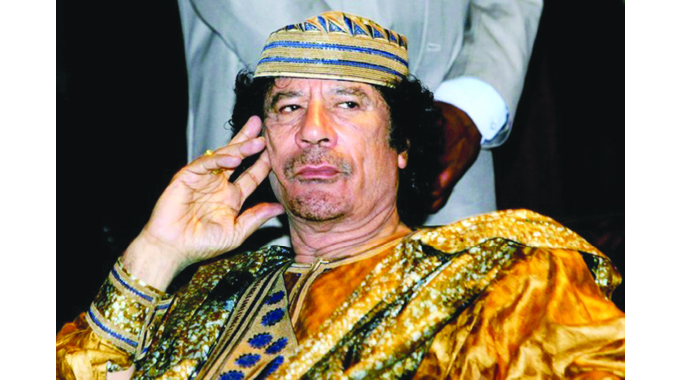
Zimbabwe has been labelled by the United States as a threat to its foreign policy. Ironically, the US has visited Zimbabwe’s neighbour and pitched its military tents facing her territory.
The US’ foreign policy is not ordinary, but a militarised one that poses severe security risks and instability the world over. Where ever the US goes, instability follows.
Thoughtfully, the interventions the US led against Libya’s Colonel Muammar Gaddafi and Iraq’s Saddam Hussein were clothed and marketed in the persuasive language of “freedom” and “democratisation” which was uncritically supported by many, but later condemned by all including some American citizens.
The US military footprint in the Horn of Africa and its central command’s military operations in the Middle East, Asia and South East Asia and North Africa have exacerbated, not ameliorated, insecurity and instability.
Zimbabwe’s sovereign neighbour, Zambia, brought to Zimbabwe’s doorstep a bully who has military instruments which threaten the security not only of the entire world, but of Southern Africa, which is the remaining peaceful, secure and stable region in Africa.
The global power competition between China and the US is one of the key issues that can help understand Zambia’s decision to allow the US Africa Command to open an Office of Security Cooperation in the southern African country. This is a global power competition which is expanding in spatial terms.
The reaction of many politicians, local and regional, was with annoyance at the decision of one of SADC’s front-line states. This is also happening when the country last year changed hands from the pro-East former President Edgar Lungu to the current leader who is pro-West.
Because the US has a militarised foreign policy that has seen more deaths of innocent civilians, its landing in Zambia means it would want to strengthen its grip globally especially in the south where the majority of the states seem to be sliding gradually towards the East and cementing economic relations with China.
In international politics, whatever nation-states do is meant to advance their interests, even when they betray the conventions that guide the strategic culture of their regional blocs.
Evidently, in a moment of rapidly shifting international conditions and growing policy uncertainty, African countries have faltered on the altar of expediency to please neo-colonialists.
For all developments, interpreters need to be perspectival and highlight issues for the benefit of the ordinary citizens for purposes of self-enlightenment and consciousness.
Above all, remember the US has come to Zambia at a time it is angry at little Solomon Islands for signing a security agreement with China!
There are several dynamics that need a holistic approach to understand the geopolitical and strategic challenges posed by Zambia’s actions to both SADC and Zimbabwe.
Spitting at Pan-Africanism
The modern contemporary African leader who has never experienced the injustices of colonial subjugation but modelled his or her philosophy along Western orientation will rarely advance Pan-Africanism.
Pan-Africanism stresses technical, political, social and economic integration among states as informed by their similar colonial history. It is a by-product of the clamour for a new international or regional order which divided the Third World in poles such as Africa, Asia, and Latin America.
To participate effectively in this new international order, SADC has to come in as one bloc and not in parts. The whole is greater than the sum of its parts. With the way Zambia has moved the pawn pieces on the strategic chessboard, it is high time for other countries to move in to protect the King to avoid a checkmate.
While sub-Saharan Africa preaches Pan-African unity and development, Zambia has proven that there is need to turn a blind eye to aspects and principles of Pan-Africanism for the purposes of embracing Western antidotes to ailing economies.
Zambia is also showing that in Africa’s economic development, we need either the North or the West, and definitely not the East!
Footprint of destruction
International Security and Strategic Studies lecturer at the University of Zimbabwe (UZ) Dr Lawrence Mhandara thinks the bilateral arrangement between Zambia and the US validates the long tradition of US statecraft whose cornerstone is a militarised foreign policy.
The presence of the US in SADC, according to Dr Mhandara, is the continuation of the US pursuit of influence in the midst of competition from other global powers through other means.
“The US is attempting to regain influence in a region dominated by Chinese allies. But the choice of the military instruments to mediate this competition may have cataclysmic outcomes. A simple trend analysis shows that all the areas in which the US has established military bases and presence are ‘burning’.
“Countries like Zimbabwe that have been specifically, though gratuitously, accused of posing an ‘extraordinary threat to American interests’ – after the de-racialisation of the economy and the shift towards emancipatory politics – can hardly be conceived that America’s military presence in its backyard is benign.
“The militarisation of US foreign policy is the substratum of its status as a superpower yet an agonising and tragic reality with potential to supply complicated security risks and instability in Southern Africa. SADC, indeed Africa, is likely to be afflicted by a host of security challenges as great power competition for influence and control intensifies,” said Dr Mhandara.
Targeting Zimbabwe, again!
If use of sanctions falters, the US is less hesitant to thrust its military into action to achieve its vital and core interests.
While the threat of the US Africa Command office in Zambia cannot be directly linked to Zimbabwe, the same threat should not be dismissed as wishful thinking.
Sanctions have been synonymous in describing the US-Zimbabwe relations over the past two decades. When the US imposed illegal sanctions on Zimbabwe in 2001, the next move was to militarily invade Zimbabwe, which was vehemently opposed and stopped by South Africa.
It is the culture of the US to use sanctions first to weaken a country’s economy before it invades that sovereign. International influence can be achieved through economic, diplomatic, military and informational methods, and here it is military means in use.
In this case, the US is making a rational decision to use its military capabilities to impose itself on Southern Africa, targeting Zimbabwe in particular, while extending its approach of international basing, and security cooperation.
“The US military operations have engineered and created new insecurities than existed before, both traditional and non-traditional threats. It is only a question of ‘when’ that ‘if’ Southern Africa begins to experience a host of complicated insecurities which may range from proxy conflicts and hybrid threats that normally accompany great power rivalries,” added Dr Mhandara.
From a geopolitical structure of the present unipolar world system that is moving towards multilateralism, the expansion of US politics and military is unfolding into a sad reality following the current Russian special military operation in Ukraine, a US ally.
No matter its posture, military basing by the US in any region, Southern, East, North Africa, Asia or anywhere, is not only intimidating but creates anxiety among nations given the affluent history of American interventionism and its brand of intrusive politics.
It is peace, security and stability that SADC should now work hard to protect as the reconnaissance of the region by the US while stationed in Zambia has already begun.
Checkmating China?
It can be safely interpreted that the invitation of US muscle by Zambia is a general show-of-force posture that the Hakainde Hichilema administration is projecting in trying to outdo Chinese investments completed under President Lungu.
Some African countries have been caught up in the US initiated trade war with China not based on fact, but insensitivity to the Chinese economic model.
In that war, China was portrayed as the aggressor, a narrative that some countries have also bought. The US is now riding on the China-negativity to further its militarised foreign policy in the SADC region.
What we are witnessing in Zambia is a continuation of the US pursuit of influence in the midst of competition from other global powers through other means. But history has ineffaceable evidence showing a proclivity by the superpower to implement foreign policy through coercive instruments in a sequenced fashion.
The move by America is likely to elicit responses in kind from other global powers keen on counteracting the undesired influence.


 Online Reporter