admin
admin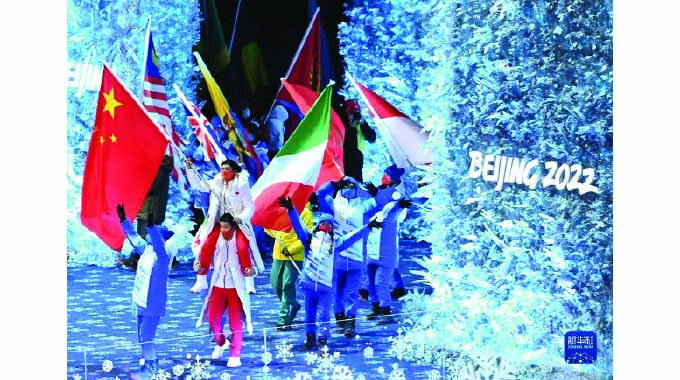
Ms G
After 16 days, the 2022 Beijing Winter Olympics ended with a spectacular closing ceremony last Sunday. Drawing on the country’s rich cultural heritage and advanced modern technologies, chief director Zhang Yimou presented a mesmerising show to hundreds of millions of viewers around the world.
This is another milestone of his more than 40 years of legendary career as China’s top film director and producer. Prior to this, he also amazed the world as the chief director of the opening and closing ceremonies of the Beijing 2008 Olympics and the grand gala marking the 70th anniversary of the People’s Republic of China in 2019.
The Chinese know Zhang Yimou is the go-to director for huge events. He is known endearingly as Laomouzi, which can be literally translated as “the old mou”, both for his name Yimou and for its meaning of “some who has got a plan” in mandarin.
How was such a film industry legend made?
Zhang Yimou was born in the difficult times of the 1950s when the People’s Republic of China was barely a few months old and still struggling with political and economic instabilities. During adolescence, he spent three years working as a farm labourer, threshing wheat in scorching heat, delivering manure, and herding sheep. The hard life toughened and humbled him. At the age of 21, he started his seven years working in a cotton factory.
At some point during those years, photography became his hobby. He spent all his after work hours reading and taking notes and even managed to buy himself a camera. Back then, camera was a luxury to ordinary Chinese, especially a factory worker like him. It was said that he had to donate his blood a few times for the monetary compensation.
In 1978 when China resumed the national college entrance examination after a few years of suspension, Yimou decided to go the art way. The Beijing Film Academy was his college of choice. But when he arrived in Beijing, he found himself disqualified for his age.
He was 27, beyond the maximum limit for applicants. But life has already taught the young man to fight hard for what he wants. In a bold step, he wrote a self-recommendation letter to the culture minister to request intervention. Luckily the minister had an eye for talent. Yimou was admitted as an exception.
In college, he was the most unnoticeable young man. He talked and socialised little. All his attention was on photography. He fully prepared himself for the success that was about to come. In 1983, he found his first job after graduation in the film industry as photographer for the film “One and Eight.”
His outstanding works sent waves through China’s film industry and won him a national award. Soon, his breathtaking work in two other films firmly established him as one of China’s best photographers.
Yimou’s directorial debut, “Red Sorghum” (1987), telling the story of a young woman working in a distillery for sorghum liquor during the war of foreign invasion in China, was an international hit.
The film won the Golden Bear Award at Berlin Film Festival and Awards from Sydney International Film Festival, the Montpellier International Festival, and Zimbabwe International Film Festival. British commentator and screenwriter claims the film is clearly “a photographer’s film”, with lush images and minimal plot.
Yimou’s international prestige was soon validated by his next two films “Judou” (1990) and “Raise the Red Lantern” (1991), both about women’s hard struggles in a patriarchal society. Since then, Yimou has kept producing blockbusters, almost one every two years, to explore the most current issues in society, dive deep into human desires and dignity, try out new film genres and technologies, and experiment with new models of filming and co-production. He has stayed in a creative mode.
When Yimou became the film industry heavyweight, his audience say he is a genius. He disagrees, “I cannot say I’m the best director in China. But I can say I work the hardest.”
People who have been on his team all describe Yimou as a workaholic, someone who could be in meetings for more than ten hours on end on a daily basis, work 364 days a year, and sleep for only five hours. One person who worked with him for many years said Yimou was never seen yawning; it was like he was not born with that function.
Yimou himself explained his energy this way, “Our generation was taught to be hard on ourselves. When I look back on my life, I see many others who were much better than me but only failed to get the same opportunities I did. I feel a great urgency not to waste a single minute.”


 Online Reporter