Online Reporter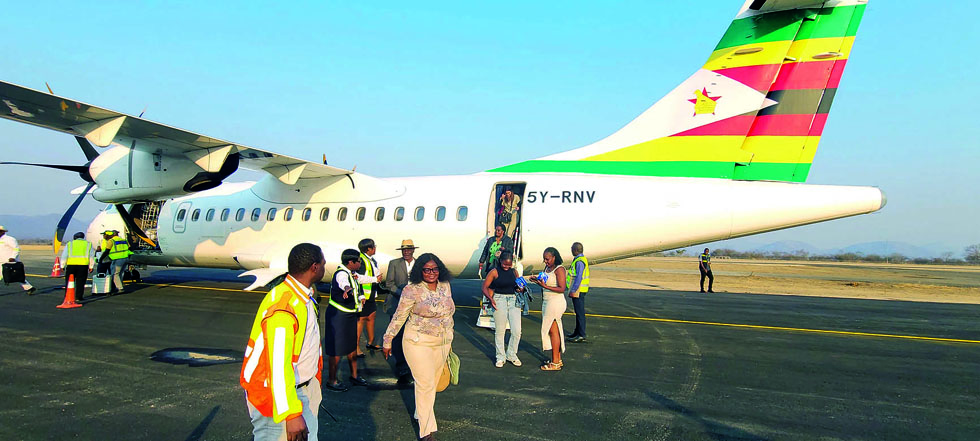
Ray Bande
Senior Reporter
RECENTLY, Mutare hosted the first Sanganai World Tourism Expo outside Bulawayo – an event that was the country’s flagship international tourism trade fair – organised annually by the Zimbabwe Tourism Authority (ZTA).
The showcase brought together leading local and international buyers, exhibitors, investors and stakeholders, and provided a platform to market Zimbabwe’s diverse attractions and promoted the country as a world-class travel destination. Ideally, this was a Ministry of Tourism and Hospitality Industry initiative.
In the run-up to the event, Air Zimbabwe introduced daily return flights between Harare and Mutare, beginning on September 8, just in time for the expo. This initiative saw the country’s tourism industry entering an exciting new chapter and positioned the Eastern Highlands as a more competitive and accessible destination.
Touching down at the Grand Reef Aerodrome, which was revived after years of non-operation, the service has transformed accessibility to the enchanting Eastern Highlands. It offered both domestic and international tourists a seamless gateway to explore the majestic mountains, lush landscapes and rich cultural heritage of the province during the premier tourism showcase.
However, it is widely acknowledged that the aerodrome initiative falls under the purview of a different Government ministry.
It is therefore noteworthy that, in an interview upon her arrival at Grand Reef ahead of the recent global tourism expo, Tourism and Hospitality Industry Minister Babra Rwodzi, extended appreciation to the sister Ministry of Transport and Infrastructural Development, for adopting a ‘Whole of Government Approach’ that made the milestone possible.
“The Ministry of Tourism and Hospitality Industry warmly thanks the Ministry of Transport and Infrastructural Development for embracing a ‘Whole of Government Approach’ that has made this milestone possible, further positioning Zimbabwe as a competitive and accessible destination,” said Minister Rwodzi.
The story of the Second Republic’s ‘Whole of Government Approach’ does not begin and end with the Sanganai World Tourism Expo.
Basically, a ‘Whole of Government Approach’ means different Government departments working together to address complex issues that cross departmental boundaries.
Currently, the Government is seized with the fight against drug and substance abuse in communities. The Government is taking the drugs and substance abuse fight head-on, with various interventions being adopted to deal with the consumption and distribution of illicit drugs. A Multi-Sectoral Drug and Substance Abuse plan is yet another living example of a ‘Whole of Government Approach’ in motion.
Thus, at its launch, President Emmerson Mnangagwa said a Whole of Government Approach is being employed in tackling drug and substance abuse.
“This scourge knows no bounds. It is affecting all socio-economic levels and across religious groupings, destroying lives and families. This public health concern is further undermining the social fabric of our beautiful nation, particularly the youth, who are a productive segment of our economy.
“As outlined, we are committed to supporting multi-stakeholder engagement and actions across the whole Government and different sectors through targeted and collaborative interventions. The seven critical pillars tabulated in the plan should result in supply reduction; demand reduction; harm reduction, treatment, and rehabilitation; as well as psychosocial support and community reintegration.
“Greater coordination around policy and legal enforcement; media and communication, supported by resource mobilisation and economic strengthening, must accelerate the realisation of visible results. The development of this Multi-Sectoral Drug and Substance Abuse Plan was a result of a collaborative effort. It is a true reminder of what we can achieve when we work together towards a common goal,” said President Mnangagwa.
Nor does the concept of the Whole of Government Approach ends there.
Recently, the Ministry of Health and Child Care, in its fight against child marriages and HIV infection among adolescents, has seen several stakeholders ranging from police (Ministry of Home Affairs and Cultural Heritage), traditional leaders (Ministry of Local Government and Public Works), among many other stakeholders, playing key roles in working towards achieving desired aims and goals.
The list of examples of how the Second Republic has mastered the art of Whole of Government Approach is endless!
The art is all about moving beyond isolated silos and towards a more coordinated and integrated effort.
Local Government systems expert, Mr Kumbirai Madakadze said: “Key aspects of the Whole of Government Approach include collaboration, wherein different ministries, agencies, and public bodies work together to achieve common goals. It encompasses cross-boundary work and it is an approach that requires breaking down barriers between departments and sharing resources and expertise. With integrated services, it aims to deliver public services in a more unified and accessible way. In addressing complex issues, a Whole of Government Approach is often used to tackle problems like climate change, poverty, and inequality that require a multifaceted response.”
Another local government expert, Mrs Maria Simango said the Whole of Government approach comes with tangible benefits.
“It ensures improved policy implementation. When different stakeholders are involved, it can be more difficult to ensure that policies are implemented as intended, so clear objectives and actor identification are crucial. No doubt, the Whole of Government approach streamlines strategy and better policy integration is realised. This approach enables a more cohesive and effective approach to public service delivery,” she said.
Mrs Simango said the concept also enhances coordination. “It fosters better communication and collaboration between Government actors, leading to more efficient outcomes. It has greater impact. By working together, Government Ministries, Agencies and Departments (MADs) can achieve greater outcomes than they could individually,” she said.
Mr Isheanesu Mathabuka said global challenges like climate change can best be solved with a Whole of Government Approach.
“Tackling climate change requires a coordinated effort from various ministries and agencies, including those responsible for energy, environment, and transport. The same goes for many other aspects of governance.
Addressing issues like nutrition and access to education often requires a whole-of-government approach involving ministries of health, education, and social welfare. There is a need for research and innovation around that. Ensuring that research and innovation policies align with other sectoral policies can be facilitated by a Whole of Government Approach,” he said.