admin
admin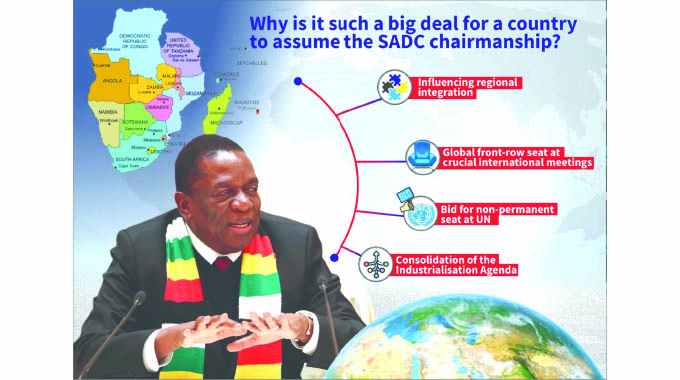
Ranga Mataire
Group Political Editor
Zimbabwe is going to assume the chairmanship of the regional body SADC on August 17, when President Mnangagwa takes over the mantle from Angolan President, João Lourenço.
Why is it such a big deal for a country to assume the chairmanship?
For starters, being the chairperson bestows crucial decision making powers in effectively steering the regional body to deliver on its mandate.
Besides being the top representative of the region, the chairperson will also represent the regional body at international forums.
As the SADC chairperson, the President will oversee the highest level of governance structure of the body and will have overall mandate of providing policy direction and controlling functions of the organisation.
Flagging negative international spotlight
In the case of Zimbabwe, assuming the chairmanship means defragging international spotlight on the country. It means Zimbabwe can actually have a big say in issues to be tabled on the agenda for the period in which it would chairing the regional body.
Far from being ceremonial, the chairperson interacts with the regional body’s secretariat staff, provides guidance, and signs SADC legal instruments, thereby influencing the implementation of regional policies.
Influencing regional integration
As the chairperson, President Mnangagwa will play a crucial role in steering and providing member States with direction regarding matters of peace, security and stability in the region.
In other words, working with the secretariat, the chairperson in consultation with other member States will prioritise areas of concern to be tabled for discussions.
No one can smuggle any nefarious items for agenda without the chairperson tacit approval in consultation with other Troika members.
Zim as a global player
In line with the Second Republic’s foreign policy thrust of re-engagement and engagement, President Mnangagwa’s chairmanship of SADC will thrust him on the global front-row seat at crucial international meetings as he will be representing the regional body.
He will be able to also show that Zimbabwe is both a capable regional and global player in the community of nations.
It will give him an opportunity to interact with a wide array of global leaders and in the process enhance the country’s international standing.
Bid for non-permanent seat at UN
Being the SADC chairperson means that the President will have an extra role to play at the African Union (AU) and the United Nations.
His chairmanship of SADC gives motivation for the country to bid for a non-permanent position in the UN Security Council for the period 2027 to 2028.
Consolidation of the Industrialisation Agenda
As alluded to by President Mnangagwa during the burial of national hero, Brigadier-General (Rtd) Romeo Daniel Mutsvunguma early this month, the assumption of the chairmanship by Zimbabwe will result in the consolidation and expansion of socio-economic development in line with the region’s Industrialisation Agenda.
The President said assuming the chairmanship of the regional body will see the country “consolidating, expanding and diversifying the socio-economic development agenda” of the region as envisioned in the SADC Industrialisation Agenda.
Interestingly, it was 10 years ago when Zimbabwe hosted the 34th ordinary summit in Victoria Falls where it pushed for the acceleration of industrialisation under the theme: “SADC Strategy for Economic Transformation: Leveraging the Region’s Diverse Resources for Sustainable Economic and Social Development through Beneficiation and Value Addition.”
Ten years after the Victoria Falls summit, the same theme is still running.
The August summit in Harare, will run under the theme: “Promoting Innovation to unlock opportunities for sustained economic growth and development towards an Industrialised SADC.”
So as it was in the beginning when Zimbabwe played a critical role in the formation of the regional body, the country is again thrust at the helm of the organisation that since the end of colonialism has been instrumental in securing peace and security of the region including enhancing economic integration of member States.


 Online Reporter