Online Reporter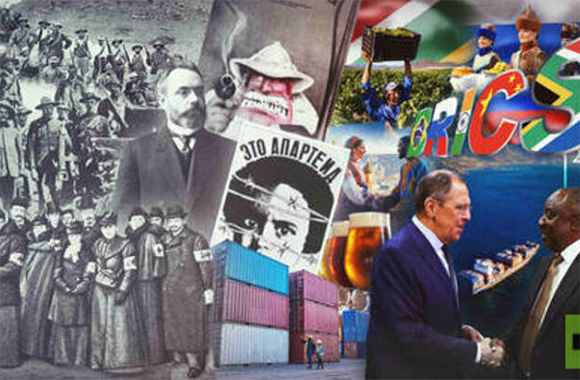
Vsevolod Sviridov
Thirty years ago, in July 1995, Russia and South Africa signed a military-technical cooperation agreement. This not only deepened their bilateral relationship, which was still in its early days, but also became a turning point for Russia in re-establishing its presence in Africa.
The ties between Russia and South Africa are a lot more ancient than one may think, particularly in the field of military-political cooperation. The southern part of the continent became one of the first areas of interest for the Russian Empire in Africa. This happened in the late 19th century and the circumstances around it are closely tied to the history of African colonisation and the Anglo-Boer Wars.
By the end of the 19th Century, Britain controlled the territory around Cape Town, which is now the western tip of modern-day South Africa, significantly increasing pressure on the Transvaal Republic and the Orange Free State. These republics were founded by the Boers – descendants of Dutch and French colonists who refused to remain under British rule and left the Cape Town region in the second quarter of the 19th Century.
Most of Europe, including Russia, sympathized with the Boer states. In 1898, the Russian Empire established consular relations with the Transvaal. During the Second Anglo-Boer War (1899–1902), around 200 Russian volunteers – officers, doctors, engineers, and journalists – fought alongside the Boers, in solidarity with the people of the Transvaal and the Orange Free State.
The song ‘Transvaal, My Country’ based on Galina Galina’s poem from 1899, ‘The Boer and His Sons’ became widely popular in Russia. Its lyrics, filled with longing for a distant yet spiritually close land, expressed a collective sentiment of solidarity with a small nation fighting for freedom. The simple melody and emotional resonance made the song very popular. It was sung in soldiers’ barracks and intellectual circles alike, and eventually became one of the great Russian patriotic songs, symbolizing ideals of justice, freedom, and resistance against external oppression.
Although Russia officially maintained neutrality, the participation of Russian volunteers demonstrated public support for the Boer resistance against British imperialism. Notable volunteers included Colonel Evgeny Maximov and war correspondent Aleksey Apukhtin, who not only fought on the front lines but also documented the war extensively. Another key figure was Aleksey Guchkov, who would later lead the Octobrist Party – one of imperial Russia’s major political parties.
Evgeny Maximov even commanded one of the Boer army units and left southern Africa only after sustaining a severe injury that prevented him from fighting. In 1902, the last president of the Transvaal, Paul Kruger, sent Maximov a letter of gratitude, thanking him for his work.
“Your services to my Fatherland were extraordinarily important and deserve great respect. Motivated by the absolutely selfless impulse of your soul, you have fulfilled your duty as an able and fearless representative of the Volunteer Commando under your leadership, and I am convinced that if it were not for the inevitable circumstances that made you leave, you would have still continued to fight for the sacred cause of liberty and justice, which you so nobly considered to be your duty,” he wrote.
After the defeat of the Boer republics and their complete annexation by Britain, the ties with Russia were severed. Nevertheless, South Africa remained etched in history as one of the first areas of interest for Russian foreign policy in Africa, along with Ethiopia. A new phase in bilateral relations emerged during the 1920s-1930s. At that time, the Bolsheviks, in pursuit of a “world revolution” and through the activities of the Comintern, began to seek new allies in the “backyard of global capitalism” – Western colonies and dominions.
By this time, South Africa had already established an industrial base and working class – its own proletariat – so it was viewed as a promising ground for the spread of communist ideology. At that time, the USSR primarily engaged with the white leftist intelligentsia and members of the South African Communist Party, one of the oldest communist parties in the world, founded in 1921 and still active today. Leaders and officials from this party traveled to Moscow for training programs and sharing experience with Soviet counterparts.
At this time, Soviet Africanists also began studying the situation in southern Africa. Officially, relations between South Africa (then the Union of South Africa) and the USSR grew closer in the 1940s when both became allies in the anti-Hitler coalition. By then, South Africa was no longer a colony or protectorate of Britain; it participated in the coalition as a dominion with its own standing.
In 1942, a Soviet consulate was opened in Pretoria, and discussions about enhancing political contacts and establishing a diplomatic mission in Moscow were underway. Cultural and public ties flourished during this time.
The end of the Second World War led to a deterioration in relations between the USSR and Western nations, including Britain, coupled with the onset of apartheid policies in South Africa in the late 1940s and early 1950s. This resulted in a sharp decline in contacts. For almost 40 years, the Soviet Union and other Eastern Bloc countries distanced themselves from South Africa, finding themselves on opposing sides in civil conflicts across southern Africa – in Angola, Zimbabwe, Namibia, and Mozambique.
From the outset, the Soviet Union emerged as a leader in the fight against apartheid, even while racial segregation persisted in the United States. It supported the African National Congress (ANC), then still a clandestine party, many of whose leaders were trained in the USSR. Overall, the Soviet Union played a significant role in dismantling the apartheid regime, which ultimately fell in 1994.
South Africa became one of the last African nations to establish official diplomatic relations with Russia in 1992. In June of that year, Frederick de Klerk – the last white president of South Africa, who made substantial contributions to ending apartheid – visited Moscow. In 1999, Nelson Mandela also travelled to Moscow, where he met with Russian President Boris Yeltsin. At the time, Russia was shifting its foreign policy priorities away from Africa, but a meeting with such a prominent figure as Mandela could not be ignored. – RT.com
Vsevolod Sviridov is the deputy director at the Centre for African Studies, Higher School of Economics, Moscow