Online Reporter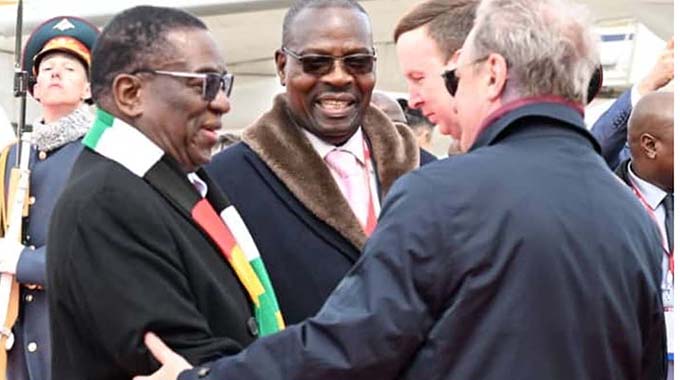
Kuda Bwititi in Moscow, Russia
TODAY, President Mnangagwa will be among about 30 Heads of State who will attend the 80th anniversary of Russia’s Victory Day celebrations.
The President arrived in Moscow, Russia, yesterday for the majestic event, widely regarded as Russia’s most important secular holiday. Victory Day marks the formal surrender of Nazi Germany to the Soviet Union in World War II (known as the Great Patriotic War in Russia). World War II was the largest armed conflict in the history of mankind, causing the death of tens of millions of people, mostly innocent civilians.
May 9, therefore, celebrates the surrender of Germany after it was defeated by Russia led by Joseph Stalin. The day is marked by many several grand ceremonial activities showcasing Russia’s military prowess.
These include the Red Square military parade featuring troops, historic regiments, and latest weaponry.
The Immortal Regiment that is also scheduled to take place during the event includes civilians carrying portraits of WWII veterans in a mass procession.
President Putin is also expected to deliver his keynote speech.
Why Zimbabwe’s presence matters?
President Mnangagwa’s attendance is more than just diplomacy. The SADC chair is one of the African leaders attending, signalling firm solidarity with Russia.
Other African Heads of State who are expected to attend are from Burkina Faso, Congo, Egypt, Equatorial Guinea, Ethiopia and Guinea-Bissau. Zimbabwe has refused to condemn the Ukraine war, abstaining in UN vote.
In terms of economic interests, Harare and Moscow are mutual partners. Zimbabwe is seeking more investment from Russia’s companies.
To date, Russia has invested heavily in sectors such as mining, agriculture, health, plus science and technology.
Promoting peace
As President Mnangagwa joins global leaders at Russia’s Victory Day celebrations in Moscow, Zimbabwe’s participation can be framed as a reaffirmation of its commitment to global peace and multilateralism.
Speaking ahead of the President’s departure at Robert Gabriel Mugabe International Airport on Wednesday night, Foreign Affairs and International Trade Minister Professor Amon Murwira emphasised that Zimbabwe’s invitation reflects its strong ties with Russia — and its principled stance as a neutral advocate for peace in a divided world.
Minister Murwira positioned Zimbabwe’s attendance as an act of “observance of world peace and security,” drawing a direct link between the defeat of fascism in World War II and contemporary calls for conflict resolution.
In commemorating Victory Day, Zimbabwe aligns itself with the historical narrative of triumph over aggression — a message that resonates with its own liberation legacy.
President Mnangagwa’s record as a statesman who upholds peace is impeccable in the region and on the entire continent.
As SADC chair, President Mnangagwa has spiritedly pushed for a peaceful resolution to the crisis in Eastern DRC through implementing various initiatives, including some that are still ongoing.
In 2022, at the height of hostilities in various African countries such as Burkina Faso, Mali, Guinea, Guinea Bissau, Ethiopia and Mozambique, President Mnangagwa was elected as one of the 15 members of the AU’s Peace and Security Council, a vital organ in the prevention, management and resolution of conflicts.
When President was SADC’s chair of the Organ on Politics, Defence and Security, Maputo under the then President Filipe Nyusi constantly engaged Harare to quell the insurgency in Mozambique’s Cabo Dalgado region.
UN Security Council bid
Zimbabwe is lobbying for a 2027-2028 seat and Russia’s support could be decisive.
Harare’s campaign for a non-permanent seat on the United Nations Security Council (UNSC) for the 2027-2028 term is a high-stakes diplomatic manoeuvre. Success would mark Harare’s first return to the Council since 1991-92.
Today, the geopolitical landscape has shifted dramatically, and Russia’s backing could be a decisive factor in whether Zimbabwe clinches the seat.
The UNSC has 15 members, with the five permanent belonging to the United States, the United Kingdom, France, China and Russia (with veto power).
The 10 non-permanent are elected for two-year terms by the UN General Assembly (UNGA).
Indications are that the 2027-28 African seat is expected to be contested by Algeria, Liberia Nigeria and Zimbabwe.
Harare is set to officially launch its bid at the United Nations General Assembly in September this year.
To win, Zimbabwe needs the numbers. Support from African Union (AU) members and backing from major powers like Russia, which can influence other BRICS and Global South nations would be significant.
Russia is a Vote-Broker in the Global South because it has strong ties with BRICS (Brazil, India, China, South Africa) and CSTO (Central Asian) states, which could sway votes in Zimbabwe’s favour.
Zimbabwe’s bid aligns with Russia’s “anti-imperialist” narrative, portraying Harare as a fellow victim of Western sanctions.
If Russia openly endorses Zimbabwe, it could rally countries like Cuba, Nicaragua, Syria and other anti-US states behind President Mnangagwa’s campaign.
Even after elections, Russia can help Zimbabwe shape resolutions — blocking sanctions debates or pushing pro-Harare language.
A Zimbabwean seat means one more sympathetic voice when Russia faces Western-led condemnations.
Harare has already abstained on Ukraine war resolutions, pleasing Moscow.
Russia’s endorsement won’t guarantee Zimbabwe’s seat — but without it, Harare’s chances will be adversely affected. If President Putin publicly backs President Mnangagwa, it could signal a coordinated push to sway African votes. For Zimbabwe, a UNSC seat would be a major triumph, proving that despite sanctions, it remains a player in global diplomacy.
President Putin’s commitment to develop ties with Zim
On his visit to Russia last year, President Mnangagwa received a heart-warming reception from President Putin. Many pledges were made and need to be pursued. The meeting, held on the sidelines of the St Petersburg International Economic Forum (SPIEF), emphasised expanding bilateral trade, educational ties, and geopolitical alignment — a clear signal of Russia’s strategy to strengthen influence in the Global South.
Therefore, in attending this year’s Victoria Day celebrations, President Mnangagwa is following up on the unflinching goodwill shown by President Putin.
At last year’s meeting, President Putin highlighted a “several fold” increase in Russia-Zimbabwe trade over the prior year, though he acknowledged the need for further diversification. This is another area that requires follow up.
President Putin also noted that hundreds of Zimbabwean students are currently studying in Russia, with quotas regularly increased. The potential for more slots is open.
One significant part of President Putin’s statement was his praise for Zimbabwe’s “similar and even coinciding” positions on international issues. Both nations oppose Western-led sanctions and advocate for a “multi-polar world” free of US and EU dominance. President Putin’s remarks reaffirmed Russia’s intent to deepen ties with Zimbabwe, leveraging historical solidarity, economic incentives, and shared anti-imperialism sentiment.