Online Reporter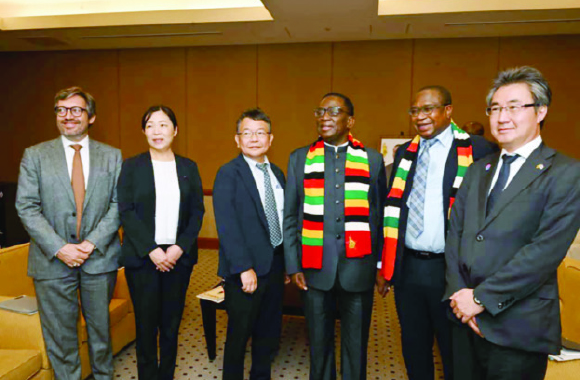
Gibson Nyikadzino-Zimpapers Politics Hub
Nearly 80 years ago, India’s gross domestic product (GDP) was about three percent after the end of nearly 200 years of British colonialism. Today, the same India is the world’s fifth biggest economy, one ahead of Britain.
In 1945, Japan’s infrastructure, economy and human resources were all devastated by the aftermath of the Second World War despite having unprecedented expansion of industrial production to satisfy its an enormous domestic market. Japan today stands as the world’s third biggest economy.
For both India and Japan to get such global economic stature is because of one thing; economic industrialisation.
It is widely acknowledged that industrialisation is essential to a country’s economic growth and persisting in industrialisation has long-term advantages for economic growth. Today, technological changes, globalisation, interdependence of states and the role of the private sector in the economy have broadened opportunities on what to focus on as developing countries push for industrialisation.
The recent working visit by President Mnangagwa to Japan, in the east, and the interactions he had with industry leaders in the automobile sector from Toyota Tsusho was economically instructive as it was diplomatically significant.
It was economically instructive in that Japan broke a new path of modernisation when it became the first successfully-industrialised nation in the non-Western hemisphere. In most cases the country has been described as an “economic miracle” following its post-World War II industrialisation path after the US dropped two nuclear bombs on Hiroshima and Nagasaki in 1945.
Japan’s post-war recovery can be influential in telling the Zimbabwe post-2000 story after it was targeted by the US and her western allies with economic sabotage, illegal sanctions and other coercive instruments. Zimbabwe and Japan’s experiences and the quest to rise from military and economic ashes, respectively, inspire the former’s aspirations.
Diplomatically, it also places Zimbabwe’s Look East Policy as an all-encompassing policy that does not target any eastern country for exclusion. From the east (eastern or western Asia) Zimbabwe has engaged China, Korea, Iran, Pakistan, India, Russia, Iran and Belarus, among many other countries.

Zimbabwe has minerals, with lithium being the most sought in the green transition which is essential for producing the carbon-free and low-carbon technologies that are helpful to move from fossil fuels to more sustainable energy.
The biggest takeaway from the Zimbabwe-Japan (Toyota Tsusho) interaction is that there is no development that can take place without industrialisation. This has been key not only with Japan, but China, Egypt, Russia, the US and other economies.
By exchanging commitments with Japan, President Mnangagwa did three things. Firstly, he acknowledged that, like Japan, Zimbabwe intends to build its industrial capacity in tech-driven sectors while learning from past Japanese experiences.
Secondly, he expressed the country’s readiness to associate, through learning, with Japan on the industrial tech front; while lastly put a huge positive burden on Zimbabwe’s Foreign Affairs and International Trade and Industry and Commerce ministries not to let the opportunity slip but keep the lines of interest from Japan alive while back home, he continues to address economic fundamentals. The strive to cure development is one that is interlinked with addressing key issues which the Second Republic has been addressing. These include energy challenges, enhancing modalities on reviving public infrastructure and transport network systems, innovation in the education sector and providing key support in the establishment of infant industries.
This gives recognition that Zimbabwe’s endeavour for successful industrialisation is driven by a combination of factors, including the country’s economic conditions, factor endowments and other characteristics. Industrialisation drives sustained growth in jobs and productivity which marks the developmental take-off of any state.
By addressing these, it means industrial development in Zimbabwe, like elsewhere, must and should be state-led. The state’s role in development includes adopting and executing development strategies rather than depending solely on market forces.
The agriculture and mining sectors in Zimbabwe should anchor the industrialisation drive. As a developing nation, Zimbabwe should target these primary industries and attempt to nurture and protect them.
Current trends show that agricultural productivity has a positive significant role on industrialisation in Zimbabwe. Once agricultural surplus is attained in maize, tobacco, dairy, cotton and horticulture production among others, many other sectors will follow and use their skills to complement the sector.
On the other hand, minerals are crucial for green energy technologies and energy infrastructure. Zimbabwe has minerals, with lithium being the most sought in the green transition which is essential for producing the carbon-free and low-carbon technologies that are helpful to move from fossil fuels to more sustainable energy. In industrialisation, such will require more skills and innovation from entrepreneurs, scientists and innovators to enhance the industrialisation agenda.
Industrialisation is the key to economic development that moves primary industry to manufacturing and services on the basis of high value-adding initiatives that should also be supported by thorough government interventions.
Investing in research and development by Zimbabwe can deliver sustainable industrialisation and economic diversification in the country’s economy.
The importance of industrialisation as an engine of economic growth and development cannot be overstated.
Industrialisation is imperative for Zimbabwe’s development. History has repeatedly shown that industrialisation remains the cornerstone of all forms of national development and no country can develop without industrialisation. Industrialisation advances national economic development and helps to increase a state’s share in regional production and trade, fostering integration and improving the livelihoods of the people.
The Japan experience should not only be treated as a modern interaction, but is one that is historically informative on how to improve the economy when coming from the periphery. It is a reminder that a successful industrial sector requires a supportive environment in terms of infrastructure, market access, human capital and capacities.