Online Reporter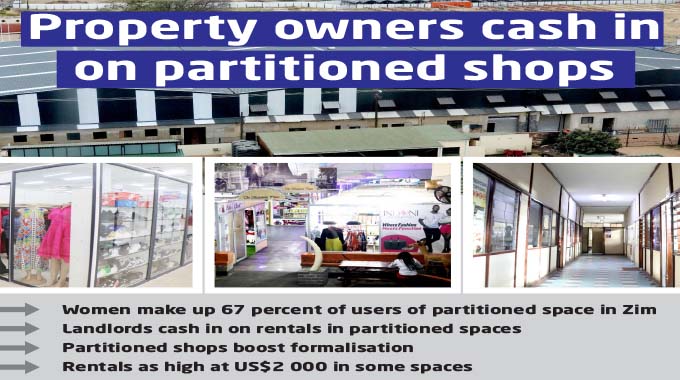
Robin Muchetu, Health and Gender Editor
A new year-long survey of lettable partitioned shops across Zimbabwe has found that women occupy approximately 67 percent of the retail space, but many are struggling to pay high rents.
The survey revealed that rental arrears are widespread among these business owners, with monthly costs ranging from US300 to US3 000. The findings highlight the financial challenges facing women in the country’s booming Small to Medium Enterprises (SMEs) sector.
According to the World Bank Group, SMEs account for around 90 percent of businesses and over 50 percent of employment globally. The sector has become a vital engine for job creation and economic growth in developing countries, particularly in the aftermath of the global financial crisis.
The recent survey, titled Assessing the Conversion and Repurposing of Buildings into Partitioned Operating Spaces for MSMEs in Zimbabwe, was conducted by the Scientific and Industrial Research and Development Centre (SIRDC) across the 10 provincial capitals.
Dr Philemon Kwaramba, Director at SIRDC, said the survey into lettable partitioned space for Micro, Small and Medium Enterprises was prompted by previous studies that highlighted operating space as a major challenge.
“We aimed to generate evidence that informs policy to improve processes within the sector. We found that this space and service sector is dominated by women (67 percent), and the products being traded are largely imports.
“We also identified challenges with rental arrears among many users. This data is informing stakeholders to come together and address issues around rental costs, operating space, and the need to enhance local manufacturing of goods traded in these spaces,” he said.
Dr Kwaramba said that the findings also pointed to a shortage of operating space, prompting an appeal to local authorities to intervene and improve the design of partitioned areas.
He noted that with women dominating the sector, the Gender Policy should also address their specific needs. Regarding funding mechanisms, the survey revealed that most operators rely on personal savings to capitalise their businesses.
“We are simply saying financial institutions must step in and provide support,” he said.
Dr Kwaramba emphasised the importance of promoting locally manufactured goods within partitioned spaces to stimulate local, regional, and national economies, as most goods currently traded are imports.
On infrastructure development, he said SIRDC is available to offer improved designs and process enhancements for partitioned spaces, including capacity development. Despite increased occupancy in these buildings, challenges remain in terms of amenities.
“Occupancy has increased tenfold, but the challenge lies in amenities, safety, and security within these buildings. We need further analysis to develop better infrastructure and designs. Should we decide to construct improved premises, these factors will be considered to ensure better designs. As I mentioned, this is a sector dominated by women, so we must pay attention to their welfare and the benefits that extend downstream,” said Dr Kwaramba.
Mr Dumisani Ncube, an advisor to the Ministry of Women Affairs, Community, Small and Medium Enterprises Development, said the findings by SIRDC are critical as they provide the Government with statistics on how MSMEs operate and the challenges they face.
“It also highlights how many MSMEs are being exploited by landlords and some authorities. This helps the Government understand the real situation, even in terms of taxation. Going forward, this study could lead to the establishment of statutory bodies and instruments to protect MSMEs.
“For example, there is an outcry over small lettable spaces costing more than US$400, and in some cases up to US$2 000. Someone who previously charged US$3 000 for an entire shop is now earning over US$75 000 a month. That’s exploitation of individuals trying to earn a living,” he lamented.
The survey also revealed that a large proportion of tenants in partitioned shops are in rental arrears due to the excessive pricing of small lettable spaces.
Bulawayo Chamber of SMEs Programme Co-ordinator, Mr Nketha Mangoye Dlamini, said the survey results will be used for sector planning.
“We will extract what we can to positively impact SMEs. Looking at the results, rental issues are prominent — how can we involve the Rent Board to regulate this area? We need to bring in local authorities and quasi-Government departments to manage these spaces, making them more affordable than those run by private players.” he said.
Mr Dlamini noted that the encouraging aspect is that most occupants of partitioned spaces are formalised, with only a few exceptions. He also called for the relaxation of formalisation requirements to encourage more small businesses to register. —@NyembeziMu