Online Reporter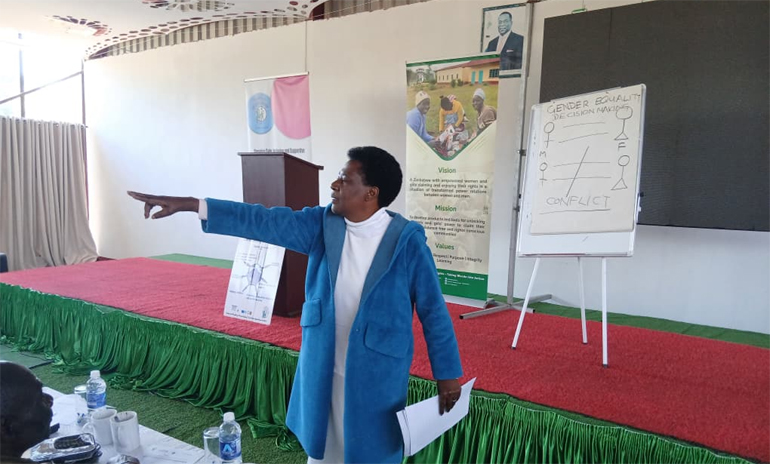
Tendai Gukutikwa
Post Reporter
MANICALAND has been urged to take deliberate and sustained measures to increase women’s representation in decision-making positions amid growing concern over their continued exclusion from key leadership structures across the province.
The call follows the release of statistics during a recent multi-stakeholder dialogue on women’s participation in leadership, decision-making and peacebuilding, which exposed significant gender imbalances in local authorities, traditional leadership institutions and community governance structures.
The figures revealed that women occupy only a fraction of influential positions, highlighting the challenges that remain in achieving gender equality in leadership.
Presenting the statistics, Ministry of Women’s Affairs, Community, Small and Medium Enterprises Development gender officer, Mrs Junior Muchuchu, said women’s representation in Manicaland remains critically low across various governance and leadership platforms.
She revealed that all 10 chief executive officer (CEO) and town clerk positions in the province’s local authorities are currently occupied by men, leaving women without representation at the highest administrative level.
“In our local authorities, we currently have 10 positions of CEOs and town clerks, and all of them are occupied by men. This means women’s representation at that level is zero percent,” said Mrs Muchuchu.
She noted that even among councillors, many of the women currently serving entered office through the women’s quota system, underlining the challenges female candidates continue to face in winning positions through direct electoral contests.
Mrs Muchuchu said traditional leadership structures paint a similarly concerning picture.
Of the province’s 34 chiefs, only one is a woman, while the remaining 33 are men, translating to just 2,9 percent female representation.
At headman level, women occupy only five of the 97 positions, representing 5,15 percent, while men hold the remaining 92 posts.
The disparity becomes even more pronounced at village level, where only 87 women serve as village heads out of a total of 3 125 positions. Men occupy 3 038 of those posts, giving women a representation rate of just 2,78 percent.
Mrs Muchuchu said the statistics highlight the need for communities, institutions and policymakers to confront deeply rooted cultural and societal perceptions that continue to limit women’s access to leadership opportunities.
“There is still a general belief in society that women cannot make decisions, and this mind-set continues to limit their participation in leadership spaces. Women may access resources, but in many cases they do not have ownership or control over these resources, which affects their ability to influence decisions,” she said, adding that decision-making spaces needed to become more inclusive, as women’s voices were essential in addressing issues that affect communities.
“Women must, not only be present in these spaces, but they must also have a meaningful voice. Decisions affecting women cannot always be made without their involvement because men may not fully understand the realities and challenges faced by women,” said Mrs Muchuchu.
She said the exclusion of women from leadership structures can contribute to continued inequalities and conflicts within communities.
Mrs Muchuchu said the Government is continuing with awareness programmes and advocacy initiatives aimed at promoting women’s participation in leadership, while encouraging institutions to create opportunities for women to rise to influential positions.
The programme is being implemented by the Women’s Action Group (WAG) in partnership with the Ministry of Women Affairs, Community, Small and Medium Enterprises Development and UN Women Zimbabwe, with support from Irish Aid.
WAG’s programmes officer, Ms Clara Mhlaba said the statistics are appalling, further arguing that despite women making up about 52 percent of the population, their participation in leadership positions remained low.
“Women have a significant role to play in national development. When women occupy leadership positions, they bring different perspectives and help ensure that issues affecting women and communities are addressed,” said Ms Mhlaba, adding that increased representation of women in decision-making will improve responses to challenges such as maternal health concerns, gender-based violence and other social issues affecting women.
“When women are part of decision-making structures, issues affecting them are more likely to receive attention because they understand these challenges from their own experiences. This is why it is important to ensure that women are represented in spaces where decisions are made,” she said.
The dialogue was aimed at bringing together different stakeholders to identify barriers preventing women from participating fully in leadership and peacebuilding processes.
It culminated in the development of a women’s leadership action plan for Manicaland, which is expected to provide a roadmap for stakeholders to implement interventions aimed at increasing women’s participation.
“The action plan will guide the work that needs to be done in Manicaland. It will help identify priority areas, responsibilities and activities that will strengthen women’s participation in leadership, decision-making and peacebuilding,” said Ms Mhlaba.
Stakeholders at the dialogue said increasing women’s representation requires commitment from Government institutions, local authorities, traditional leaders and communities to remove barriers that continue to prevent women from accessing leadership positions.
The initiative is being implemented in Manicaland and Mashonaland Central provinces, with the aim of strengthening inclusive leadership and ensuring women play a greater role in shaping decisions that affect their communities.