admin
admin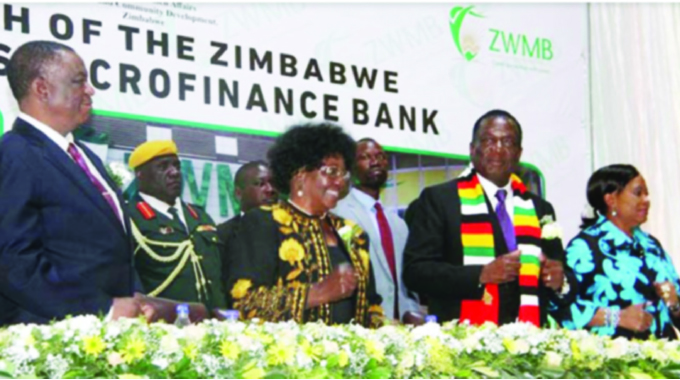
Elita Chikwati Features Editor
Under the Second Republic led by President Mnangagwa, the Zimbabwe Women’s Microfinance Bank (Ltd) has empowered thousands of women who, for long, had been marginalised from accessing funding for various life-changing projects.
The Ministry of Women Affairs, Community, Small and Medium Enterprises Development partnered the United Nations, Ministry of Finance and Economic Development and the Reserve Bank of Zimbabwe (RBZ) to open the Zimbabwe Women’s Microfinance Bank (ZWMB )to economically and socially empower women in their broad totality.
The bank which was officially launched by President Mnangagwa on June 25, 2018 has provided lasting solutions to challenges facing most women especially those not formally employed.
The ZWMB was also fine-tuned to ensure the provision of women centric products that address major concerns among marginalised groups.
Women in Zimbabwe were experiencing challenges accessing funding from banks as they did not have the requisite collateral such as immovable property.
The women who did not have assets to their names found it difficult to access loans from banks and this excluded them from participating in economic activities and contributing towards household food security and national development.
Thus many women were lagging behind and could not make decisions as they were not economically empowered.
The ZWMB with its chief executive Dr Mandas Marikanda was innovative and came up with tailored funding models which could suite most women even those without collateral and those who were not formally employed.
The bank has since its establishment, offered a wide range of products including micro farming, micro entrepreneur, value chain financing, asset finance-micro leasing, salary based loans and instant Katsaona loans.
Women can now also access medical and funeral insurance.
The Women’s Bank has, during the four years of its existence, demonstrated capacity to reach out to its target market.
Over 120 000 accounts have been opened this year and the value of loans disbursed is more than $470 million.
The women’s bank has so far provided loans for more than 120 000 projects predominantly fronted by women across the country.
The funding models of the bank are adaptable to where women are and this has enhanced the role played by women in economic development in the country through job creation and poverty alleviation.
The bank is making strides in answering financial exclusion matters relating to relaxed know your customer requirements.
The financial institution has also been offering services for remote unbanked and underbanked clients and offering alternative collateral for those who want to borrow.
The ZWMB also addressed the challenge of age limit cap and even giving a chance to those who had been blacklisted from the financial sector.
Dr Marikanda said the bank had been receiving applications for loans, mostly from people involved in agriculture and others seeking funding for education.
Most women who benefitted from the bank can now make significant contributions to the economy through their entrepreneurial activities and involvement, thanks to the Second Republic.
The Women’s Bank is, thus, a strategic asset for the whole nation, and it is central to the fulfilment of the Financial Inclusion Agenda.
The bank has proved to be the appropriate vehicle to complete the empowerment of all women.
Vendors, small to medium enterprises and smallholder farmers are some of the beneficiaries of the Women’s bank.
Some of the beneficiaries have also ventured into value addition of agricultural produce while others have expanded their existing businesses.
Zimbabwe Indigenous Women Farmers Association president. Mrs Depinah Nkomo said the bank came at the appropriate time when most women were failing to make it in business due to lack of affordable funding.
She said this facility came to help women especially the vulnerable groups who did not qualify to get funding from other financial institutions.
“This bank came as a blessing to include all women. I was among the first beneficiaries of the bank. We benefited as an association and produced sorghum with support from the Women’s bank.
“The bank also linked us with the market and we did not have problems marketing our sorghum,” she said.
Mrs Nkomo also said the group did not have collateral such as land or houses but just belonging to a cluster was enough security for them to access funding.
“Some of the members also bought grinding mills, peanut butter processing machines, freezits making machine and others ventured into poultry ad piggery projects. Our projects were a success and our lives were transformed.
“The bank should continue to assist all women regardless of social standing,” she said.
Mrs Mayiwepi Jiti who is also into farming said the bank was instrumental in empowering women and job creation.
“Women’s banks are trying to increase women’s economic, financial, and social inclusion.
“The bank has fulfilled the its mandate to provide affordable and innovative financial services to women and youth.
“Through its micro financial scheme, the bank will reduce unemployment on vulnerable women and youth by creating employment opportunities in agriculture, agribusiness, the value chain, and artisanal mining through entrepreneurship.
“The bank has enabled women to eliminate poverty, empowering them and reducing their vulnerability.
“Most banks need collateral, which is unavailable, especially from rural based women, rendering the financial access impossible.
“The interest rates charged by the banks are not conducive for borrowing and the ZWMB has helped many,” she said.
Through partnership with various stakeholders, the bank now has representation in all the country’s 10 provinces.
It has branches and offices in Harare, Bulawayo, Gweru, Mutare and Masvingo. It has registered fixed agencies as well as mobile agents to complement its distribution efforts.
Under the National Development Strategy 1, the bank is focusing on women empowerment, small and medium enterprises development, community development, gender mainstreaming and cooperative development.
The bank endeavours to improve and increase participation of women in key economic sectors, as well as improve social empowerment of women and girls.
The continued capitalisation of the bank provides more capacity to empower women countrywide as enunciated by Vision 2030.
With research revealing that only 27 percent of women have access to formal banking products, and accounting for only 10 percent of total bank loans, a financial institution like Zimbabwe Women’s Microfinance Bank can go a long way in empowering the fairer sex, and attainment of an upper-middle income economy by 2030.
Speaking at a function during the early days of the establishment of the bank, Women’s Affairs, Gender and Community Development Minister Sithembiso Nyoni applauded the institution for being non-discriminatory and also welcoming women with poor track records.
“The ZWMB is conducting training sessions to make sure that women understand how the loans work. Women can access information about the bank anywhere around Zimbabwe, either at provincial, district or even ward level. Women can get information and forms from the ministry and Zimbabwe Farmers’ Union branches in the country,” she said.
When the history of Zimbabwe is written in future, the Second Republic led by President Mnangagwa will occupy a special place for transforming the lives of many people through the ZWMB.


 Online Reporter