Peter Matika, [email protected]
WORKERS across Zimbabwe yesterday joined their counterparts worldwide in commemorating International Workers’ Day, amid renewed Government commitment to improving worker welfare, strengthening labour protections and expanding opportunities in line with the country’s development agenda.
Observed annually on May 1, International Workers’ Day, also known as May Day, honours the contributions, rights and struggles of workers globally and is marked as a public holiday in more than 80 countries.
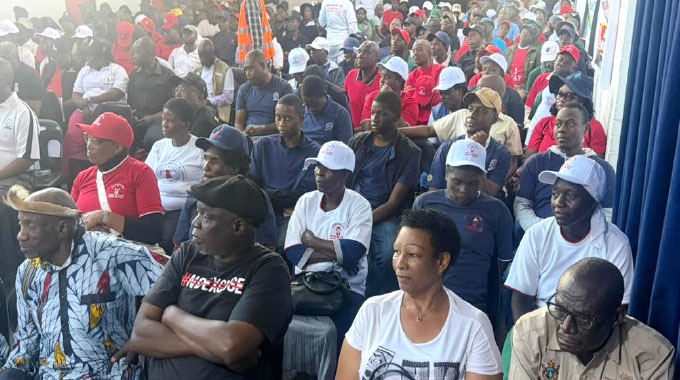
In Bulawayo, workers gathered at the offices of the Zimbabwe Congress of Trade Unions (ZCTU) to mark the day, reflecting on both progress made and the challenges that persist in the world of work.
In a speech read on his behalf by the Bulawayo provincial director for labour and administration, Mrs Sandra Afia, Public Service, Labour and Social Welfare Minister Edgar Moyo said the occasion was more than a ceremonial holiday, describing it as a moment for reflection and renewed commitment to the country’s workforce.
“It is a day that belongs entirely and unreservedly to the men and women who, in their quiet and tireless dignity, hold this nation together. Workers are the cornerstone of society since they take the leading role to develop nations, create wealth and bring up future generations,” he said.
Minister Moyo said the National Development Strategy 2 (NDS2) places workers at the centre of inclusive growth, with an emphasis on fair remuneration, social dialogue and the protection of workers’ rights. He noted that the Government continues to regulate labour relations through key legislative frameworks, including the Labour Act and the Public Service Act, alongside occupational safety and health regulations.
“These frameworks are the living expression of the social contract between the State and the working people of Zimbabwe,” said Minister Moyo.
Providing an economic backdrop, Minister Moyo said signs of recovery recorded in the second quarter of 2025 had resulted in reduced job losses, with expectations of sustained growth supported by policy interventions.
“With the operationalisation of the National Employment Policy, Government will coordinate agencies, workers and the private sector to close remaining employment gaps and expand workforce participation at every level,” he said.
Minister Moyo highlighted progress in collective bargaining, saying 17 National Employment Councils concluded agreements with wage adjustments in the past year.
He said there are ongoing negotiations in the public sector under the National Joint Negotiating Council and the Health Service Bipartite Negotiating Panel, aimed at improving working conditions and establishing a unified salary structure.
The minister stressed the importance of non-monetary benefits, including occupational safety, housing and social welfare initiatives, adding that quarterly consultative meetings between Government and workers were enhancing engagement and addressing key issues.
On workplace safety, Minister Moyo said 847 improvement notices and 143 prohibition notices were issued in 2025 following inspections, while more than 12 000 injury compensation claims were processed.
“No worker should leave home for work and not come back alive. The Government has adopted a ‘zero harm’ approach and is finalising a new Occupational Safety and Health Bill to strengthen compliance,” he said. Minister Moyo also expressed concern over child labour, describing it as a violation of human rights. He said the Government is working towards eliminating its worst forms by 2030 in line with global commitments.
He added that social security coverage now reaches over 85 percent of formal sector workers, with efforts underway to extend protection to those in the informal economy.
Turning to economic transformation, Minister Moyo said Vision 2030 prioritises job creation through industrialisation, value addition in mining, agricultural expansion and growth of the digital economy.
“Our major thrust is to ensure that jobs created are decent jobs, with fair pay, safe conditions, social protection and the right to organise,” he said.
Speaking at the same event, Bulawayo deputy mayor Councillor Edwin Ndlovu commended workers for their resilience and contribution to national development.
“Today is a day that belongs entirely to the men and women who hold this nation together through their tireless efforts. The principles of NDS2 reinforce the need for inclusive growth anchored on a protected and empowered workforce,” he said.
Cllr Ndlovu said local authorities remain committed to supporting labour initiatives and improving working conditions.
He also commended ongoing efforts to strengthen collective bargaining systems and expand social protection, noting that collaboration between Government, business and labour remains key to sustainable development.
However, labour representatives called for more to be done.
ZCTU western region chairperson Ambrose Sibindi said many workers continue to earn below the poverty line, urging both Government and employers to address wages and pension concerns.
“Our salaries are very low. In fact, they are below the poverty line in the majority of cases.
We, therefore, implore employers and the Government to consider improving the welfare of the workers, including addressing the issue of pension payout, which is too little. I also challenge us as leaders, the trade unions who are here as workers, to fight for our rights so that our welfare is improved,” he said.
Meanwhile, Public Service Commission (PSC) chairperson Dr Vincent Hungwe said workers are the true engine of national development and must be protected, fairly rewarded and empowered in a rapidly changing world of work.
Addressing Workers’ Day commemorations in Harare yesterday, Dr Hungwe said the importance of labour often becomes most visible in its absence, stressing that the strength of a nation lies in its workforce rather than its institutions alone.
“There is a profound truth that the true power of a nation does not sit in palaces, but in the hands of those who show up to work every day,” he said.
Held under the theme “Honouring the dignity of labour: Defending workers’ rights, fair wages and social protection for all,” this year’s commemorations called for renewed commitment to improving conditions for workers across the public sector.
Dr Hungwe paid tribute to teachers, health workers, administrators and other civil servants whose contributions, he said, are often unseen but critical to the functioning of Government and society.
“Your presence here is not just symbolic, it is a statement that the dignity of labour must be upheld, fairness must not be deferred, and social protection must be strengthened as a matter of justice,” he said.
However, Dr Hungwe noted that the global world of work is undergoing significant transformation driven by technological change, urging workers to adapt and embrace new systems being introduced across Government.
He highlighted the ongoing job evaluation, organisational optimisation and rationalisation exercise, describing it as a key reform aimed at improving efficiency, fairness and performance within the public service.
“Job evaluation is not an adversary of the worker; it is an instrument of fairness, clarity and efficiency, ensuring that jobs are properly defined and contributions appropriately recognised,” he said.
Addressing concerns over automation, Dr Hungwe dismissed fears that technology would replace workers.
“Technology does not replace the worker; it amplifies the worker. It removes inefficiencies and allows you to focus on higher-value work that truly makes a difference,” he said.
Dr Hungwe said Government’s goal is to build a digitally empowered workforce capable of thriving in a fast-evolving global environment.
On remuneration, he said the new framework introduced on April 1 was designed to align jobs within a fair and structured system, rather than serve as a direct cost-of-living adjustment.
However, he acknowledged that concerns over the rising cost of living remain valid and would be addressed through established negotiation platforms.
“The question of cost-of-living adjustment is both legitimate and pressing, and it deserves priority and careful consideration. Let us move forward with a shared commitment to uphold the dignity of labour, strengthen fairness and opportunity, and ensure every worker is valued and empowered,” said Dr Hungwe.