malvernmugadzikwa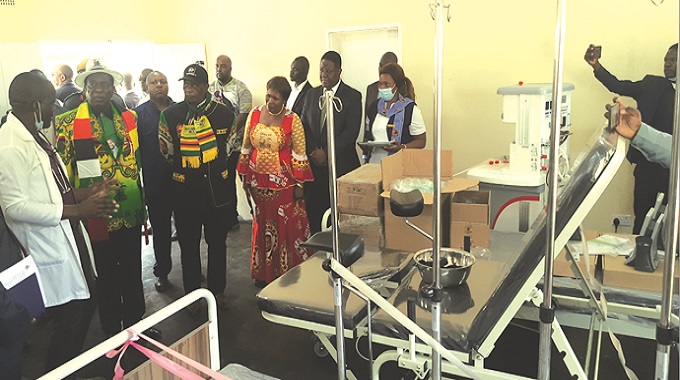
Rangarirai Shoko
PRESIDENT MNANGAGWA yesterday officially launched the election campaign for the ruling ZANU PF party, brimming with confidence on the back of five years of impactful economic and social developmental change under its State stewardship.
The launch took place in Chipinge, a far-flung district in the east of the country, typical of rural regions the party draws most of its electoral support from.
President Mnangagwa is seeking a second term, and will be battling it out with 10 other aspirants who successfully registered on Wednesday to contest in the election slated for August 23.
His main rival, as in the last election in 2018, is likely to be Citizens Coalition for Change (CCC) leader Nelson Chamisa, who also successfully registered to run as a presidential candidate.
In the last election, President Mnangagwa sought the Presidential mandate from the electorate, promising to engineer fundamental positive economic and social transformation for the country, sapped by 20 years of a sanctions-induced decline.
At the time he took over in 2017, Western sanctions imposed on Zimbabwe, in an attempt to force the Government to relent on land reforms under which it compulsorily acquired excess farmland from white farmers to resettle landless peasants, had reduced the country to near economic collapse, and driven the majority of its citizens to destitution.
Cumulatively, the sanctions cost the economy an estimated US$100 billion over 20 years, and forced millions of the country’s citizens to emigrate, mostly as economic refugees to neighbouring countries.
That is the challenging state of affairs, including dry coffers, that President Mnangagwa inherited, and promised the electorate in 2018 to turn around if entrusted with a Presidential mandate. The electorate obliged, and gave him his first Presidential mandate, and awaited delivery with bated breath.
They did not have to wait long, nor anxiously, as time went by.
First, President Mnangagwa dispensed with the notion that a developing nation can only grow and develop if it accessed funding from the developed world, or through foreign investment.
No wonder his rallying call: “Nyika inovakwa nevene vayo” (A country’s citizens are the masters of its destiny, and in charge of its development). What followed is short of a miracle for the country. The Government, through belt-tightening and good fiscal management, mobilised domestic funding for massive investment in economic and social sectors, particularly infrastructure.
The road network countrywide, in a dilapidated state for long, is among areas that received his earliest attention. And the result, five years down the line, are some highways that are comparable to those in neighbouring countries. Dam projects such as the long-mooted but neglected Lake Gwayi-Shangani have been built in many areas around the country, with associated irrigated farming and fishing industries also added.
In the health and education sectors, hundreds — perhaps thousands — of clinics and schools have been constructed countrywide, mostly in rural areas using devolution funds.
This is in addition to increased and timely funding for small-scale rural farmers, the net effect of which, this year, saw the biggest tobacco output in the country’s history.
The impact of the President’s reform-centred policy appears to have been felt greatest on the economic front.
After dispensing with restrictive investment laws, domestic and foreign investors flooded in, pouring billions of dollars that are fast transforming the landscape of the country’s economy. A Chinese investor is developing a greenfield iron and steel plant near Chivhu at a cost of over US$1 billion. Another Chinese contractor has just completed upgrading the Hwange Power Station for over US$1 billion, and billions more have been poured into platinum and lithium mining.
This has seen exports surging threefold, from just around US$3 billion at the time President Mnangagwa assumed office, to nearly US$9 billion now, the bulk of the figure accounted for by minerals.
Despite the current election-related economic headwinds, caused by speculative currency manipulation, the economy is widely seen as poised for strong, sustained growth.
This is a tangible performance record, or scorecard, that President Mnangagwa will now be presenting to the electorate in the upcoming election battle, and is an impressive one, achieved when the odds were heavily staked against him.
It is a scorecard which is convincing many analysts that it should comfortably carry him and the ruling party through, with the electorate now less sceptical than in 2018, when he had no presidential track record to assess him on. Already, President Mnangagwa and ZANU PF have received a huge electoral boost when, on Wednesday, 74 local government candidates of the party were elected unopposed after the opposition failed to field candidates.
As it kicks off its election campaign, the party will be promising more of what it has delivered in President Mnangagwa’s first term, the difference being increased tempo given the foundation has been laid successfully across the board. — New Ziana


 Online Reporter