Online Reporter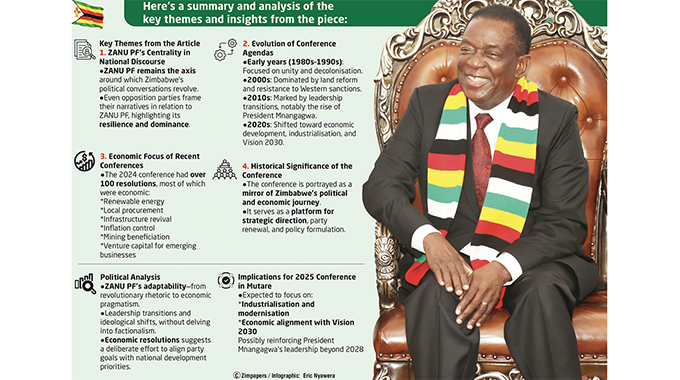
Ranga Mataire-Group Political Editor
There is a palpable buzz ahead of the ZANU PF National Annual People’s Conference, set for Mutare from October 13-18, 2025.
That the event has seized the nation’s attention long before it begins says something fundamental about Zimbabwe’s political reality: 45 years after independence, ZANU PF remains the centre of national discourse.
Today, you will not find members of what remains of the opposition, or those who speak for them, talking about their own entities and leaders. Instead, discourse in the opposition is led not by its own initiatives, but by their positions in relation to the ruling party, a reluctant acknowledgement of ZANU PF’s resilience.
Everywhere, conversations circle back to ZANU PF: its policies, its internal dynamics, its next moves. The upcoming conference is no exception. It is an annual stocktake of the party’s performance, resolutions and direction.
In the early years after independence, these gatherings were largely about consolidating political control and decolonisation. Over time, as the liberation rhetoric gave way to developmental imperatives, the agenda evolved, from indigenisation to economic empowerment, from land reform to industrial revival.
Public discourse on the revolutionary party’s 2024 conference is telling. While many focused on the key resolution on the President’s term, the bulk of the party’s resolutions – over 100 of them – were focused on the economy.
There were diverse themes, from boosting renewable energy to encouraging companies to procure raw materials locally. There were resolutions urging the revival of railways and the completion of other public infrastructure projects, as well as resolutions calling for policies on stabilising inflation, beneficiation in mining and capitalising emerging businesses through venture capital.
This shows how each conference, in its own way, has captured the shifting priorities of both party and nation.
Beyond the speeches and resolutions, the ZANU PF National People’s Conference stands as a chronicle of Zimbabwe’s journey.
It is a mirror of its political evolution, its economic struggles, and the enduring dominance of the party that has shaped them.
Since 1989, the annual conference has served as both a stage for triumphs and a crucible for debates that have shaped Zimbabwe’s trajectory.
The 1990s: The Era
of Consolidation
The 1990 conference marked the first major gathering after the 1987 Unity Accord, which had merged ZANU PF and PF ZAPU into one cohesive entity.
It was a time of reflection, as the party sought to entrench unity while addressing the lingering socio-economic inequalities left by colonial rule.
These conferences emphasised land reform, a simmering issue that would become a cornerstone of national discourse by the end of the decade.
By 1999, the tone had shifted dramatically, as the party prepared to implement the fast-track land reform program, setting the stage for the seismic changes of the 2000s.
The 2000s: Land, Sanctions, and Survival
The early 2000s conferences were dominated by the land redistribution agenda. The 2000 conference, themed “Towards a Prosperous and Empowered Zimbabwe,” was a rallying cry for reclaiming ancestral lands from white commercial farmers.
By 2005, amidst growing Western hostility and economic sanctions, the conference narratives shifted to resilience and sovereignty. The party adopted a defiant stance, branding the sanctions as an attack on Zimbabwe’s sovereignty.
The annual conferences became a rendezvous for became for mobilisation and conscientisation, with the party urging its members to defend the gains of the liberation struggle at all costs.
The 2010s: Power Shifts and New Beginnings
The 2014 Elective Congress was one of the most dramatic in ZANU PF’s history. It marked the fall of Joice Mujuru, the then-Vice President, amidst allegations of disloyalty. This congress paved the way for Cde Emmerson Mnangagwa’s ascendancy within the party hierarchy.
By 2017, the conference was historic for another reason: it followed the resignation of President Robert Mugabe, the party’s long-time leader.
Cde Mnangagwa, took over as First Secretary and President, ushering in the Second Republic. The mood at the 2017 conference was a mix of optimism and celebration, as the party sought to rebrand itself while maintaining its revolutionary ethos.
The 2020s: Vision 2030 and President Mnangagwa’s Era
Under President Mnangagwa, the conferences have leaned heavily on the Vision 2030 agenda, a blueprint aimed at transforming Zimbabwe into an upper-middle-income country.
The 2022 conference introduced modern reforms, such as the digitalisation of party registers and the formal inclusion of war collaborators as Veterans of the Liberation Struggle.
In 2024, the Bulawayo conference saw an endorsement of a resolution extending President Mnangagwa’s term beyond 2028, which led to a key resolution to explore legal avenues towards achieving that goal.
This year’s conference in Mutare is expected to focus on industrialisation, modernisation, and aligning party policies with national economic goals.
A Platform for Unity and Strategy
Throughout its history, the ZANU PF Annual People’s Conference has been more than a meeting of delegates. It is a ritual of renewal – a reaffirmation of the party’s revolutionary roots and its commitment to shaping Zimbabwe’s destiny.
Each conference has reflected the mood of the nation, from the optimism of the early 1990s to the defiance of the 2000s and the economic pragmatism of President Mnangagwa’s era.
As the party gathers this year, it does so with the weight of history on its shoulders and the promise of an industrialised future ahead.