Chronicle Editor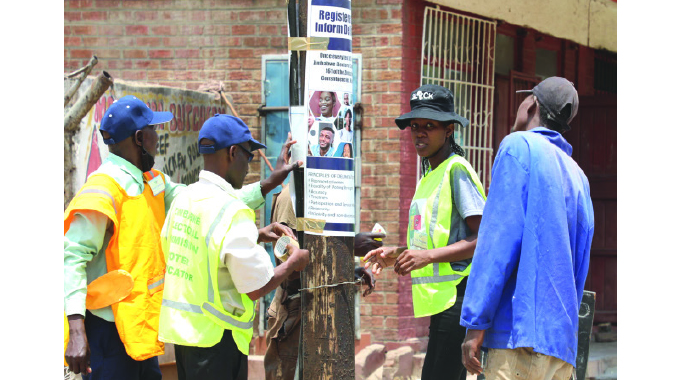
Sukulwenkosi Dube-Matutu, Matabeleland South Bureau Chief
THE voter education process on the delimitation exercise is in full swing in Matabeleland South Province with Information, Education and Communication (IEC) materials written in various languages being distributed in constituencies.
The voter education process is part of the final preparatory stages ahead of mapping of electoral boundaries as the country prepares for the holding of general elections next year. The Zimbabwe Electoral Commission (Zec) said the ongoing delimitation process would be completed by December this year.
Zec is in the process of delimitating the 210 National Assembly constituencies ahead of next year’s harmonised elections based on the latest census data. It further said due to different rates of population growth, migration and land use changes, the boundaries of constituencies and wards would be redrawn on a regular basis. According to Zec, there are more than 5.8 million registered voters in Zimbabwe at the moment drawn from the country’s 10 provinces.
Matabeleland South provincial elections officer Mr Rabson Nyoni said IEC material was being distributed in all languages in the province, including braille.

“The voter education is a critical process as it seeks to inform the public that there is a process of delimitation happening within our communities. We have received IEC material in different languages found in Matabeleland South and it is being distributed to various districts and then it will be distributed in various wards. We also have material available in braille,” he said.
Mr Nyoni added, “We have voter educators who have started raising awareness on the delimitation process and now we are bringing in IEC material which they will be distributing as well. We have also held engagement meetings in the province where we have engaged provincial heads, faith-based organisations and the civil organisations, today we are meeting with people with disabilities and then we will move on to engage political parties. We want to bring all stakeholders on board and make them understand this exercise as much as possible.”
Delimitation, which is carried out after a population census and is provided for in Sections 160 and 161 of the Constitution refers to the dividing of the country into constituencies and wards for the purposes of elections and involves coming up with a minimum threshold of registered voters in each of the country’s 210 National Assembly constituencies.
In preparation for mapping of electoral boundaries, the Commission is bringing together provincial and district maps with topographical features such as mountains, rivers, roads, communication lines, settlements and different types of land use.
From this stage, extracted information will be combined with voter registration statistics of polling stations and physical addresses of voters to assist in drawing the polling areas so that they remain within a stipulated voter population threshold.
After mapping polling areas, fieldwork will be carried out to verify polling area boundaries in what is referred to as ground trothing. Polling areas are then combined to form wards while several wards are combined to form constituencies.
The average voter population of each constituency is obtained by dividing the delimitation voters’ roll population by 210 constituencies with an allowable upper and lower limit of 20 percent. Using this formula, Matabeleland South province is likely to lose a constituency although Zec is yet to confirm that development. Zec conducted phase 1 and 2 of its mobile voter registration which it concluded in February and April this year respectively ahead of the delimitation exercise.
For purposes of the boundary delimitation, the voters’ roll was closed on May 30. Voter registration, however, remains open for purposes of any by-election that may become necessary and the 2023 harmonised elections. In terms of Section 161 (7) of the Constitution, at the conclusion of delimitation, Zec shall produce and submit to the President a preliminary report. The report shall contain a list of the wards and constituencies, with the names assigned to each and a description of their boundaries, a map showing the wards and constituencies and any further information or particulars which the commission considers necessary. — @DubeMatutu



 Online Reporter