Judith Phiri
Zimpapers Business Hub
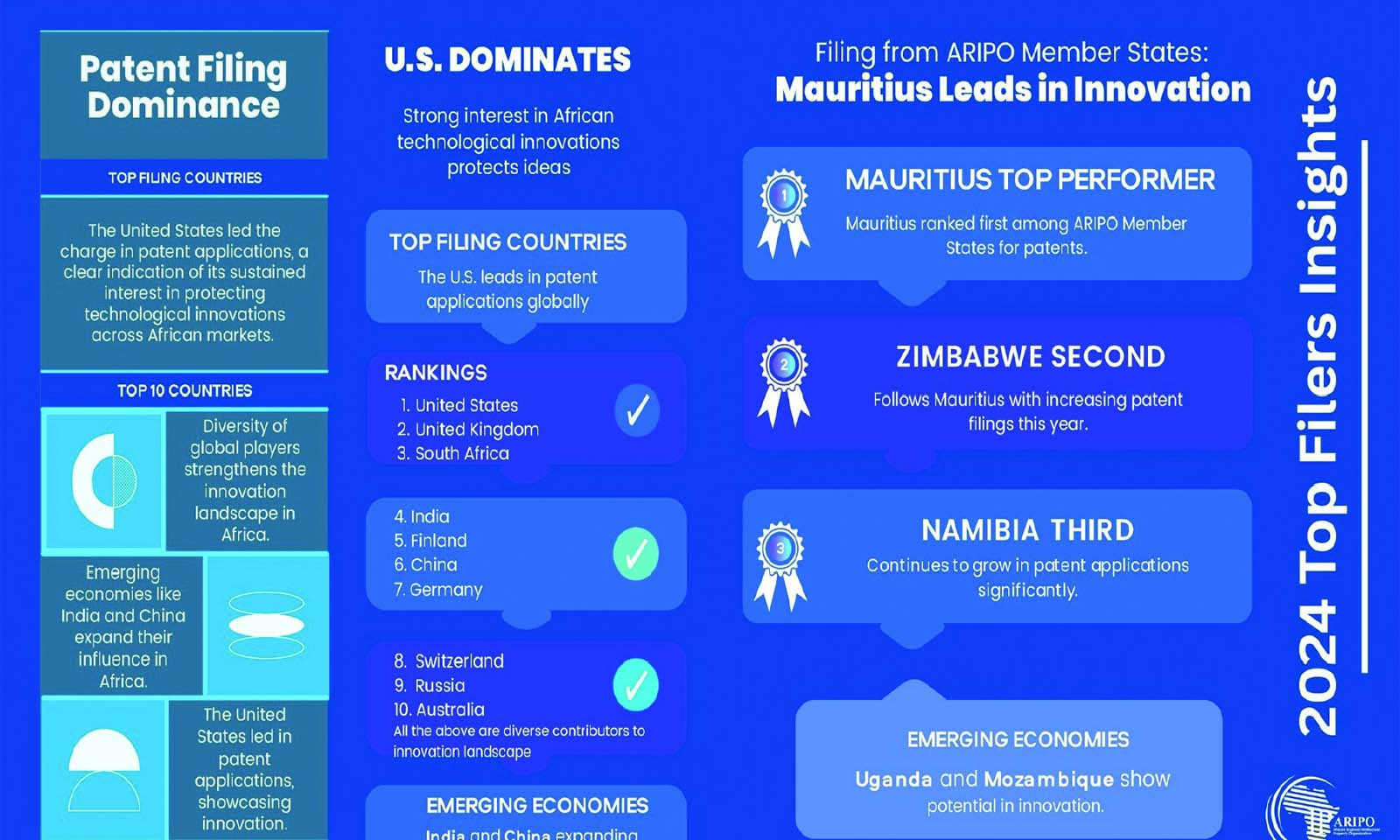
ZIMBABWE emerged as the second top filer of patent applications for 2024 among the African Regional Intellectual Property Organisation (ARIPO) member states, demonstrating early, but promising engagement in patent-based innovations.
Mauritius was the top performer while Namibia took third place, according to the 2024 Intellectual Property (IP) Filing Trends: Key Insights from ARIPO’s Top Applicants.
A patent application is a formal request to a patent office for the grant of legal protection to a new invention. It’s a detailed document that includes a description of the invention, its features and how it works, along with claims defining the scope of protection sought.
Registering patents is crucial for inventors as it provides legal protection against unauthorised use of their inventions, granting them exclusive rights to manufacture, sell, and use their creations for a specific period.
This protection allows inventors to commercialise their inventions, generate revenue through licensing or sales and establish a competitive advantage in the market.
Patenting incentivises innovation by granting inventors exclusive rights to their inventions, fostering investment in research and development, and promoting knowledge sharing, which contribute to economic progress.
ARIPO, an intergovernmental organisation that facilitates cooperation among its member states in IP matters, in 2024, recorded a diverse range of sector engagement, international participation and regional entrepreneurial activity in IP filings.
“Among ARIPO’s 22 member states, Mauritius emerged as the top filer of patent applications in 2024. Zimbabwe followed closely, while Namibia took the third spot. Uganda and Mozambique each contributed, demonstrating early but promising engagement in patent-based innovation.”
The organisation said global pharmaceutical giants and tech innovators led the way as pharmaceutical companies were the most active patent filers, with Eli Lilly and Company (US) leading, primarily in pharmaceuticals, organic fine chemistry and biotechnology.
ARIPO said this suggested ongoing efforts to protect drug innovations in the African market, likely driven by public health initiatives and the emergence of new markets in the region.
“Other major pharmaceutical players included Gilead Sciences, Inc, Amgen Inc and AstraZeneca AB. The increase in biotech and health-related filings underscores Africa’s growing importance as both a market and a source of clinical research opportunities,” added the organisation.
It said for technology and engineering contributions, Nokia Technologies OY (Finland) applications focused on digital communication and telecommunications, which highlights the increasing development of digital infrastructure across Africa.
ARIPO said in terms of trademarks, the regional brands thrive amid global competition.
“In 2024, multinational and regional firms continued leveraging ARIPO’s centralised trademark filing system to secure protection across multiple jurisdictions.
“This has resulted in strong engagement from African companies, particularly in the fast-moving consumer goods (FMCG) and digital sectors.”
The organisation said Zambian firms showed strong momentum, as Bigtree Beverages Limited (Zambia) led all trademark applicants, primarily in Class 32, which covers non-alcoholic beverages and beer. It said this underscored the region’s growing investment in brand development and market presence.
On strong regional representation, ARIPO added: “Regional economies were well represented in 2024’s trademark filings, with Zimbabwe leading, followed by South Africa and China. This strong performance by African states underscores the growing local awareness of intellectual property rights as a crucial foundation for business growth and economic development.”
The organisation said among ARIPO member states, Zimbabwe continued to lead in trademark filings, far surpassing those of other countries, while Zambia and Mauritius ranked second and third, respectively.
It said other active contributors included Tanzania, Namibia, Kenya, Botswana, Uganda, Mozambique, and Liberia, each playing a significant role in advancing brand protection and fostering innovation-driven economies. On grassroots innovation with a focus on local needs, ARIPO said while utility model filings were fewer, they provide insight into grassroots innovation, especially in public health, mechanical engineering and computing.
“Key highlights include John Hemming Trading Ltd (UK) applications for pharmaceutical solutions. Great Zimbabwe University (GZU) and its collaborators, led the development of mechanical engineering machines tailored to local contexts, said the organisation.
“Brian Turyabagye and colleagues (Uganda), the creation of medical instruments that align with frugal innovation and rural healthcare delivery.
“Innovators from Kenya and Zimbabwe were particularly active, indicating a rich environment for practical, needs-based solutions among ARIPO member states.
“This category emphasises ARIPO’s role in promoting accessible innovation pathways for individuals, research institutions, and small and medium-sized enterprises (SMEs),” said the organisation.
It said on utility models, often regarded as “petty patents”, which are crucial for incremental innovation, Zimbabwe topped the list, followed by Kenya.
ARIPO said although the numbers remain modest, this area represents considerable growth potential, especially among SMEs and grassroots inventors.
“The organisation said Zimbabwe, Zambia and Tanzania shared the top spot in 2024 with designs increasingly being recognised as valuable IP assets for product aesthetics and user appeal.
“Kenya and Mauritius also performed well, followed by Mozambique and Uganda, indicating the growing interest in creative industries across the continent.”
ARIPO said it remains committed to assisting creators and innovators in Africa and globally in securing their rights and unlocking value through the power of IP.
The organisation was established in 1976 to facilitate cooperation among its member states in matters of intellectual property.
ARIPO administers several key protocols, including the Banjul Protocol on trademarks and the Harare Protocol on patents and industrial designs.
Headquartered in Harare, Zimbabwe, ARIPO aims to centralise and harmonise IP registration and protection across its member states.