Online Reporter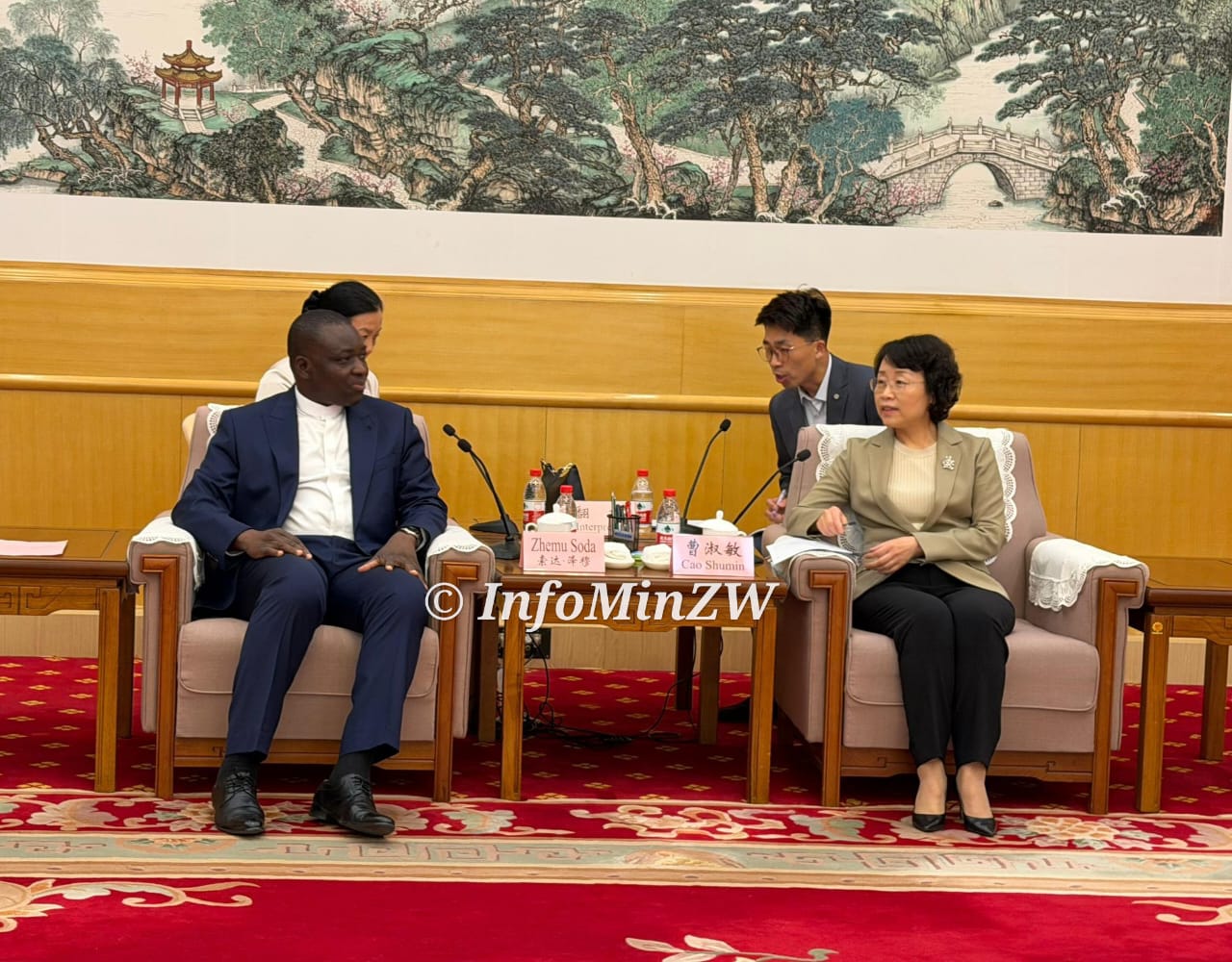
Nqobile Bhebhe in Beijing, China
ZIMBABWE and China have taken a major step towards deepening media cooperation and accelerating the modernisation of the information sector, with senior officials from the two countries pledging stronger collaboration in content production, technology transfer, professional training and infrastructure investment.
Minister of Information, Publicity and Broadcasting Services Dr Zhemu Soda on Monday held high-level talks with China’s Minister of the National Radio and Television Administration, Ms Cao Shumin, here, where the two sides explored new opportunities to strengthen bilateral cooperation in the broadcasting and communications sectors.
The engagement comes at a time when Zimbabwe is intensifying efforts to modernise its media landscape under the broader digital transformation agenda being pursued by the Second Republic, which includes migration from analogue to digital broadcasting systems, expansion of transmission infrastructure and adoption of emerging technologies such as artificial intelligence.
The meeting between the two ministers focused on areas including content development and exchange, co-productions, technology transfer, skills development and professional training.
Dr Soda said Zimbabwe values the long-standing media cooperation with China, noting that Chinese-produced television and radio content has played a significant role in enriching programming and broadening public awareness on global developments.
“There has been some content that was being shared with us in our country which our national broadcaster has been airing on television, including our radio stations, to give awareness on what China has to offer,” said Dr Soda.
Zimbabwe and China share deep historical and diplomatic ties dating back to the liberation struggle, when China supported Zimbabwe’s fight for independence. Since independence in 1980, the relationship has expanded into various sectors, including infrastructure development, mining, agriculture, energy, telecommunications and media cooperation.
Dr Soda said Zimbabwe now seeks to broaden the partnership beyond content acquisition towards joint productions and technical capacity building.
“We appreciate the assistance, especially in the area of content creation, co-production of content, where possibly our people have an opportunity to be trained so that as we exchange our content, the content meets specifications from your expected standards for viewing,” he said.
“You know the audience that you have here in China. So it’s an area that we think we could deepen cooperation that we already have in existence and to have our people, if it’s possible to be trained even in our country.”
The minister said Zimbabwe is keen to leverage China’s experience in digital broadcasting, media industrialisation and technological innovation as the country modernises its communication systems in line with Vision 2030 and the National Development Strategy 2 (NDS2).
China has emerged as one of the world’s leading producers of digital broadcasting infrastructure, smart communication systems and media technologies, while also significantly expanding its global media footprint through international partnerships and co-productions.
Ms Cao Shumin said China stands ready to share its expertise and strengthen practical cooperation with Zimbabwe in media development and broadcasting innovation.
She highlighted China’s extensive experience in content production and international collaborations, saying increased engagement between Chinese and Zimbabwean media houses would further strengthen people-to-people relations between the two nations.
Addressing journalists during the opening of a Seminar for Media Professionals of Zimbabwe in Beijing last week, Dr Soda said there were vast opportunities for foreign investment in broadcasting infrastructure, transmission systems and digital studio technologies.
The seminar, organised by the Academy for International Business Officials (AIBO), has brought together Zimbabwean media practitioners and experts for training on development-oriented journalism, media innovation and digital communication systems.
Dr Soda said Government aims to increase national radio and television signal coverage from the current 81 percent to full national coverage by 2030.
“This provides a vast opening for partners to invest in transmission networks and signal distribution. On studio equipment and modernisation, our focus is on the total transformation of studios from analogue to digital technologies,” he said.
Dr Soda said opportunities also exist in integrated media systems, including digital television and radio studios, playout centres and media asset management systems.
Zimbabwe has in recent years accelerated the digitisation of its broadcasting sector through the Digital Migration Project, which has seen the installation of new transmitters, expansion of community radio stations and upgrading of broadcasting infrastructure across the country.