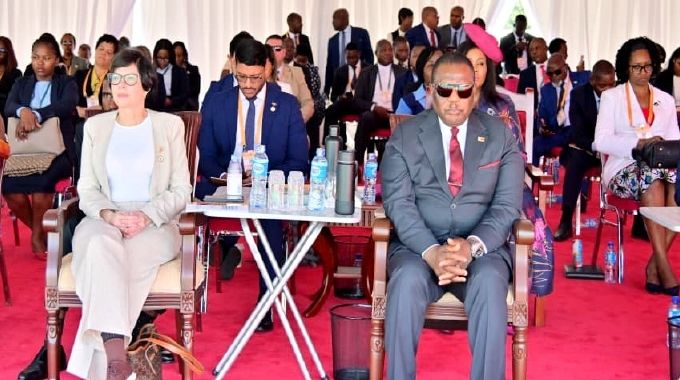
Mukudzei Chingwere in Kampala, Uganda
ZIMBABWE’S participation in African union member States’ inauguration and national ceremonies is driven by a deliberate continental framework aimed at strengthening peer review, benchmarking governance systems and sharing development experiences, Vice President Dr Constantino Chiwenga has said.
Speaking to journalists on the sidelines of President Yoweri Museveni’s inauguration and swearing-in ceremony in Kampala yesterday, where he represented President Mnangagwa, the VP dismissed the notion that such events were purely ceremonial or social engagements.
He said the visits are part of structured AU engagements that allow member States to assess each other’s progress in governance, democracy and development implementation.
VP Chiwenga said that although African countries remain sovereign, they are bound by agreed continental treaties, protocols and frameworks that guide democratic governance and development standards.
“When we go to member States of the AU at ceremonies like inauguration after their elections, it is to see the level of advancements a country would have achieved,” said VP Chiwenga.
He explained that Africa’s unity frameworks, from the Organisation of African Unity to the African union now, were built around shared goals of liberation and development, and continue to evolve through agreed benchmarks.
“African countries came together to form the Organisation of African Unity, which later translated to the African union and each period of time they gave themselves objectives to meet, principles to meet and this is what we also learn as Zimbabwe, to see what other countries have achieved and to learn the way they might have done their things and do better at home.
“You might recall that way back in the 1960s, Africa declared that the whole of Africa had to be liberated. Those were the main objectives until the liberation of the last country on the African continent, that is, South Africa; thereafter, we were giving ourselves objectives to meet for our development,” said VP Chiwenga.
He pointed to key continental instruments that guide governance and rights on the continent, including the 1981 African Charter on Human and Peoples’ Rights, commonly known as the Banjul Charter, adopted on June 27, 1981, in Banjul, Gambia, which he said remains foundational to governance standards.
VP Chiwenga also referenced the African Charter on Democracy, Elections and Governance, adopted in 2007, as well as Agenda 2063, the AU’s long-term development blueprint adopted in 2013, which sets out Africa’s collective vision for transformation.
“Then in 2013, the Heads of States came up with Agenda 2063 to say what Africa should be like. Of course, the majority of us will not be there, but these are set objectives,” he said.
He noted that he has previously attended similar inauguration ceremonies in Tanzania and Nigeria, saying such engagements provide opportunities for engagement, reflection and mutual learning among African states.
“So, these things will have been discussed at various levels of officials until it gets to the Heads of State. They agreed on elections on how we should develop our democracies as African countries,” said VP Chiwenga.
President Museveni’s inauguration attracted a wide range of African leaders, former Heads of State and international delegations, reflecting continued diplomatic engagement and cooperation across the continent.