Online Reporter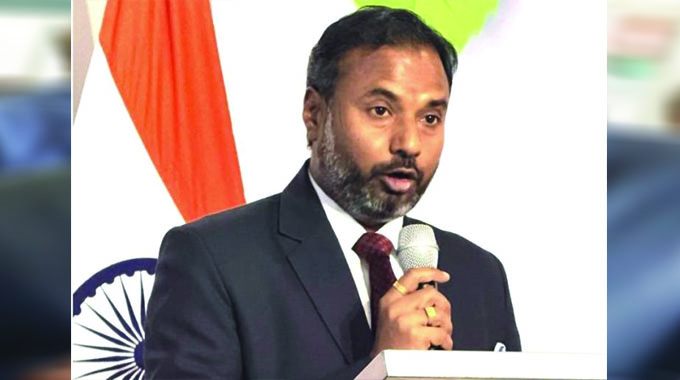
Obey Musiwa
Herald Reporter
SENIOR Government officials, diplomats and business leaders from Zimbabwe and India converged at a hybrid interactive seminar in Harare yesterday to deepen bilateral trade and investment cooperation towards Vision 2030.
The event, organised by the Embassy of India in partnership with ZimTrade, the Zimbabwe Investment and Development Agency (ZIDA), and leading business chambers, highlighted India’s growing role as a trade partner and Zimbabwe’s commitment to industrialisation, investment facilitation, and export diversification.
The seminar reinforced Government priorities while pointing to practical opportunities for collaboration.
The Indian Ambassador to Zimbabwe, His Excellency Bramha Kumar, emphasised India’s trillion-dollar trade profile and its growing investment footprint in Zimbabwe. He said Indian investors have already injected over US$600 million into manufacturing, creating more than 15 000 jobs.
“So far, our rough estimate is that Indian investors have invested more than 600 million dollars in various manufacturing activities that directly or indirectly provide employment to more than 15 000 people locally.
“Similarly, bilateral trade is on the rise and for the first time, it has crossed its usual range to touch US$250 million, wherein Zimbabwe’s exports have reached US$46 million,” said Ambassador Kumar.
Reiterating India’s economic trajectory, Ambassador Kumar said India’s exports had grown by 6.18 percent in 2025, with GDP rising by 7,8 percent in Quarter 1 (Q1) of Financial Year 2026 (FY26).
He said Zimbabwean businesses should integrate into India’s supply chains.
“India’s cumulative exports (merchandise and services) during April-August 2025 stood at US$349,35 billion, up 6,18 percent from US$329,03 billion in the same period of 2024.
“With a rising economy, the Indian market seeks to integrate further with the global supply chain,” he said.
The Deputy Minister of Industry and Commerce Raj Modi aligned the seminar with Vision 2030 and NDS2, emphasising industrial growth, value addition, and re-engagement.
“Zimbabwe is guided by the national vision set by His Excellency, President Dr ED Mnangagwa, the Vision 2030 of transforming Zimbabwe into an upper-middle-income society by the year 2030,” he said.
He emphasised people-to-people ties, with 10 000 persons of Indian origin in Zimbabwe and 5 000 Zimbabwean students studying in India.
“Today, Zimbabwe is home to around 10 000 persons of Indian origin, a very successful, peaceful, and law-abiding community.
“With around 5 000 Zimbabwean students currently enrolled in Indian universities, this vibrant academic exchange underscores a deep-rooted partnership and shared commitment to knowledge and progress,” he said.
ZimTrade CEO Allan Majuru represented ZimTrade, and Manager-Export Development Mr Tatenda Marume said the trade is imbalanced but stressed opportunities in agriculture, pharmaceuticals, machinery, plastics, and textiles. He called for diversification beyond tobacco.
“Zimbabwe’s exports to India reached US$46,9 million in 2024, up significantly from US$10,4 million in 2022.
“India’s exports to Zimbabwe stood at US$189,6 million in 2023, dominated by pharmaceuticals, cereals, machinery, plastics, and vehicles,” said Mr Majuru.
In his remarks, Investment Promotion Officer Silibaziso Chizwina, on behalf of Zimbabwe Investment Development Agency (ZIDA) CEO Mr Tafadzwa Chinamo, emphasised the new aftercare unit designed to support investors post-entry.
“Our role is to advocate for policies that push positive investments into the country and address the gaps for investors.
“Once you are established in the country, our role is to check in on investors to see if there are gaps,” said Mr Chinamo.