admin
admin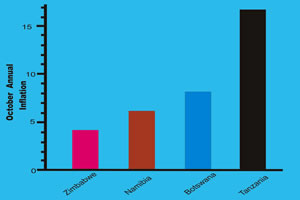
regional trend of inflation going up.
Tanzania’s rate rose to 17,9 percent in the same period, Botswana’s to 8,8 percent while Namibia’s jumped to 6,1 percent (see graph). The decline in inflation has been partly attributed to reduced imports, coupled with lower costs of importing.
Zimbabwe is prone to inflation pressures from imported products as it imports some of the basic goods to meet insufficient local demand.
Exchange rate movements between currencies of the country’s major trading partners were also bringing inflationary pressures to the country.
But there has been an improvement in the supply of locally-produced goods, which has caused a reduction of imports, particularly from South Africa.
A recent survey by the Confederation of Zimbabwe Industries showed that capacity utilisation had gone up to an average of 57 percent this year.
The Zimbabwe National Statistical Agency’s year-on-year food and non-alcoholic beverages inflation prone to transitory shocks stood at 3,68 percent while non-food inflation was 4,44 percent.
Zimstat said month-on-month food and non-alcoholic beverage inflation stood at 0,08 percent in October 2011 from 0,42 percent the prior month.
Monthly non-food inflation for October stood at 0,14 percent, after shedding 0,86 percent on the previous month’s inflation rate of 1 percent.
Analysts say although Zimbabwe was on course to achieve its annual inflation target of 4,5 percent this year, the expected increase in demand for most goods during the festive season would put pressure on prices.
“I think the year-end inflation target (of 4,5 percent) can be achieved, although the numbers for November and December might show some marginal increases as a result of high demand which will put
pressure on prices,” said a Harare-based economist.
“Fuel prices are likely to increase due to high demand and this would have a widespread impact on the economy, as the fuel is primarily used by industry and the transport sector.
“When the cost of transporting food increases, the prices of food will also rise.”
Traditionally, prices rise during the festive season as retailers take advantage of high consumer spending. According to local media reports, civil servants are expected to get their bonuses this month.
“This will trigger price increases as a result of high consumer spending,” Bindura University economics lecturer Mr Gift Mugano said.
More importantly, a report by the National Economic Consultative Forum Industrial Taskforce has noted that companies intend to raise prices, citing the recent 31 percent power tariff increase, which it said would translate to 53 percent in extra costs.
Inflation denotes the rate or magnitude by which prices increase over a given period, either measured over a one-year period or on a monthly basis.
As such, while an increase in the rate of inflation reflects an increase in prices, a decline in inflation does not necessarily mean a drop in prices.



 Online Reporter