

 admin
admin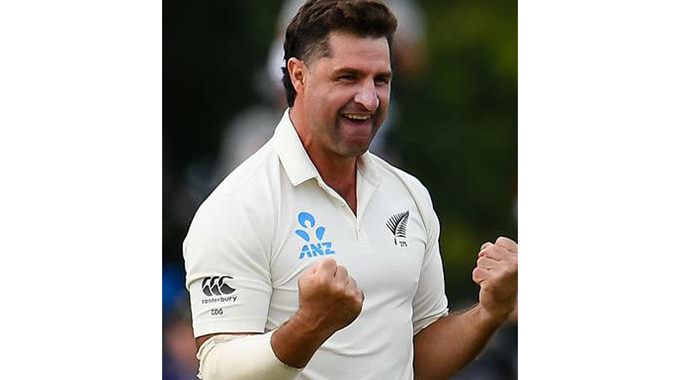
OF course, it would not have felt like a real World Test Championship final without a Zimbabwean influence.
The showdown in England featured India and New Zealand but the small country, which prides itself as the world’s biggest sports nursery, had an influence in proceedings.
It’s a measure of Zimbabwe’s abundance of riches, when it comes to sport, that its athletes continue to influence major events around the world.
The other day, it was their Beast, Tendai Mtawarira, helping the Springboks of South Africa to win the Rugby World Cup in Japan.
This week, it was all-rounder, Colin de Grandhomme, helping New Zealand win the maiden World Test Championship final in England.
The 34-year-old, affectionately known as “The Big Man,” was born in Harare and even played for Manicaland and the Midlands in domestic cricket.
“A bruising, broad-shouldered batsman, and a disciplined medium-pace bowler, Colin de Grandhomme left Zimbabwe for Auckland in 2006, before eventually finding his way into New Zealand’s representative teams,” the authoritative ESPN Cricinfo reported.
“Unsurprisingly, his first international foray was in the T20 format. Having earned a reputation as a heavy hitter in New Zealand’s domestic T20 competition, de Grandhomme earned a debut against his native Zimbabwe in 2012.
“He did not sufficiently impress to keep his place on that occasion, but continued to flourish on the domestic circuit.
“De Grandhomme had represented Zimbabwe at the Under-19 World Cup in 2003-04, and broke into the Manicaland side in 2004-05 before ascending to Zimbabwe A and Zimbabwe Under-23s, for whom he scored a century against Eastern Province in the SAA Provincial Challenge.”
In the lead up to this World Test Championship final, any former New Zealand cricketers you encountered played down their team’s chances of success.
“Surely the favourites are the country with 1,3 billion people?” asked former player turned commentator Simon Doull, a point echoed by many.
But, you can only field 11 players in a cricket match, and in the final assessment the men chosen by New Zealand were better equipped — and better prepared — to exploit the prevailing conditions at the Ageas Bowl.
Even though the Kiwis bowling attack was uniformly seam — as opposed to India’s three seamers and two spinners — there was enough variety among the Kiwis’ bowlers to take wickets at vital times.
With two left-armers, a classic old-fashioned swing bowler in Tim Southee and de Grandhomme, a niggardly medium pacer, they already had a good combination to utilise the grassy pitch and cloudy conditions for most of this game.
But, the addition of 6ft 8in Kyle Jamieson has turned this New Zealand attack in seamer-friendly conditions from penetrative to truly potent. With his seven wickets in this match — at paltry cost – Jamieson now has 46 wickets at an average of 14.1 in his eight Test appearances.
Jamieson was awarded the man-of-the-match prize largely for his 5 for 31 in India’s first innings, which turned a promising start — 62 for 0 — into a disappointing finish — 217 all out.
But, his forthright approach with the bat (21 off 16 balls) — which helped gain New Zealand a slender lead — and two big wickets on the final day capped his fine third-day bowling.
Resuming on 64 for 2 on the final morning, India, with Virat Kohli and Cheteshwar Pujara at the crease, would have been optimistic of batting at least until tea in glorious weather and on a now decent surface to make the game safe and perhaps even give New Zealand a little fright in the last session before shaking hands on a stalemate.
Jamieson — preferred to Trent Boult to start proceedings from the Pavilion End — immediately asked awkward questions of both batsmen, angling the ball in from his lofty height and bowling a demanding length. Kohli — mindful of having departed lbw to Jamieson in the first innings — made a conscious effort to keep his pads out of the way and play at everything, and after negotiating each straight ball, fenced at one outside off stump that didn’t require a shot and edged behind.
Pujara, a more tentative player than a few years ago, offered an uncertain defensive shot to another Jamieson delivery and could only guide it to Ross Taylor at slip.
CricViz had revealed earlier that Kohli and Pujara average 10 runs less per innings against bowlers of exceptional height than in their career as a whole.
Rishabh Pant, dropped by Southee on five, tried gamely to counter attack, but no one could dominate Jamieson and as well as his seven wickets he only conceded an average of 1.3 runs an over through the match. His overall analysis of 7 for 61 in 46 overs, with 22 maidens, is the most frugal bowling in a Test match in England since 1994. India’s fragile tail was soon exposed and New Zealand’s catching was now faultless. A target of 140 was unlikely to seriously tax a strong and deep New Zealand batting order that was in the groove after two hard-working Tests against England.
It was entirely fitting that their two excellent stalwarts – Taylor and Kane Williamson — first-class men and fabulous players – were there at the end to see them home.
The finest New Zealand team the country has ever produced has triumphed with a combination of skill, stability, versatility, teamwork, determination and a wonderfully positive and engaging spirit which makes them tremendous ambassadors for Test cricket and the game generally.
There never was a more worthy winner of a major ICC trophy. – Sports Reporter/The Cricketer



 Online Reporter
 dyton mupawaenda