admin
admin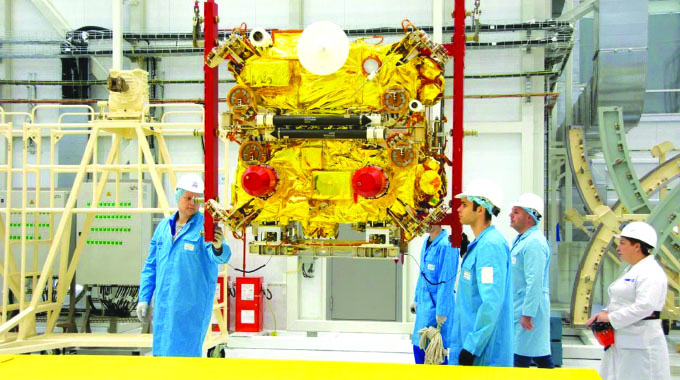
Blessings Chidakwa
Herald Reporter
The historic launch of Zimbabwe’s second earth observation satellite, ZimSat-2, into orbit is scheduled for today, the Zimbabwe National Geo-Spatial and Space Agency (ZINGSA) said yesterday.
ZimSat-2 is scheduled to be launched from Vostochny Cosmodrome in Amu Oblast, Russia, contingent on favourable weather conditions.
The large Soyuz-2.1b launch vehicle is planned to launch into orbit the Ionosphere-M heliogeophysical satellites Number 1 and 2, as well as 49 spacecraft as an associated payload, including the first Russian-Zimbabwean spacecraft, ZimSat-2.
Zimbabwe’s satellite was designed and manufactured through a collaborative research programme between ZINGSA and Southwest State University, one of the top public universities in Kursk, Russia. It was designed for earth observation and data collection in agriculture, environmental protection and natural resource management.
Barely two years after having the first satellite, ZINGSA coordinator Dr Painos Gweme, who was in Russia yesterday, said due to time differences the satellite would be launched approximately seven hours ahead of Zimbabwean time in Amu Oblast, Russia.
ZINGSA engineers and students on the Presidential scholarship programme were part of the team that developed the satellite, from the mission design to the flight model.
ZimSat-2 will monitor the Earth using a multispectral camera with an 8-metre spatial resolution, supporting missions that keep track of crop health, predict yields and identify nutrient deficiencies.
It will also aid geological research, identifying potential mineral resources, while assisting in urban mapping by producing detailed maps of infrastructure and natural features. The satellite is equipped with a data transmission system that allows the collected information to be sent to a ground control point.
Developed using modern technologies, ZimSat-2 demonstrates high efficiency and reliability. It can operate in a variety of spectra, including visible and infrared, which expands its capabilities for observation.
By the end of the year, Russian specialists plan to modernise the existing ground infrastructure to ensure the technical ability to work not only in the VHF bands, but also in the S, L and X bands, as well as advanced training of ZINGSA specialists in relevant areas both within the framework of basic programs (bachelor’s, master’s, postgraduate) and short-term additional education programs.
Zimbabwe’s first satellite ZimSat-1 was launched on November 7, 2022, and later moved into its final orbit on December 2 the same year.
It was launched from NASA’s Wallops Flight Facility in Virginia, United States, as part of the BIRDS-5 constellation, along with Uganda’s Pear AfricaSat-1.
The satellites were then released from the Japanese Kibo module on the International Space Station on November 21, 2022.
Zimbabwe is among a handful of African countries that include South Africa, Nigeria, Ghana, Kenya and Rwanda that have satellites in orbit.
Presently, ZINGSA is finalising upgrading its satellite ground control station at the Mazowe Earth Station to enhance its capacity to receive data from the new satellite.



 Online Reporter